Open Source Contributions for Small Teams
Small teams can contribute to open source through disciplined management and documentation. See the mechanism, a worked example, and limits on what contributions can do.
Small teams often want to contribute to open source but treat it as a code-only activity. Google re:Work publishes management practices about how teams are organized and grown, and Write the Docs collects documentation community resources on structure and style. The real problem is that a contribution survives or fails based on management habits and documentation quality, not on the size of the code change.
Direct answer:
A small team contributes effectively to open source when it treats the work as a managed practice with clear ownership and documentation that others can use.
The sources describe management practices and documentation resources; the rule that these determine whether a contribution lands is a synthesis. Without both, effort is spent on changes nobody can review or maintain.
Delta: This article adds a claim-status table and a contribution-readiness test beyond the sources: it maps management and documentation habits to the decision to contribute, with claim status explicit.
The mechanism
Google re:Work sets out management practices that cover how teams define roles, set expectations, and support growth. The practical consequence for open source is that a contribution needs an owner and a scope before any work begins. A team that assigns someone to a specific issue, defines what a finished contribution looks like, and agrees on how much time it can take is more likely to produce something a maintainer can accept. The source describes practices in a general management setting, not open source specifically, so the transfer is a judgment.
Write the Docs provides documentation community resources that emphasize structure, style, and the needs of readers. The practical consequence is that a code change is only half of a usable contribution. A fix without a clear explanation of what it does, why it was needed, and how to verify it leaves maintainers to reconstruct the reasoning. Documentation turns a local fix into a reusable artifact, because it lets someone who was not in the conversation understand and maintain the change.
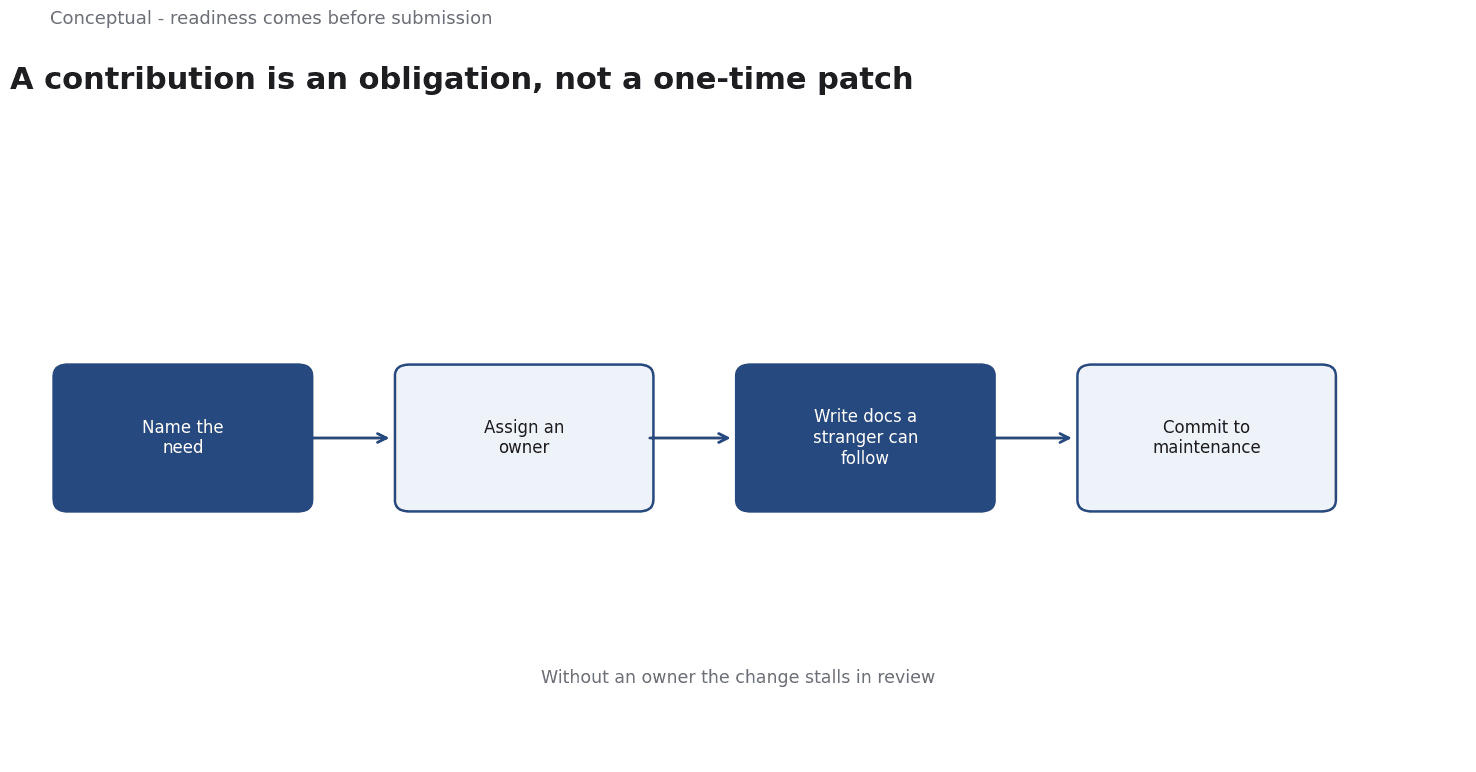
Neither source says whether a particular team should contribute to open source. That decision is inferred, not source-reported. A useful discipline is to evaluate readiness before committing: does the team have time to maintain the change, a person who owns it, and documentation a stranger can follow? If the answer to any of these is no, the contribution is likely to stall in review or become a burden later. Starting from readiness prevents the common pattern of submitting a change and abandoning it when attention moves elsewhere.
The consequence for practice is that open source contribution should be planned like any other work, with a decision, an owner, and a maintenance commitment. Management practices supply the structure for ownership and expectations, while documentation resources supply the means to make the work legible to outsiders. A contribution that lacks either is fragile. The same logic applies to choosing which project to support: the question is not only whether the code is needed but whether the team can sustain the documentation and review that follow.
A worked example
The following is hypothetical and illustrative. A small product team considers contributing a bug fix to an open-source library it depends on. Three checks decide the review. First, has the team named an owner who will see the change through review and follow-up? Second, does the contribution include documentation that explains the problem, the fix, and how to verify it? Third, can the team commit to maintaining the change if a maintainer asks for revisions weeks later? The review finds that the fix is small but no owner has been assigned and no documentation has been written. The team assigns an owner, adds a short explanation and test note, and submits only after those checks pass. The scenario is hypothetical; the verification method is the contribution.
Evidence status
| Claim | Status | Source | Verified | Recheck when |
|---|---|---|---|---|
| Google re:Work publishes management practices for teams | source-reported | Google re:Work, Management practices | 2026-11-18 | Practices revised |
| Write the Docs collects documentation community resources | source-reported | Write the Docs, Documentation community resources | 2026-11-18 | Guide updated |
| Contribution readiness depends on ownership and documentation | inferred | Derived from the sources | 2026-11-18 | Team or project changes |
The first two rows restate what the sources offer. The third row is a synthesis, since neither source prescribes an open-source contribution process. Recheck when the management or documentation guidance changes, or when the team's capacity and the target project's expectations shift.
What it cannot do
Open source contribution cannot substitute for a team's own priorities. Google re:Work describes management practices for teams, but it does not tell a small team what to build or which project to support. A contribution that serves a maintainer's roadmap but not the team's needs can consume scarce time and leave internal work undone. The decision to contribute is a local choice about where effort creates value, and the sources do not make it.
The hidden cost is maintenance after submission. A change that is accepted today may require updates when the upstream project changes, and that work falls on whoever owns the contribution. Documentation also needs upkeep: a note that explains a fix becomes misleading when the fix is superseded. Neither source prices this ongoing cost, so a team that budgets only for the initial change will underestimate the commitment. Review cycles and follow-up questions add time that is easy to overlook.
Without an owner, review feedback goes unanswered, documentation goes stale, and the project's maintainers are left with a change nobody supports. This damages the team's reputation and can make future contributions harder. The management-practices source describes the value of clear ownership, and the documentation source describes readable artifacts; combining them shows why an orphaned contribution fails. The conclusion is an inference drawn from that gap.
There is a boundary around what these sources cover. Management practices are written for teams generally, not for the specific norms of open-source projects, which vary widely in how they review and accept work. Documentation resources describe how to write for readers, not the governance of a particular community. Neither source covers licensing, legal review, or the confidential-information risks of contributing code. A team must treat those as separate checks rather than assuming the sources settle them.
Because both team capacity and project norms change, a contribution policy needs periodic review. Each contribution should be checked against the owner still available and the documentation still accurate, and retired or updated when either fails. Owners and recheck dates should be recorded with the contribution, so a new team member can see why it exists and who maintains it. Without that record, a small team can accumulate obligations it no longer remembers accepting.
The counterargument that contributing code is simple is fair for a single patch and incomplete for the ownership and documentation that make it useful.
A decision test
- Name the need the contribution is meant to serve.
- Check that the team has capacity to maintain the change.
- Assign an owner for review and follow-up.
- Write documentation that explains problem, fix, and verification.
- Check the target project's contribution and review expectations.
- Confirm licensing and confidential-information checks are complete.
- Record the owner, recheck date, and maintenance decision.
A contribution is an ongoing obligation, not a one-time submission. The test ties the work to a need and makes ownership and documentation explicit, so a reviewer can see whether the team can sustain what it submits. For further reading, see Technical Writing: Documentation, API Docs, and Developer Experience.
References & Further Reading
- Google, 2026. Google re:Work — A large company's published people practices, including hiring and growth frameworks.
- Write the Docs, 2026. Write the Docs Documentation Guide — The practitioner guide to documentation structure and style.