Options Strategies Explained
An option is a bounded right, not a simple bet. Read how calls and puts work, a worked example, and the risks that are easy to miss.
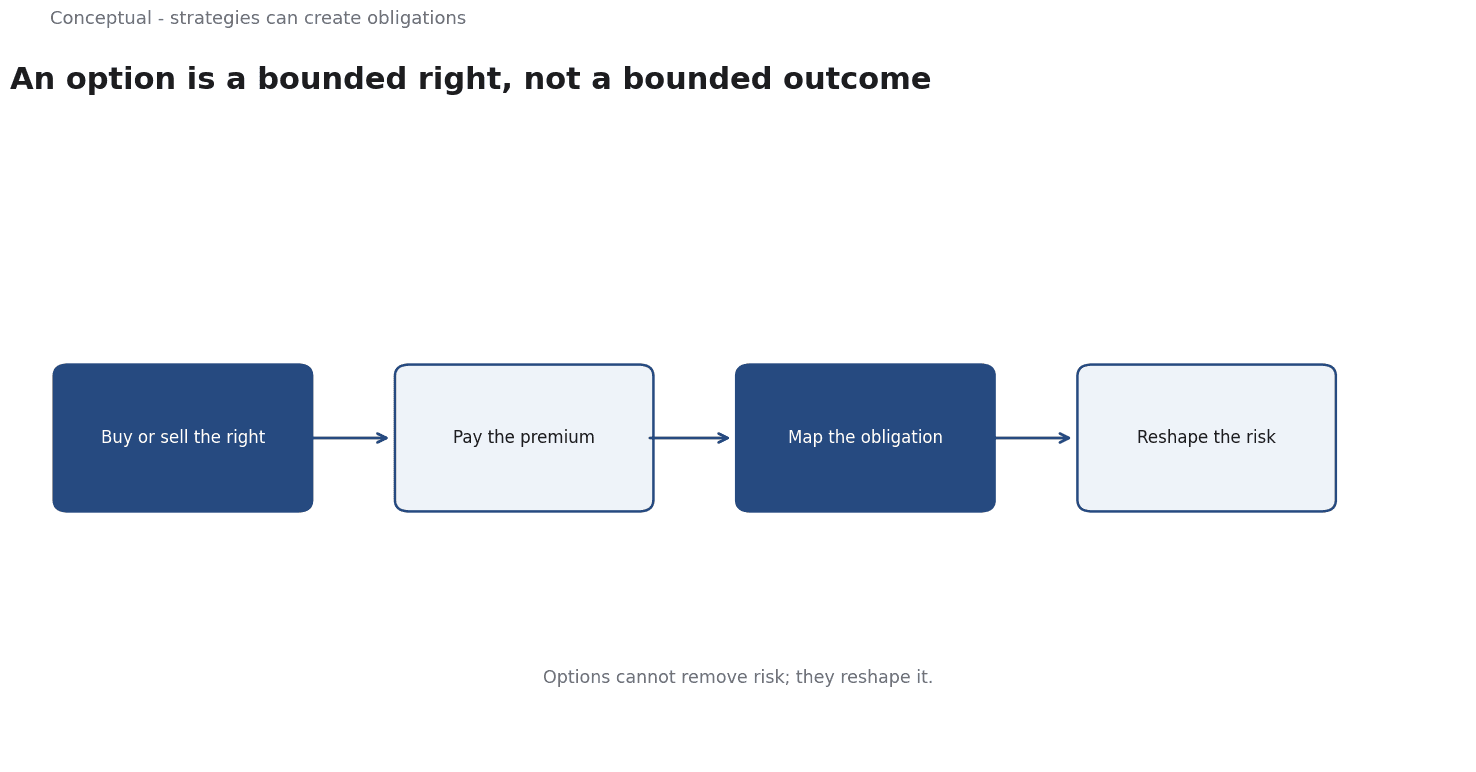
An option gives its holder a right, not an obligation, to buy or sell an asset at a set price by a set date. That bounded loss is attractive, which is why options are often described as cheaper than owning the underlying. The description is incomplete: the premium is paid whether or not the option is used, and strategies that combine options can create obligations that are anything but bounded.
Direct answer: A call gives the right to buy, a put the right to sell, and the premium is the price of that right. The Options Industry Council's education center is the primary source for the mechanics and risks, and investor education frames derivatives as instruments with risk. The boundary: this is educational explanation, not trading advice — strategies can create losses larger than the premium, and margin and tax treatment are jurisdiction-specific, as the tax article requires a dated check.
The mechanics
A call pays if the underlying rises above the strike before expiry, with the holder choosing whether to exercise, as the options-education material explains. The maximum loss is the premium, which the fixed-income article analogises to a fee paid for a right.
A put pays if the underlying falls below the strike, which the derivatives article treats as a form of protection, as the hedging discussion explains for how a loss in one position can offset another.
The premium reflects time to expiry, volatility, and the distance from the strike, which the derivatives article explains for how options are priced, as the Greeks article treats sensitivity to those inputs.
Strategies combine contracts, and combinations can create obligations. A covered call caps upside in exchange for income, while a naked put creates an obligation to buy if assigned, as AI Risk Assessment: A Pre-Deployment Checklist treats exposure aggregation, as the margin discussion in the options material warns.
Three consequences follow. The payoff should be drawn before entering, which the scenario-analysis article recommends for understanding outcomes, as the decision-memo article requires for a recorded judgement. The costs include premium, commissions, and potential assignment, which the cost estimator treats as real expenses. And tax treatment should be checked with a current source, as the tax article advises.
A worked example
The following is hypothetical and illustrative. An investor buys a call on a share trading at 100, with a strike of 110 and a premium of 3, expiring in three months.
Three checks decide what the position means. First, break-even: the share must exceed 113 at expiry for the call to be profitable, which the option mechanics imply, as the worked arithmetic shows. Second, downside: if the share stays at 100, the investor loses the 3 premium, which the bounded-loss property describes, as AI Risk Assessment: A Pre-Deployment Checklist treats that as the certain cost, as the cost estimator requires for any fee. Third, time: if the move happens after expiry, the option pays nothing, which the time-decay discussion in the derivatives article explains, as the scenario-analysis article advises for timing risk.
Three conclusions follow. The bounded loss is real for a long call, which the mechanics support. The probability of the required move is a separate question, which the forecasting article treats as conditional, as the benchmark article warns about applying a model without checking conditions. And the decision should be recorded with the payoff, as the decision-memo article requires.
What options strategies cannot do
They cannot remove risk; they reshape it, which the derivatives article explains for how positions offset, as AI Risk Assessment: A Pre-Deployment Checklist requires for residual exposure.
And they do not remove the need to understand the underlying, which the company-analysis article treats as the prior question, as the commodity article explains for physical constraints in other markets.
The counterargument that options are too complex for most investors is fair for multi-leg strategies and misses the educational value of understanding a single call or put, which the worked example provides, as AI Risk Assessment: A Pre-Deployment Checklist argues for knowing exposure before acting.
A decision test
- Draw the payoff at expiry before entering, as the scenario-analysis article recommends.
- Compute break-even and maximum loss, as the worked example shows.
- Check margin and assignment obligations, as the options material warns.
- Account for premium and commissions, as the cost estimator requires.
- Treat a forecast as conditional, as the valuation article advises.
- Check tax treatment with a current source, as the tax article requires.
- Record the decision, as the decision-memo article requires.
For the instrument, see Derivatives and Options; for the risk, see Risk Assessment.
References & Further Reading
- Options Industry Council, 2026. The Options Industry Council (OIC) - Home — A primary industry reference for option pricing mechanics and Greeks.
- FINRA, 2026. Introduction to Investing (SEC Investor.gov) — Regulator explanation of market mechanics, bonds, and investor protection.