Paid Search Examples
Paid search captures existing intent. Read worked examples, a worked review, and why a click is not the same as a customer.
Paid search is often evaluated by clicks and cost per click, which stops short of the business result. The search-engine-marketing entry describes paid promotion in results, and Google's measurement documentation covers conversion credit. The examples show where the useful questions sit.
Direct answer: Judge paid search by the qualified action it produces and the contribution behind it, with a comparison for any claim about effect. The sources describe the channel; the rule is a synthesis.
Delta: This article adds a claim-status table and a worked review, separating documented measurement from local judgements about value.
The mechanism
The first point is intent. The SEM entry describes paid placement in search results, which means the channel mostly captures demand that already exists. A click from someone searching for a solution is different from an interruption, and the measure should reflect that.
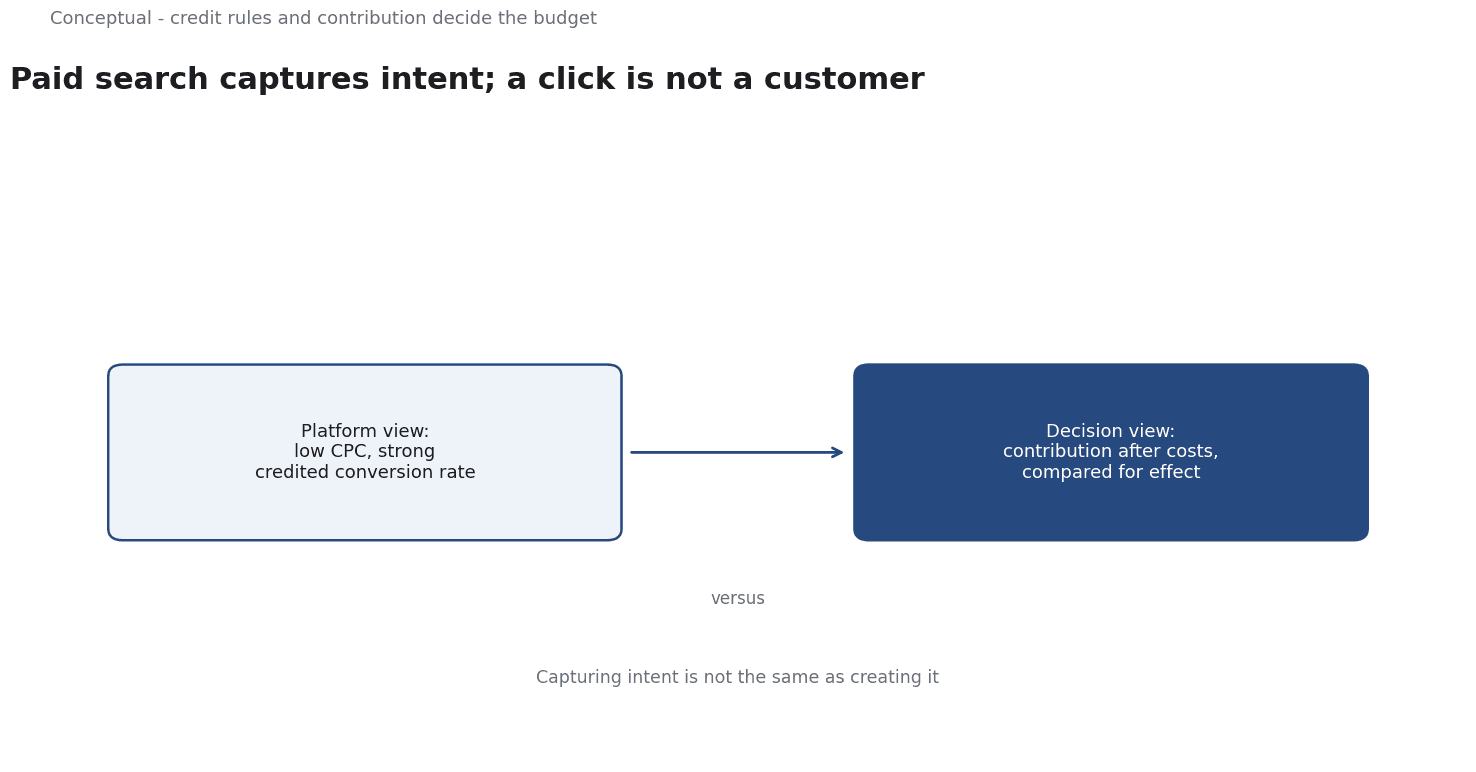
The second point is credit. Google's measurement documentation describes how conversions are attributed, which depends on a rule. A conversion credited to a search ad may have begun elsewhere, and the credit rule does not establish that the ad caused it.
The third point is contribution. A click that leads to a low-margin sale can cost more than it returns, and a single cost-per-click figure will not show it. Reading contribution by campaign is the check that supports a budget decision.
The sequence is: define the qualified action, check the credit rule, compute contribution, then use a comparison for effect. The choices are local, so the conclusions are inferred; the channel is source-reported.
Worked examples
Illustrative. A campaign reports a low cost per click and a strong conversion rate, but revenue falls.
Three checks decide. First, what counts as a conversion, and does it represent a customer or a form fill? Second, what is the contribution after the cost of goods and the click cost? Third, would those customers have arrived through another channel?
A second example: a brand term shows an excellent return. The question is whether the ad created demand or simply collected people who were already searching for the brand.
The outcome is a qualified reading, not a channel verdict. The scenarios are hypothetical; the method is the contribution.
Evidence status
| Claim | Status | Source | Verified | Recheck when |
|---|---|---|---|---|
| SEM is paid promotion in search results | source-reported | Wikipedia, Search engine marketing | 2026-11-18 | Definition changes |
| Platforms document conversion credit | source-reported | Google Ads measurement docs | 2026-11-18 | Product changes |
| Read contribution and compare for effect | inferred | Derived from both | 2026-11-18 | Margin changes |
Why a click is not a customer
A click records an action on an ad. The business needs a customer who stays, and the gap between those two is where most paid-search analysis goes wrong. Measuring the later stage is the correction.
A further consideration is that branded and generic terms behave differently. A branded term often has a high reported return because it captures existing intent, while a generic term may create demand but look weaker in a short window.
The campaign also has a budget horizon. A small budget can show a strong return by capturing the easiest searches, while a larger one reaches less certain intent. Reading the marginal return, not the average, is the discipline when deciding whether to increase spend.
The third limitation is that a platform's credit rule can change. A report that was comparable last quarter may use a different attribution window today, and a difference in outcomes can belong to the measurement rather than the campaign. Recording the rule with the report is the control.
A branded term often looks efficient because it collects existing intent rather than creating it.
The attribution window should be reported with the result, since it decides what the number includes.
A click is an action on an ad, while the business needs a customer who stays, and the two deserve separate measures.
The marginal return matters more than the average when a budget grows.
A measured change should be compared with what would have happened without the campaign.
The credit rule should be stated with any return figure, since it determines the number.
A campaign that captures intent should not be credited with creating it.
A decision test
- Define the qualified action.
- Check the credit rule.
- Compute contribution.
- Separate branded and generic terms.
- Read the marginal return.
- Record the decision and recheck date.
For the comparison, see Incrementality.
A counterargument
The argument that paid search 'mostly captures demand that already exists' is stronger than its source. The SEM entry describes paid promotion in search results, not a claim about where intent originates, and ads also appear on generic queries where no solution is yet being sought. More importantly, the article's own rule that credit does not establish causation undercuts its recommended measure: contribution by campaign still depends on Google's attribution model, so a 'qualified action' and its contribution remain credit-rule-dependent numbers. The article is right to call for a comparison, but that admission means its contribution-and-qualified-action method cannot deliver the causal answer it says matters. A critic would say the framing presents a measurement discipline as a verdict when the sources only support a more modest, attribution-aware reading.
References & Further Reading
- Wikipedia contributors, 2026. Search engine marketing - Wikipedia — Paid promotion in search results.
- Google Ads Help, 2026. About attribution models - Google Ads Help — First-party documentation of attribution models and their limits.