Paid Social Trade-Offs
Paid social buys attention on platforms; demand generation builds it over time. Read the trade-offs, a worked example, and what each method can prove.
Paid social and demand generation are often treated as the same activity, but they operate on different time horizons. The Wikipedia social media marketing entry describes promotion through platforms, and the demand generation entry describes building awareness and interest over time. The real problem is that a team can buy attention efficiently and still fail to build the demand that makes later sales cheaper.
Direct answer: Paid social buys placement and attention on platforms, while demand generation builds awareness and consideration that compound. The sources describe promotion and demand building; the rule that the two need separate measures is a synthesis. Clicks from a campaign are not evidence that demand was created.
Delta: This article adds a claim-status table and a horizon-based test beyond the sources: it maps each method to the decision it supports, with claim status explicit.
The mechanism
The social media marketing entry describes using platforms to promote content and engage audiences. Paid placement is one part of that, buying access to a defined audience in a format the platform controls. The practical consequence is that reach is purchasable but attention is not guaranteed. A platform can deliver an impression, yet the signals available to the buyer often stop at clicks and conversions that the platform itself records.
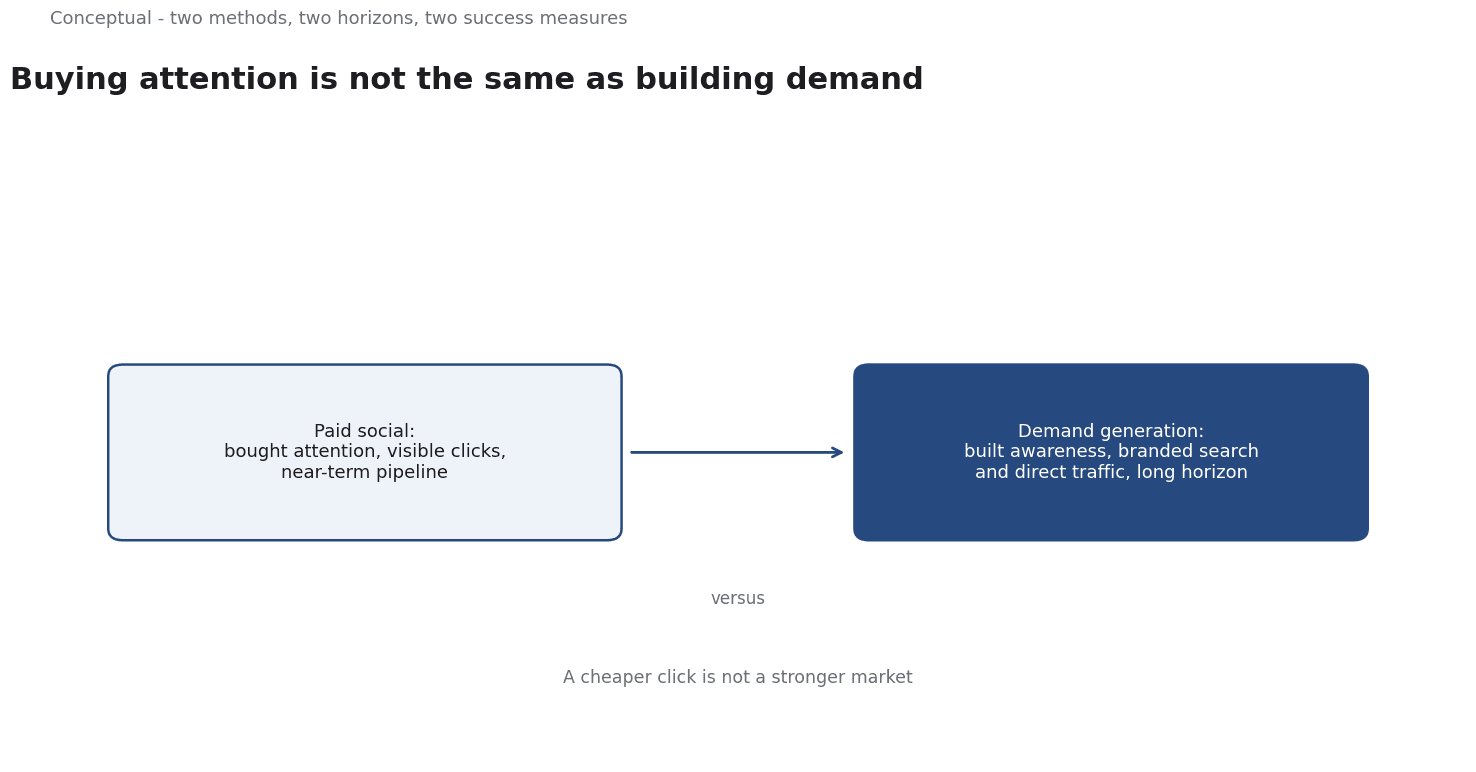
Demand generation describes a longer process: creating awareness and interest so that a market is ready to buy before a sales push. Its effects are diffuse and appear in branded search, direct traffic, and the willingness of prospects to take a meeting. The practical consequence is a measurement gap. Engagement signals are immediate and visible, while demand shows up later and is hard to attribute to a single exposure. A team optimising only the visible signal will systematically favour paid social.
The sources describe the two activities separately, and that separation is the point. Paid social is a channel with a cost per action; demand generation is a state of the market. Treating them as substitutes leads to a category error: a cheaper click is not the same as a stronger market. The synthesis here is to assign each to a different decision, with a different horizon and a different success measure.
The sources do not prescribe budgets or a split between the two. Allocation is inferred, not source-reported. A useful discipline is to state which decision each spend is meant to change: filling a near-term pipeline, or reducing the cost of future acquisition. Once the decision is named, the appropriate measure follows, and a team can stop asking one method to prove the other's result.
A worked example
The following is hypothetical and illustrative. A marketing lead must split a fixed budget between a paid social campaign and a demand generation program. Three checks decide. First, what decision does each spend support - near-term pipeline this quarter, or lower acquisition cost next year? Second, which signal would count as evidence for each, given that demand appears in branded search and direct traffic rather than in campaign clicks? Third, what window is long enough to observe that signal? The lead funds both, sets a short review for the campaign and a longer one for demand, and records the measures. The budget is not reallocated on early clicks alone. The numbers are hypothetical; the verification method is the contribution.
Evidence status
| Claim | Status | Source | Verified | Recheck when |
|---|---|---|---|---|
| Social media marketing promotes content through platforms | source-reported | Wikipedia, Social media marketing | 2026-11-18 | Platform practices change |
| Demand generation builds awareness and interest over time | source-reported | Wikipedia, Demand generation | 2026-11-18 | Definition revised |
| Assign each method a decision and horizon before measuring | inferred | Derived from the sources | 2026-11-18 | Funnel or budget changes |
The first two rows restate descriptions found in the sources. The third row is a synthesis, since neither source prescribes budget allocation. Recheck the definitions if the source entries change, and recheck the inferred claim when the funnel model or the budget window changes.
What it cannot do
Paid social cannot create demand on its own. It can place a message in front of an audience, but the sources describe promotion, not the formation of lasting preference. A campaign can generate measurable engagement while leaving the market no more ready to buy than before. Teams that read engagement as demand will overestimate the durability of what they bought.
The hidden cost is measurement asymmetry. Platform metrics are immediate and plentiful, so they dominate review meetings, while demand signals are delayed and dispersed across other channels. This makes paid social look productive and demand generation look silent, even when the reverse is true. The sources do not discuss this asymmetry; it is an inference from the different time horizons each activity operates on.
A low cost per click is a clean target, and teams will tune campaigns toward it until the clicks stop converting. Because the measure is local to the platform, it cannot see saturation or the effect on future acquisition cost. This risk is not addressed in the sources and is inferred from the gap between a channel metric and a market outcome.
There is a boundary around attribution. Demand generated this period may be bought by a competitor or captured through a channel the team does not monitor. The demand generation entry describes building interest, not assigning credit for it. A team should therefore treat attribution as approximate and avoid claiming precision that the method cannot support. Directional evidence is often the most that is available.
Because horizons differ, the two methods need separate review cadences. A campaign can be judged weekly, while demand needs a longer window and a stable set of indicators. Each spend should carry its decision, measure, and recheck date in one record. Without that separation, a short-term signal will repeatedly override a long-term goal.
The counterargument that paid social is fair for fast feedback is incomplete when no long-term measure is tracked alongside it, since a campaign can win every short-term test while the underlying market stays flat.
A decision test
- Name the decision each spend is meant to change.
- Assign a horizon to each method.
- Choose a signal that fits that horizon.
- Record what the platform cannot see.
- Set a separate review cadence for each.
- Check for saturation and future cost effects.
- Review the split against both measures and set recheck dates.
Paid social and demand generation answer different questions, so they should be judged by different evidence.
The test keeps each method tied to a decision and a horizon, so a reviewer can see what was bought and what was built. For further reading, see Voice of Customer: Turning Feedback into Decisions.
References & Further Reading
- Wikipedia contributors, 2026. Social media marketing - Wikipedia — Use of social platforms to promote products.
- Wikipedia contributors, 2026. Demand generation - Wikipedia — An overview of demand generation as a marketing discipline distinct from lead generation; secondary reference used with the lead-generation entry.