Performance Reviews: Common Questions
Performance reviews raise recurring questions about frequency, fairness, and evidence. Read how role definitions map to review decisions, a worked example, and limits.
Managers enter review season with questions they rarely answer consistently: how often to review, what counts as evidence, and who should give input. O*NET OnLine documents how occupations are described through tasks, skills, abilities, and work context, while Google re:Work offers guidance on goals, feedback, and effective teams. The real problem is that a review is only as defensible as the role definition and the evidence behind it.
Direct answer: A performance review is a structured judgment about how well a person meets defined role expectations, and it is credible only when those expectations and the evidence are explicit. O*NET supplies a model of job content; re:Work supplies guidance on goals and feedback. Use the role definition to set criteria, gather evidence against those criteria through the period, and keep the development conversation distinct from the rating.
Delta: This article adds a role-to-criteria mapping beyond the sources: it maps documented job content to specific review decisions, with claim status explicit.
The mechanism
O*NET OnLine is a database of worker attributes and job characteristics sponsored by the U.S. Department of Labor. It describes occupations through task statements, work context, knowledge, skills, and abilities. The practical consequence is that a review can anchor its criteria in a documented description of the job rather than in a manager's recent impression. When criteria come from the role, the same standard can be applied to people doing similar work, and the review becomes more consistent across a team.
Google re:Work provides guidance and tools intended to help organizations build more effective workplaces, including material on setting goals and giving feedback. The practical consequence is that goals give a review both a forward and a backward reference: they turn a vague question about performance into a comparison against agreed targets. Regular feedback, separated from the formal rating, means the review is not the first occasion on which an issue is raised. That separation is what keeps the conversation developmental rather than purely evaluative.
The two sources connect at a point neither states directly. O*NET describes what a job contains; re:Work describes how goals and feedback are run. A review that uses job content to define criteria and goal practice to track progress has both a stable standard and a current record of performance against it. Neither source supplies a specific rating scale or a review frequency that suits every team, so those remain local decisions and are marked inferred. The mechanism produces a structure, not a ready-made form.
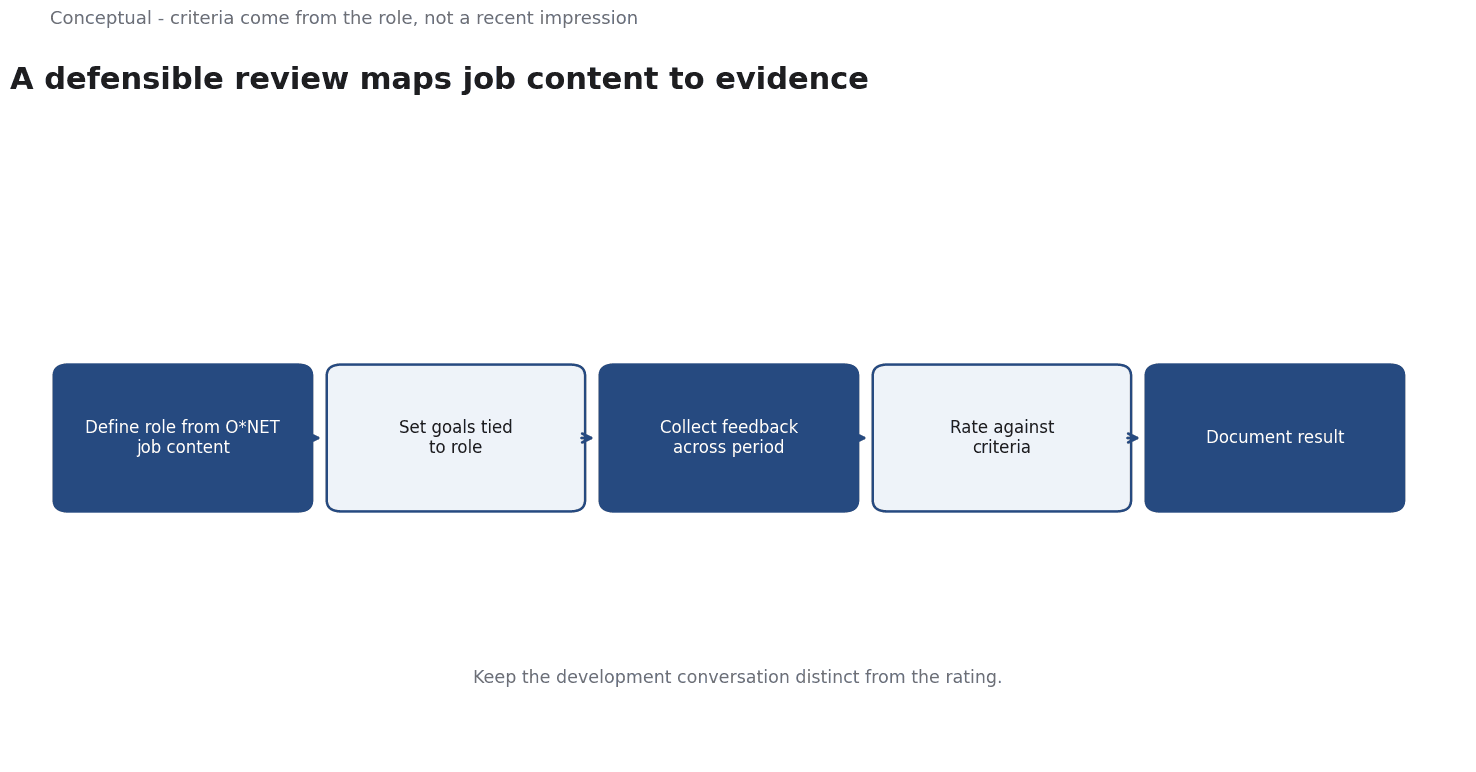
The output is a mapping from each role to its criteria, evidence sources, and review cadence. That mapping is the decision instrument. The sequence is to define the role, set goals tied to it, collect feedback across the period, rate against the criteria, and document the result. Because roles and team goals change, each element carries a recheck condition rather than a permanent definition. A review assembled in this order can be explained later, because the criterion and its evidence are recorded together.
A worked example
The following is hypothetical and illustrative. A manager is preparing a review for an engineer and is unsure how to frame the assessment. Three checks decide the write-up. First, the criteria: do they trace to documented tasks and skills for the role, or to the manager's recent impressions of a single project? Second, the evidence: is there a record drawn from feedback and goal progress across the whole period, rather than from the last few weeks? Third, consistency: would the same criteria be applied to another engineer at the same level? The review shows the criteria are mostly role-based but the evidence is recent-heavy. The outcome is to rewrite the assessment against role criteria, fill the gaps with goal evidence, name the gaps as development areas, and set a recheck date. The numbers are hypothetical; the verification method is the contribution.
Evidence status
| Claim | Status | Source | Verified | Recheck when |
|---|---|---|---|---|
| O*NET describes occupations through tasks, skills, abilities and work context | source-reported | O*NET OnLine | 2026-11-18 | Occupational data is updated |
| re:Work offers guidance on goals, feedback and team effectiveness | source-reported | Google re:Work | 2026-11-18 | Guidance or tools are revised |
| Anchoring review criteria in role definitions improves consistency | inferred | Derived from the sources | 2026-11-18 | Roles or team goals change |
The first two rows report what the reference resources provide and are comparatively stable; the third is an inference about how job content and goal practice combine in a review. The implication is that the source claims can be relied on as described, while the consistency claim should be revisited when roles or goals change. Each entry should carry a recheck condition so a reviewer can see when the criterion needs to be confirmed against the current role.
What it cannot do
A structured review cannot measure every contribution. It is a judgment against defined expectations, not a complete record of a person's work. Collaboration, context, and the unglamorous work that holds a team together can fall outside the criteria even when they matter. The sources describe job content and goal practices; they do not claim to capture every form of value a person creates. Treating a review score as a full accounting of contribution is a category error: it answers how well someone met the stated criteria, not how much they contributed overall. A reader who needs the fuller picture must look beyond the form.
The hidden cost is time and coordination. Defining criteria from a role, gathering evidence across a period, and calibrating standards across managers all require effort. Under deadline pressure, teams fall back on recent impressions because they are cheap to recall. That fallback is the real expense avoided by structure: the work of building a defensible review is front-loaded, and the benefit appears when the assessment is challenged or compared. Skipping it saves hours now and creates an argument later.
When expectations are surfaced only at review time, surprise undermines fairness, whatever the rating says. Ratings can also be distorted by recency, when the latest project dominates the assessment, and by a halo effect, when one strong or weak trait colors every criterion. Criteria that reflect a manager's preferences rather than the role have the same effect. The practical check is whether the evidence spans the period and whether the criteria would be recognized by someone who knows the role but not the person.
There is a boundary around the method. O*NET describes occupations in general, not a specific person's targets; re:Work offers guidance, not a validated rating instrument. The approach does not cover compensation design, promotion decisions, or legal compliance requirements, all of which have their own rules and constraints. It can support a conversation about performance against defined expectations, but it cannot decide pay or settle a dispute on its own. Applying it outside that boundary produces a document that looks thorough while answering only part of the question.
Because roles and goals change, the review practice needs scheduled review. Each criterion should be recorded with the role version it came from and a recheck condition tied to role or goal changes. Without that record, a future reviewer cannot tell whether a criterion reflects the current job or an older definition. The review will still be filed; the link between criterion, role, and evidence is what makes the judgment defensible. That link is the contribution of a structured approach.
The counterargument that a structured review is bureaucratic is fair for very small teams with daily contact and incomplete where roles are specialized, because undocumented criteria make consistent judgment impossible.
A decision test
- State the purpose of the review, whether development, rating, or both.
- Define the role's criteria from documented tasks and skills.
- Set goals tied to those criteria.
- Collect feedback evidence across the whole period.
- Rate against criteria rather than recent impressions.
- Check consistency with others performing the same role.
- Record the outcome and recheck when the role changes.
A performance-review practice is useful only when criteria and evidence are both recorded.
The test turns an assessment into a sequence of decisions with a visible rationale, so a reviewer can see which role definition was used and when the criterion must be revisited. It fails when a rating rests on memory alone. For further reading, see Voice of Customer.
References & Further Reading
- U.S. Department of Labor, 2026. O*NET OnLine — The standard occupational taxonomy used to compare roles across industries.
- Google, 2026. Google re:Work — A large company's published people practices, including hiring and growth frameworks.