Payables Strategy Explained
Payables strategy is a timing decision, not just a bill-paying routine. Read the source definitions, a worked timing example, and where stretching terms breaks.
A payables strategy is often treated as an administrative routine for paying bills, which hides the timing decision inside it. The accounts payable entry describes money owed to suppliers, and the working capital entry places payables among current liabilities. The real problem is that a team can optimise for paying on time while ignoring what the timing of those payments does to cash.
Direct answer: A payables strategy decides when owed amounts are settled, balancing supplier terms against the cash needed to operate. The sources define payables and working capital; the timing rule is a synthesis. It is a liquidity lever, not a measure of the total a business owes.
Delta: This article adds a claim-status table and a payment-timing decision test beyond the sources: it maps each payable to a liquidity decision, with claim status explicit.
The mechanism
Accounts payable is money a business owes to suppliers for goods or services received but not yet paid. It appears as a current liability. The working capital entry describes current assets such as receivables and inventory set against current liabilities such as payables. Payables are therefore part of the short-term funding picture, not merely a record of bills waiting to be cleared.
What a payables strategy measures is the timing of cash leaving the business relative to cash arriving.
Two businesses with the same outstanding amount can face very different liquidity positions because of when those amounts settle.
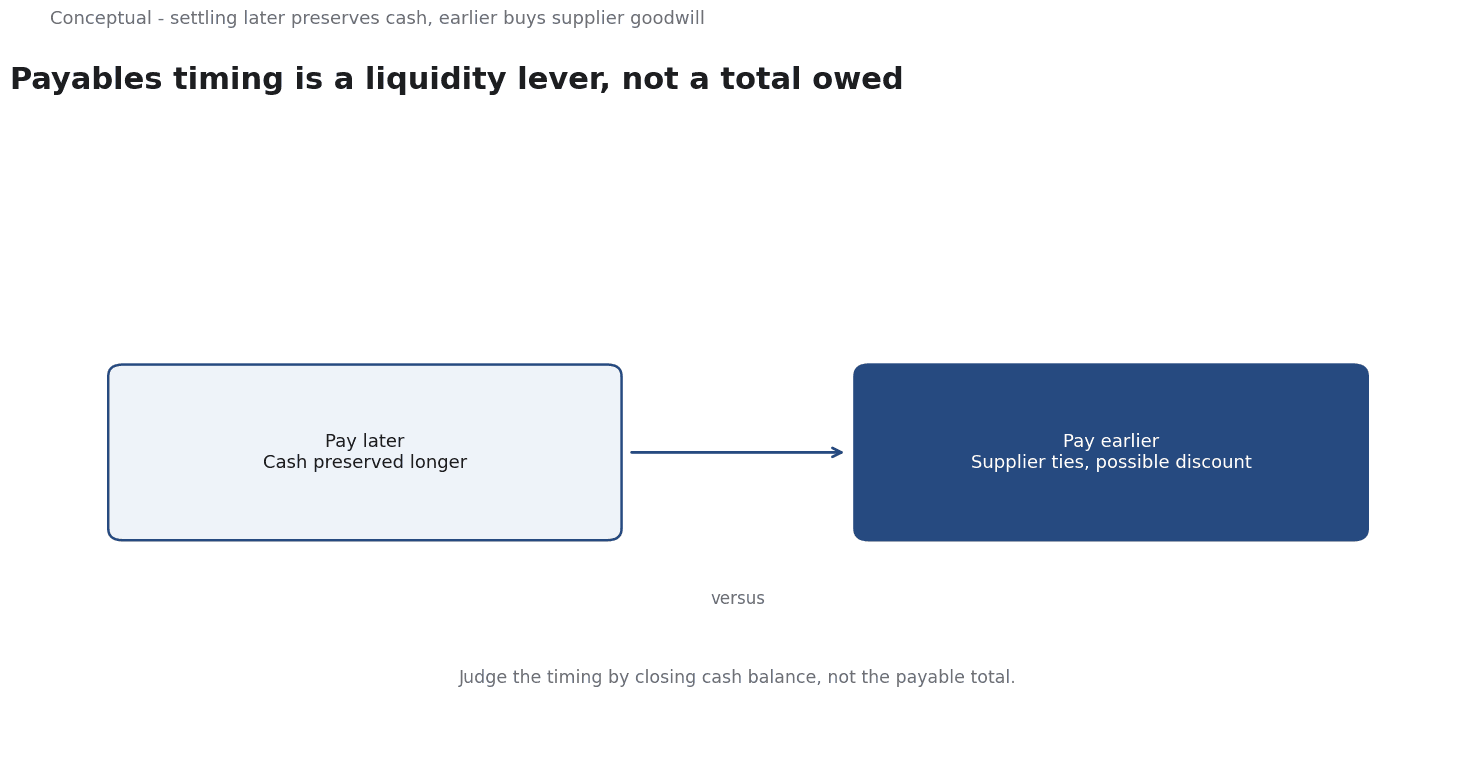
The practical consequence is that paying later preserves cash in the business for longer, which can ease a short-term gap. Paying earlier can protect a supplier relationship or capture a discount. The sources define the liability but do not prescribe an optimal payment date, so that choice is local. Because payables sit inside working capital, a change in payment timing shifts cash between periods without changing the total owed. The decision instrument is the effect on the closing cash balance, not the size of the payable itself. A manager who watches only the payable total will miss the timing effect that actually determines whether cash is available.
The discipline is to record the assumption behind each date. Terms and due dates are local facts; neither source specifies a standard horizon or a discount threshold. Marking those as inferred keeps the boundary visible and lets a reviewer see which dates were chosen deliberately. Stretching terms beyond what was agreed changes the nature of the decision from a timing lever into a credit question, and the sources do not cover that consequence. A payables schedule that ignores agreed terms can look efficient on paper while quietly transferring risk to the supplier.
The output is a schedule of payments by date compared with expected receipts. That comparison shows when a shortfall appears and how much lead time exists to act on it. The value lies in the sequence: list the obligations, place them in time, compare them with receipts, then decide. Neither source supplies a threshold, so the operating minimum is a policy choice that should be written down and revisited rather than assumed.
A worked example
The following is hypothetical and illustrative. A small distributor reviews its payables before a tight month. Three checks decide the review. First, which supplier invoices fall due in the same week that a large customer receipt is expected to be late? Second, does any supplier offer a discount worth more than the cost of paying earlier? Third, would stretching a payment breach agreed terms or damage a relationship that matters later? The schedule shows one large invoice due a week before the delayed receipt. The team negotiates a split payment and confirms the closing balance clears the operating minimum. The outcome is a timing decision, not a change in the amount owed. The numbers are hypothetical; the verification method is the contribution.
Evidence status
| Claim | Status | Source | Verified | Recheck when |
|---|---|---|---|---|
| Accounts payable tracks money owed to suppliers | source-reported | Wikipedia, Accounts payable | 2026-11-18 | Definition revised |
| Payables are current liabilities in working capital | source-reported | Wikipedia, Working capital | 2026-11-18 | Definition revised |
| Payment timing shifts cash between periods | inferred | Derived from the sources | 2026-11-18 | Payment terms change |
The first two rows are factual claims drawn directly from the sources. The third is an inference about the effect of timing, because neither source recommends a payment strategy. Recheck the definitions when the source entries change, and the inferred claim when payment terms or the pattern of receipts change.
What it cannot do
A payables strategy does not measure the total a business owes. It governs when owed amounts are settled. A large payable and a small one can have the same timing effect, and a shrinking payable balance can mean either faster payment or less purchasing. The sources define the liability, not the strategy built around it. Treating the balance as a verdict on supplier health or on operating efficiency is a category error; it answers when cash leaves, not whether the underlying purchasing decisions were sound. A reader who wants the total obligation must look to the balance sheet, which is a different question from the timing one.
The hidden cost is the relationship with suppliers. Paying later may preserve cash, but it can erode trust with the suppliers who are, in effect, financing the business. The sources describe the accounting entry and do not price that trust. A team that optimises only the cash calendar may find that suppliers tighten terms or reduce priority when a shortage occurs, which is a real cost that never appears in the payables schedule. The cost is paid in future flexibility, and it tends to surface precisely when the business most needs cooperation. That makes it easy to miss in the month when the timing decision is made.
A schedule looks exact, but the dates rest on assumptions about when invoices are approved and when cash arrives. A supplier may not accept a stretched date, and a negotiated split may fail. A manager who reads the schedule as a commitment rather than a scenario will be caught out when one of those assumptions breaks. Each date should carry a confidence marker and an owner, so that the plan can be revised openly. Without that, a single missed approval silently invalidates the weeks that follow it.
There is a boundary around the method. It covers cash leaving under current arrangements. It does not model refinancing, a new credit line, or the sudden loss of a key supplier. It does not replace a longer-term plan or a balance sheet view. An obligation that settles just outside the window is invisible by design, and a dispute over goods received falls outside the timing frame entirely. A payables calendar is therefore a partial view of liquidity, useful precisely because it is narrow and misleading if it is read as complete.
Because terms change, the schedule needs a refresh and the assumptions need periodic review. Each assumption should be recorded with a recheck condition, and the minimum balance should be treated as a local policy decision rather than a number the sources supply. Without that record, a future reviewer cannot tell which dates were deliberate and which were guesses. The schedule will still show a set of payments; the reasoning behind each one is what makes it reusable.
The counterargument that paying on time is fair for maintaining supplier trust is incomplete when a short-term liquidity gap makes timing the deciding factor.
A decision test
- List each payable with its amount and due date.
- Check the agreed terms for each supplier.
- Place each payment in the week cash actually leaves.
- Compare the payment calendar with expected receipts.
- Identify the first period that falls below the operating minimum.
- Decide which payment to move, negotiate, or split, and record why.
- Record the choice, the owner, and the recheck date.
A payables strategy is useful only when timing is owned and refreshed. The test turns a list of bills into a sequence of liquidity decisions with a visible lead time, so a reviewer can see which payment moved and when the choice must be revisited. For further reading, see Cash Flow Forecasting: A 13-Week Operating Model.
References & Further Reading
- Wikipedia contributors, 2026. Accounts payable - Wikipedia — Amounts a business owes to suppliers.
- Wikipedia contributors, 2026. Working capital - Wikipedia — Current assets minus current liabilities, and why a growing business can be cash-constrained; secondary reference.