Personal Branding Metrics that Matter
Choose personal-brand metrics tied to a decision: what web analytics can observe, a worked example, and the limits of measurement.
Personal branding is often treated as a count of followers and impressions, which feels like progress but seldom changes a decision. Web analytics can measure behavior on pages you control, yet it cannot tell you whether a reputation moved. The real problem is choosing signals that connect to a choice you will make, not to a mood you want to feel.
Direct answer: Track a small set of metrics that map to a decision you will actually make: qualified inbound inquiries, repeat engagement from a defined audience, and conversion from content to opportunity. Use web analytics for what it observes on owned properties, and label any conclusion about reputation as a judgement rather than a measurement.
Delta: This article adds a claim-status table beyond the two sources: it maps observable web signals to a specific personal-brand decision, with claim status explicit.
The mechanism
Personal branding describes the practice of marketing oneself and one's career as a brand, where the value comes from consistent signals that accumulate over time. A brand is not a single post or profile; it is the pattern of associations that others form after repeated exposure. That definition matters because it changes what can be measured. A single spike in attention is an event, while a brand is a distribution of responses across many events. Any metric that captures one moment without the pattern is describing the event, not the brand.
Web analytics is the measurement, collection, analysis, and reporting of web data for the purpose of understanding and optimizing web usage. Its scope is deliberately bounded: it records actions that happen on properties where measurement is installed, such as page views, sessions, returning visitors, and the paths people take before leaving. Those counts are reliable within that boundary because they are collected systematically. They become misleading only when they are asked to stand for something outside it, such as influence, trust, or reputation formed on platforms you do not control.
The gap between the two concepts is where most mistakes happen. Follower totals and impressions are easy to read, which is why they are overused, but they are inputs to a decision only when someone has defined what the decision is. A consultant deciding whether to write a newsletter cares about returning readers who match a target audience; a job seeker cares about the quality of inbound conversations. The same number means different things in each case. Without a stated decision, a metric becomes decoration.
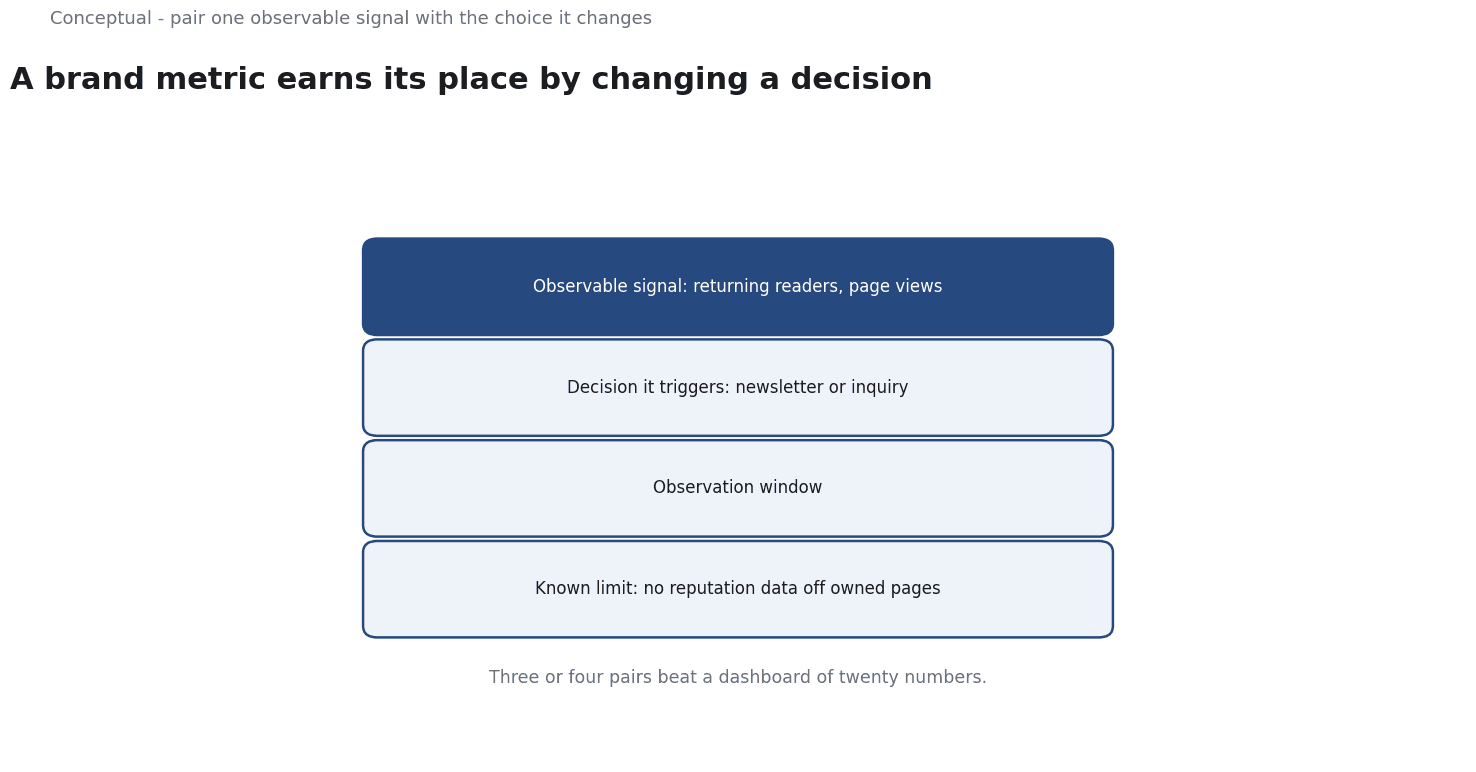
The practical consequence is to choose metrics in pairs: one observable signal from analytics, and one decision it will trigger. Add an observation window and a known limitation, and you have a measurement plan that can be reviewed. Three or four such pairs are more useful than a dashboard of twenty numbers, because each pair can be judged on whether it changed a choice.
A worked example
The following is hypothetical and illustrative. An independent consultant is deciding whether to spend the next quarter writing a newsletter or speaking at industry events, and has analytics on a personal site plus rough notes on inbound inquiries.
Three checks decide which metrics matter. First, does a metric map to the decision: does returning readership from the target audience predict consulting inquiries, or is it only page views? Second, is the signal observable within the measurement boundary, or does it depend on unseen activity on external platforms? Third, is it leading or lagging, and over what window will it be read?
The outcome is a short list: qualified inquiries per month and repeat readers in the target segment as leading signals, with conversion to paid work as the lag. Page views are recorded but not used to decide. The measurement is deliberately incomplete, and the decision is explicit.
Evidence status
| Claim | Status | Source | Verified | Recheck when |
|---|---|---|---|---|
| Personal branding is the practice of marketing oneself as a brand | source-reported | Wikipedia Personal branding | 2026-11-18 | Definition changes |
| Web analytics measures and reports web usage data | source-reported | Wikipedia Web analytics | 2026-11-18 | Measurement standards change |
| Metrics should map to a stated decision | inferred | Derived from the sources | 2026-11-18 | Decision context changes |
The table separates what the sources define from what this article concludes. The two source-reported rows describe concepts, not prescriptions. The inferred row is the local judgement that a metric earns its place only when it is tied to a decision, which is a synthesis rather than something either source states.
What it cannot do
A personal-brand metric cannot tell you that you are trusted. Trust is formed in interactions that analytics does not see, including conversations, referrals, and the judgment people form after working with you. Counting repeat visits may correlate with trust, but it does not measure it. Treating the proxy as the thing itself leads to optimizing the number while the underlying relationship stagnates. The honest framing is that the metric is a signal to discuss, not a verdict to act on without question.
It also cannot resolve attribution. When someone arrives from a recommendation in a private message or an offline conversation, the measurement boundary ends before the cause. Web analytics records the visit and its path on your site, but the reason for the visit is outside its view. This is not a flaw in the tool; it is a scope limit.
There is a hidden cost to metric choice. Numbers that are easy to read attract attention, so teams optimize what is visible. A dashboard of rising impressions can coexist with a shrinking set of qualified conversations, and the gap is invisible until someone asks the decision question. Choosing fewer metrics reduces this cost because each one has a stated purpose and can be challenged. A large dashboard hides the same weakness behind volume.
The failure mode is gaming. Any number used to evaluate a person becomes a target, and targets invite behaviour that raises the number without improving the thing it stands for. Posting more to raise frequency, or chasing broad audiences to raise reach, can dilute the very audience the brand depends on. A metric that is reviewed alongside a qualitative check is harder to game than one that stands alone.
The boundary is time. Reputation compounds over years, while most analytics windows are days or weeks. A short window encourages tactics that look good immediately and may erode the long-term signal. The practical fix is to read a metric at two horizons: a short window for operational choices and a long window for whether the audience and the inquiries are actually improving. Neither window is correct on its own.
The counterargument that any measurement is better than none is fair for building the habit of review and incomplete when the chosen metric silently drives the wrong decision.
A decision test
- Write the decision you will make before choosing a metric.
- List which behaviors that decision depends on.
- Pick one observable web signal for each behavior.
- State the measurement boundary and what it excludes.
- Set a short and a long observation window.
- Pair the number with a qualitative check.
- Review after a platform or audience change.
A metric earns its place only when it changes a choice.
If removing a number would leave your behaviour unchanged, it is decoration, and decoration is cheap to collect and expensive to mistake for evidence. Keep the list short enough that every item can be defended in a review, and record what each one cannot see. For further reading, see Marketing Dashboards without the Hype.
References & Further Reading
- Wikipedia contributors, 2026. Personal branding - Wikipedia — How individuals build a professional reputation.
- Wikipedia contributors, 2026. Web analytics - Wikipedia — Collection and interpretation of website behaviour data.