Personal Branding Trade-Offs
Personal branding is a set of trade-offs, not a popularity contest. Read how visibility, consistency and audience interact, and a test for what to share.
Personal branding is often framed as self-promotion with no downside. The real problem is that visibility is a finite resource and every signal you send has an audience and a cost. The reference entries on personal branding and employer branding describe the concepts at a general level; neither one decides what you should share. The useful question is which signal serves which audience, and what you give up by sending it.
Direct answer: Personal branding is the deliberate shaping of the signals associated with a person, while employer branding is the parallel shaping of an organization's reputation as a workplace. The sources describe both as reputation concepts. Every signal involves a trade, so the decision is what to emphasize for a given audience rather than how to be visible everywhere.
Delta: This article adds a claim-status table and a disclosure decision test beyond the two general entries: it maps branding concepts to a personal choice, with claim status explicit.
The mechanism
The entry on personal branding describes it as the practice of cultivating a public professional image and reputation. The practical consequence is that consistency across contexts matters, because audiences infer from patterns. A person who presents one focus to colleagues, another to prospective employers, and a third online gives each group weak evidence about what they actually do. Coherence does not mean repeating a slogan; it means that the signals point in a compatible direction.
The entry on employer branding describes how an organization communicates its values and what it is like to work there, with effects on recruitment and retention. The practical consequence is that your personal signals sit inside an employer's reputation. The two can reinforce each other, as when your public work reflects well on the team, or conflict, as when your message cuts against a position the organization has taken. Ignoring that relationship is how a well-intended post becomes a problem.
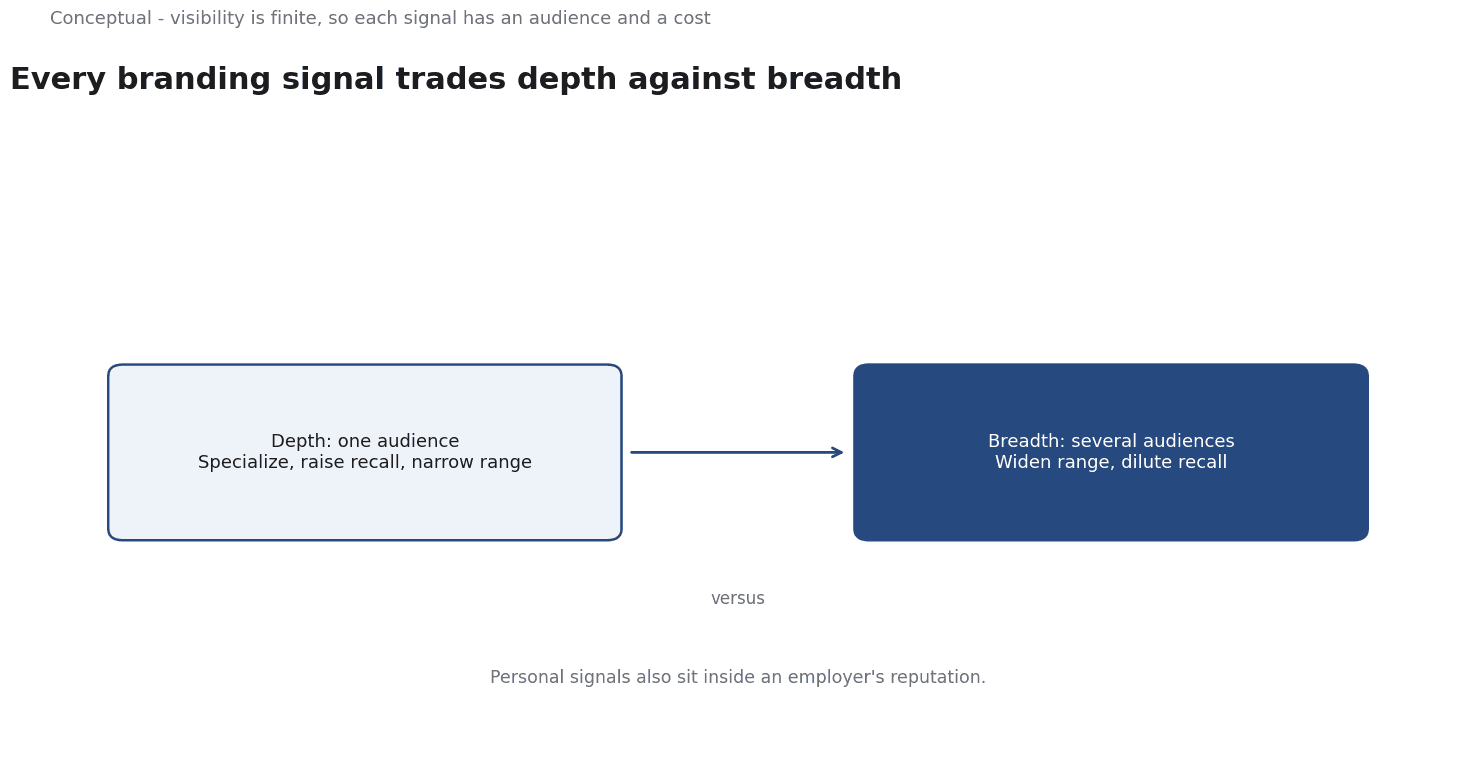
The central trade is between depth and breadth.
Time spent building recognition with one audience is time not spent with another, and a signal that helps you be known for one thing narrows how a different group reads you. Specialization increases recall but reduces range. The practical consequence is that the question shifts from how to look visible to which audience, which signal, and at what cost.
That is local judgement, so the link from a branding concept to a specific act of disclosure is an inference. The sources support the idea that reputation is shaped; they do not tell you what to post. The decision test exists to make that judgement explicit rather than accidental.
A worked example
The following is hypothetical and illustrative. An engineer wants to speak publicly about a technical topic while employed at a company with a strong employer brand of its own. Three checks decide the scope. First, does the topic overlap with confidential work or with messaging the employer owns, such as an unpublished roadmap? Second, which audience is the signal for, professional peers or prospective hires, and does the chosen channel actually reach them? Third, does the time spent on public writing reduce the core work that the reputation rests on? If the topic is general, the audience is clear, and the time is affordable, the engineer publishes on methods rather than internal plans and records the boundary. If any check fails, the signal is withheld. The scenario is hypothetical; the decision structure is the contribution.
Evidence status
| Claim | Status | Source | Verified | Recheck when |
|---|---|---|---|---|
| Personal branding involves shaping a public professional image | source-reported | Wikipedia: Personal branding | 2026-11-18 | The entry is revised |
| Employer branding shapes an organization's reputation as a workplace | source-reported | Wikipedia: Employer branding | 2026-11-18 | The entry is revised |
| A signal that helps one audience can narrow how another reads you | inferred | Derived from the sources | 2026-11-18 | Role or audience changes |
The first two rows describe what the sources cover and are reported directly. The third row is an inference about the cost of a signal, drawn from the idea that reputation is shaped rather than fixed. Neither source claims a measured career benefit from branding, so the article makes no such claim.
What it cannot do
Personal branding cannot substitute for competence. A reputation that runs ahead of the work it describes is fragile, because the gap becomes visible the moment someone examines the output. The sources describe reputation as something shaped, but shaping is not the same as creating substance. The decision to invest in visible signals should come after the decision to do work worth seeing, not before.
It also carries a maintenance cost. A public signal has to be sustained, and the time spent maintaining it is time not spent on craft or on rest. A person who builds an identity around a narrow topic can find that every later change of direction requires an explanation. The hidden cost is not the occasional post but the continuing obligation to be consistent with a story you told earlier.
When an audience expects one thing from you, deviating is read as a change of principle rather than a change of interest. That is the trade-off in its sharpest form: the same focus that makes you recognizable also makes you harder to reinterpret. The worked example handles this by choosing a general topic rather than a claim that will age badly.
There is a boundary in the evidence. Both sources are general reference entries, not studies of career outcomes. They support statements about what the concepts mean, not statements about how much branding improves hiring, pay, or opportunity. Any claim about a specific benefit would be local judgement and should be presented as such. The claim-status table keeps that distinction visible.
Finally, the trade needs review when the role, the employer, or the audience changes. A signal that was useful in one setting can be misleading in the next, and an employer's reputation can shift underneath a personal one. A decision recorded with the audience and the date is far easier to revisit than a habit formed without either. Periodic review is what keeps a personal signal from quietly becoming a constraint.
There is also a gap between the intended audience and the actual one. A signal aimed at peers can reach a future employer, and a message meant to be temporary can outlast the context that made it reasonable. Because you cannot control who reads a public signal, the decision has to account for the widest plausible audience, not the one you had in mind. That is a strong argument for choosing signals you would be comfortable defending later, and for avoiding the assumption that a narrow channel stays narrow.
Counterargument: "The counterargument that visibility always helps is fair for someone seeking a first audience and incomplete when a narrow signal closes later options."
A decision test
- Name the audience the signal is meant to reach.
- State the work or competence the signal rests on.
- Check for overlap with confidential or employer-owned messaging.
- Decide which single point the signal should convey.
- Estimate the time cost of maintaining it.
- Note which other audience might read it differently.
- Record the boundary and a date to review it.
The test replaces a vague ambition to be visible with a bounded choice. Each step can be answered without a public statement, which is the point: the decision is made before the signal is sent. Reviewing it when the role or audience changes keeps the choice from becoming a trap.
For further reading, see Marketing Dashboards.
References & Further Reading
- Wikipedia contributors, 2026. Personal branding - Wikipedia — How individuals build a professional reputation.
- Wikipedia contributors, 2026. Employer branding - Wikipedia — How organisations are portrayed as places to work.