Presentation Skills at Scale
When many people present, quality cannot depend on individual charisma. How to build a reusable structure, brief the audience, and keep the message consistent across channels.
Presentation advice usually targets the individual speaker: practise, make eye contact, know your material. That breaks down when an organisation needs dozens of people to present well, because quality then depends on whoever happens to be on stage. The real problem at scale is consistency: how to give every presenter a structure and a process that produce a clear message without eliminating the judgment the moment requires.
Direct answer:
Presentation skills at scale are less about charisma and more about a shared system: a reusable structure, a brief for each audience, consistent messaging across channels, and a feedback loop.
The public-speaking tradition supplies the structure and audience focus; marketing communications supplies the idea that a message is decoded by a receiver amid noise and should stay consistent with other channels. The boundary is that a system can raise the floor but cannot supply the substance or the presence a high-stakes moment needs.
Delta: This article adds a systems view beyond the sources: it maps public-speaking structure and marketing-communications consistency to the specific decision of how to standardise presentations without flattening them, with claim status made explicit.
The mechanism
The public-speaking tradition treats a talk as a structured act involving a speaker, an audience, a message, and a context, with an introduction, a body, and a conclusion. The practical consequence at scale is that this structure can be made reusable. When every presenter works from the same skeleton, state the objective, name the audience, make a small number of points, and close with the decision or ask, the baseline quality no longer depends on natural talent. A template is a floor, not a ceiling, and its purpose is to remove avoidable structural failures.
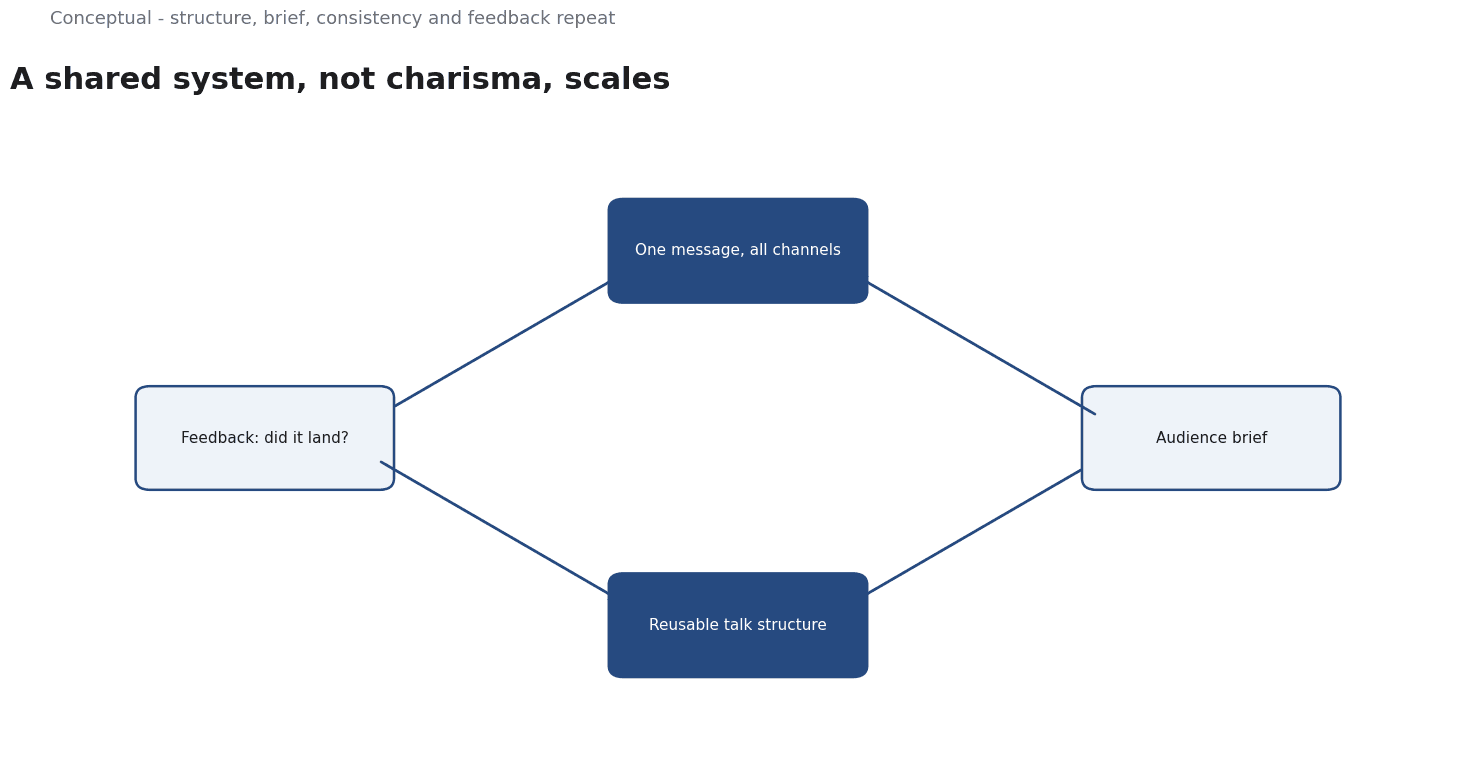
Audience analysis is the second portable lesson from public speaking. Knowing who is in the room, what they already understand, and what decision they face changes what a presenter should say. At scale, that knowledge cannot live in each speaker's head, so it becomes a short audience brief that is filled in before the deck is built. The brief asks who the audience is, what they care about, and what they should do afterwards. This turns a vague principle into a step that can be checked by someone other than the presenter.
Marketing communications contributes the idea that a message travels through a process of encoding, media, decoding, and feedback, with noise competing at every stage. A presentation is therefore one channel in a larger system, not a self-contained event. The practical consequence is consistency: the core message in the deck should match the memo, the dashboard, and the follow-up email, so the audience receives the same point rather than competing versions. It also means designing for noise, by making the main point legible and repeating it in different forms.
The same field describes hierarchy-of-effects models, in which communication moves an audience toward action through stages such as attention, interest, desire, and action. Applied to presentations, this argues for building a talk around a progression rather than a list of topics. At scale, teams can maintain a library of narrative patterns that have worked, paired with a feedback loop that records which talks changed decisions and which did not. That feedback is what lets the system improve instead of merely repeat the same deck with new dates.
A worked example
The following is hypothetical and illustrative. A company wants its project leads to present status updates consistently across many teams. Three checks shape the system. First, a common structure is defined: objective, audience, three findings, and a decision or ask, so that no presenter has to invent a skeleton. Second, each presenter completes a short audience brief naming who will attend, what they already know, and what they must decide, so the content fits the room. Third, the core message is aligned with the written update and the dashboard, and a feedback note is captured after each presentation about whether the decision was made. The outcome is a higher and more even baseline, with one caveat: a few presenters found the structure too rigid for sensitive conversations, so the team added an explicit exception for those moments.
Evidence status
| Claim | Status | Source | Verified | Recheck when |
|---|---|---|---|---|
| Public-speaking guidance emphasises audience analysis, structure, and delivery | source-reported | Wikipedia contributors, "Public speaking" | 2026-11-18 | The Wikipedia article is substantially revised |
| Marketing communications treats messaging as a system with feedback and noise and calls for consistency across channels | source-reported | Wikipedia contributors, "Marketing communications" | 2026-11-18 | The source description is updated |
| At scale, reusable structure and audience briefs matter more than individual charisma | inferred | Derived from the sources | 2026-11-18 | Feedback data from real presentations is available |
The table reports the two source-backed descriptions separately from the inference drawn from them. The emphasis on structure and audience, and the view of messaging as a system, are taken directly. The claim about reusable structure at scale is reasoned from combining those two ideas; it is a design conclusion rather than a quotation and should be checked against feedback data from real presentations before it is treated as settled practice.
What it cannot do
A structure cannot create substance. A perfectly shaped talk built around a weak argument is still a weak argument, and a template can even hide that weakness by making the delivery look orderly. Presentation skills amplify the thinking that goes into the content; they do not replace it. At scale this matters because a shared template can give bad content a professional appearance, making it harder for an audience to see that the reasoning is thin. The system must therefore check the argument, not just the format, and reviewers should be willing to send a well-formatted but empty deck back for more work.
There is a hidden cost in standardisation. Templates, briefs, and message libraries take effort to build and maintain, and they must be taught to every new presenter. Done badly, they flatten communication into a uniform style that suits no audience and signals that the organisation values consistency over clarity. The goal is a floor that frees presenters to focus on content, not a script that removes their judgment. Keeping that balance requires ongoing work and a willingness to revise the system when it produces rigidity rather than reliability across teams.
More decks, more presentations, and better design do not mean the message landed. The communications process includes noise and feedback for a reason: an audience can decode a message very differently from what the sender intended, and without feedback nobody notices. A scale system that measures itself by the number of talks given, rather than by decisions changed or understanding improved, will optimise the wrong thing and miss the failure entirely. Measurement has to reach beyond the event itself.
There are boundaries where the standard approach should not be applied. Sensitive one-to-one conversations, negotiation, and moments that demand genuine presence rely on responsiveness that a template cannot supply. Different cultures and settings reward different styles, and a single house format may be inappropriate across all of them. High-stakes persuasion often needs a bespoke narrative rather than a reusable skeleton. The system should define when its default applies and when a presenter should step outside it, so that the exception is a deliberate choice rather than a quiet drift away from any standard at all.
Finally, the system needs review. Audiences change, channels multiply, and a message library that is never refreshed becomes a source of stale claims. Feedback should be collected deliberately and acted on, so that patterns which fail are retired and successful ones are kept. Ownership matters: without someone responsible for maintaining the structure and the library, the system drifts back into individual habits. A presentation standard is a living artifact, not a document to publish once, and it should be revisited on a schedule or when the communication context changes materially.
The counterargument that scaling presentations sacrifices authenticity is fair for routine updates where consistency helps, and incomplete for moments that require genuine presence and judgment; there the right move is to set aside the template and speak directly.
A decision test
- Define a common structure that every presenter can use as a baseline.
- Require a short audience brief before any deck is built.
- Align the core message with the written and dashboard versions of the update.
- Build the talk around a progression toward a decision, not a list of topics.
- Collect feedback on whether the audience understood and acted.
- Define explicit exceptions for sensitive or high-stakes moments.
- Assign an owner to maintain the structure and review the message library.
Presentation quality at scale comes from the system around the speaker, not from hiring more naturally gifted presenters.
A reusable structure, a real audience brief, and consistent messaging raise the floor for everyone, while feedback keeps the system honest. The point is not to script people but to remove the avoidable failures so that their judgment can go into the content and the moment. When the system is working, it is nearly invisible: the audience simply receives a clear message.
For further reading, see Decision Memos That Survive Review.
References & Further Reading
- Wikipedia contributors, 2026. Public speaking - Wikipedia — Speaking to an audience and how it is prepared.
- Wikipedia contributors, 2026. Marketing communications - Wikipedia — The coordination of messages across channels and the distinction between consistent and identical communication.