Pricing Psychology: Anchors, Framing, and Fairness
Price presentation changes perception without changing value. Read the mechanisms, a worked framing test, and where fairness becomes a constraint.
Two identical prices can produce different purchase rates depending on what appears next to them. That is the subject of pricing psychology — not a trick to manipulate buyers, but a reminder that price is interpreted in context. Used well, it clarifies value; used badly, it erodes trust.
Direct answer:
Anchors, framing, and defaults change how a price is perceived without changing the product or the amount charged.
Porter's strategy argument is a useful check: a presentation advantage that a competitor can copy instantly is not a durable position. The boundary: perceptual effects are context-dependent and can backfire, and fairness is a constraint on what a business should do, not just a reputational risk, as Pricing Strategy: How to Charge What Your Product Is Worth explains.
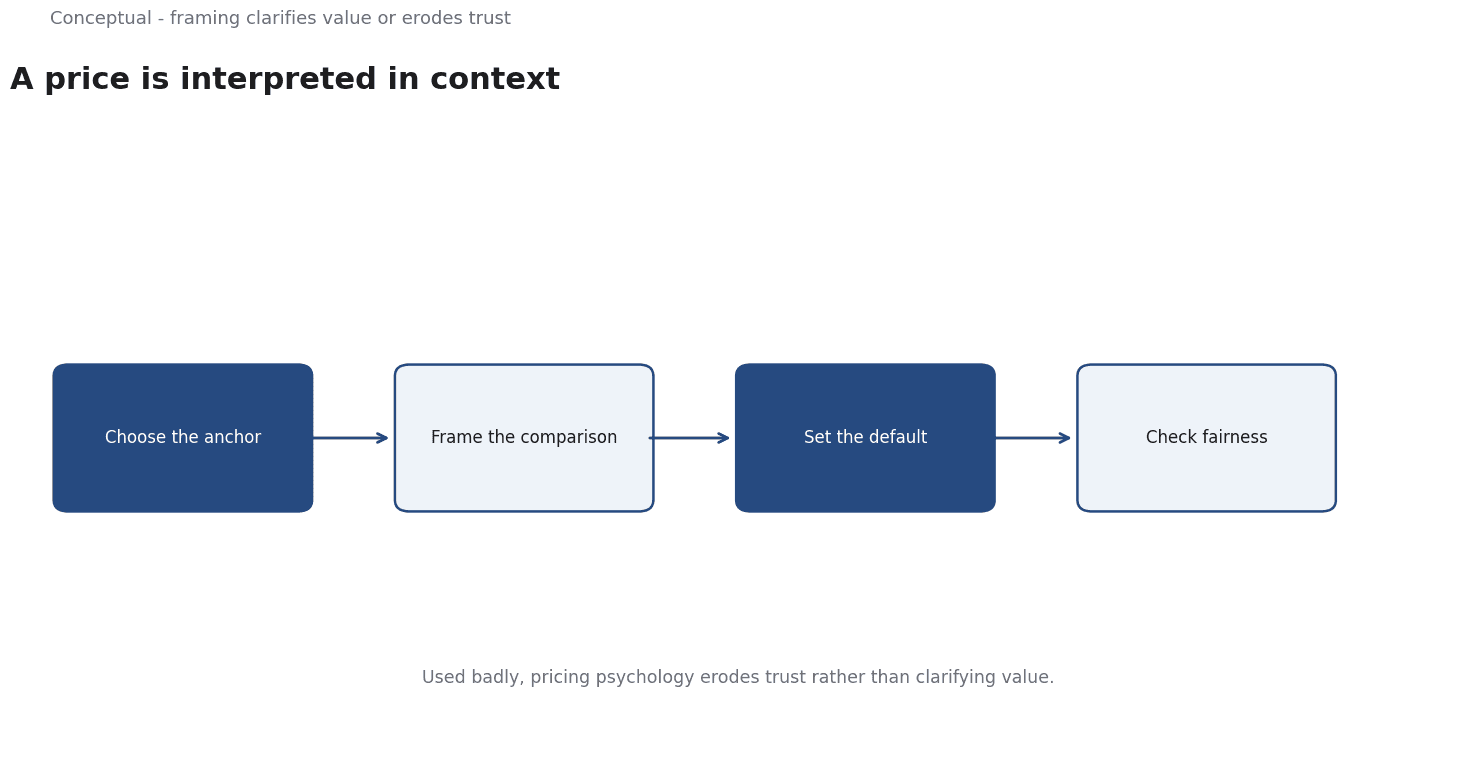
Three mechanisms
Anchors. A higher reference price makes the actual price look reasonable. The anchor must be credible — a fictional list price damages trust, as the brand-positioning article argues for claims the business cannot support.
Framing. The same cost can be presented per month, per user, or per outcome. A monthly price looks smaller than an annual one, but the comparison is only fair if the time horizon is stated, which the landing-page article recommends for concrete costs.
Defaults. A pre-selected tier influences choice without forbidding alternatives. Defaults are powerful and should be used to help a customer choose appropriately, not to exploit inattention, which the data-ethics article treats as a broader concern.
A worked framing test
The following is hypothetical and illustrative.
A B2B product costs 12,000 a year. A team tests three presentations on matched landing-page traffic:
- Annual price: "12,000 per year".
- Monthly frame: "1,000 per month, billed annually".
- Per-seat frame: "100 per user per month for 10 users, billed annually".
Three checks decide the result:
- Comprehension — do visitors understand what they will actually be charged? A frame that raises conversion by hiding the annual commitment is a liability, which the pricing-page article treats as a failure of clarity.
- Qualified conversion — do the visitors who convert become good customers, or does a confusing frame attract the wrong buyers? The funnel article distinguishes conversion from downstream quality.
- Trust signals — do complaint and cancellation rates rise over the following months? The retention article identifies repeat issues as a leading indicator of a problem that was closed but not solved.
Three conclusions follow:
- The frame that wins on conversion may lose on comprehension, which the evaluation-rubric article teaches us to measure separately.
- Fairness is a constraint, not just a reputational consideration, which the pricing-strategy article argues.
- A presentation advantage is easy to copy, so it is not a substitute for a real value proposition, as Pricing Strategy: How to Charge What Your Product Is Worth explains.
Fairness as a constraint
Three questions separate a fair frame from a misleading one:
Would a customer feel misled on reading the full terms?
Can the comparison be verified? An anchor based on a real, current list price is different from a fictional one, as the brand-positioning article argues for claims the business can support.
Would the company defend the practice publicly? A simple reputational test, which the online-reviews article treats as a real signal — a frame nobody would defend is usually one that should not be used.
These questions are not a legal analysis, which the data-privacy and regulatory articles treat separately; they are a design check on whether the presentation helps or exploits the buyer.
What pricing psychology cannot do
It cannot create value. A frame changes perception of a price, not the product's usefulness, which the value-proposition article explains.
It cannot fix a price that is wrong for the market. If the amount exceeds the value delivered, presentation delays the problem, as Pricing Strategy: How to Charge What Your Product Is Worth argues.
It does not guarantee a result. Effects vary by audience and context; the A/B testing article explains why a controlled test is the evidence, not a principle.
The counterargument — that any framing is manipulation — is too strong.
Stating a cost per month alongside the annual total clarifies rather than deceives; the distinction is whether the frame helps the buyer understand the real commitment, which the landing-page article treats as a design question.
A decision test
- State the real price clearly in every frame.
- Use anchors that are credible and verifiable, as the positioning article recommends.
- Test comprehension alongside conversion, as the evaluation-rubric article advises for separate metrics.
- Check downstream quality of converted customers, which the funnel article explains.
- Monitor cancellations and complaints as trust signals.
- Treat fairness as a constraint, which the pricing-strategy article covers.
- Re-test on change in audience or product, as the A/B testing article recommends.
For the pricing model, see Pricing Strategy; for the page, see Pricing Page Best Practices.
References & Further Reading
- Wikipedia contributors, 2026. Demand generation - Wikipedia — An overview of demand generation as a marketing discipline distinct from lead generation; secondary reference used with the lead-generation entry.
- Michael E. Porter, 1996. What Is Strategy? — The differentiation-versus-cost argument behind competitive-advantage analysis.