Pricing Strategy: How to Charge What Your Product Is Worth
Price is a decision about value, not a cost calculation. Read how to set it, segment it, and test it without destroying trust.
Pricing is the most leveraged decision a business makes and the one most often delegated to a formula. Cost-plus pricing feels rigorous, and it is not: the cost tells you the floor, not the price, and it contains no information about what a customer will pay. The right approach treats price as a hypothesis about value that has to be tested against behaviour.
Direct answer:
Set price from the value and alternatives the buyer faces, constrained by cost, then validate it with experiments.
Because revenue changes with price in a direction determined by elasticity, the same increase can raise or lower revenue depending on the market. And because price is also a signal, the way you change it — the structure, the timing, the explanation — matters as much as the number, particularly when you serve more than one segment.
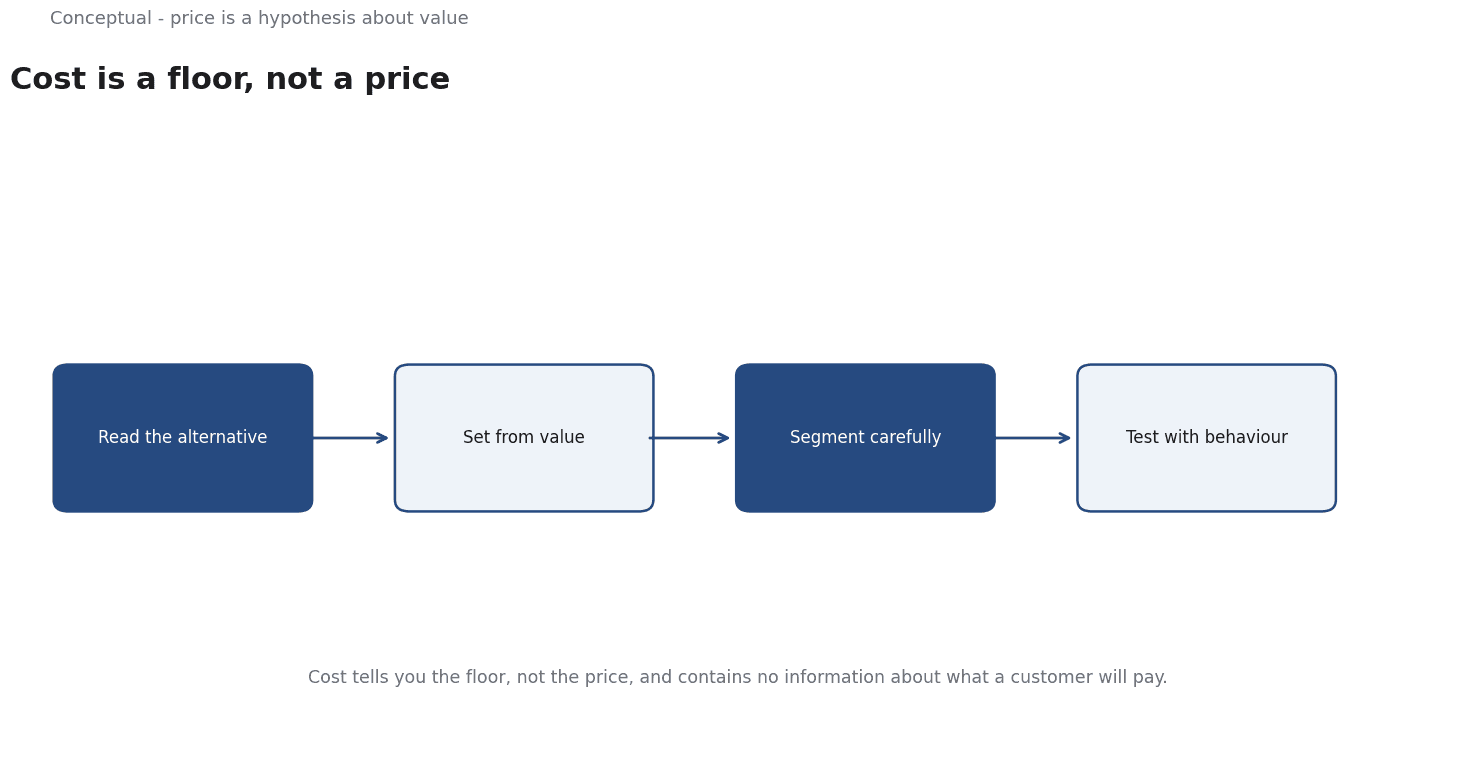
Cost is a floor, not an answer
Sometimes those correlate, and sometimes they do not. A product that costs almost nothing to serve can be extremely valuable, and an expensive product can be worthless to a buyer who does not need it.
But cost does matter, as a boundary. Below cost, the business loses money on each unit and scale makes the problem worse. Above cost, the question is how much of the gap between cost and perceived value the business can capture — and that depends on alternatives and on the buyer's elasticity.
The open-access microeconomics text The Economy 2.0 from CORE Econ frames this correctly: the models describe how buyers and sellers respond to constraints. A price is where willingness to pay and willingness to supply meet, and the firm's decision is about where on that relationship it wants to sit.
Value-based pricing starts with the alternative
The practical way to estimate willingness to pay is not to ask people what they would pay; it is to understand what they would do instead.
What is their next-best option? A buyer with a cheap, adequate substitute has low willingness to pay regardless of how good your product feels to you. One with no viable substitute has more room. This is the same substitution logic that determines market structure and the same trade-off logic Porter describes — a position is protected when a competitor would have to give up something to match it.
What does the purchase actually do for them? Value is often not in the feature but in the outcome — time saved, risk reduced, status gained, a problem that stops occupying attention. Pricing against the feature invites comparison on specification; pricing against the outcome invites comparison against the alternative way of achieving it.
How is the purchase bought? A procurement-led buyer, a consumer buying on impulse, and a team lead with a discretionary budget respond to different price structures even when the underlying value is the same.
Segment carefully, or do not segment at all
Different customers have different willingness to pay, and capturing that difference is the promise of price discrimination. Done well it increases both revenue and access — students and small firms pay less, and the business serves more people. Done badly it destroys trust, because customers discover they paid more than someone else for the same thing.
The practical distinction is between segmenting on a basis that correlates with willingness to pay and is visible as fair — volume, service level, commitment term, support tier — and segmenting on something that looks arbitrary. A year-long commitment at a lower unit price is defensible. Two customers seeing different prices with no explanation is not.
Google's own documentation about attribution models is a useful analogy here: "Attribution models let you choose how much credit each ad interaction gets for your conversions." A model is a choice of rule, and the rule must be legible. Pricing segmentation is the same: a rule customers can understand can be accepted; an arbitrary outcome cannot.
Test, but test carefully
Price experiments are among the most valuable and most dangerous tests a company can run, because the downside — a customer discovering they were in a test — is relational, not just statistical.
Three designs are worth knowing:
- Randomised price offers to comparable new customers, with a fixed horizon and a predetermined decision rule. This gives the cleanest elasticity estimate.
- Sequential tests on new cohorts rather than existing customers, which avoids the trust problem at the cost of slower results.
- Conjoint analysis where no history exists, which produces a stated-preference estimate. Research standards apply: record who was asked and what the sample supports.
CUPED is directly relevant to the statistical side. The method uses pre-experiment data to reduce metric variability and reports "reduce variance by about 50%" on Bing — "the same statistical power with only half of the users, or half the duration". In pricing tests, where the effect is often small and the sample limited, that is the difference between a decision and a shrug.
A sequence that works
- Write the alternative the buyer faces. Pricing begins with substitution, not cost.
- Establish the floor from fully loaded cost and the ceiling from the value of the outcome.
- Choose a segmentation rule that a customer could understand and defend.
- State the hypothesis: which price, for which segment, will produce which behaviour.
- Test on new cohorts where possible, with variance reduction and a fixed horizon.
- Measure revenue and retention, not conversion. A price that lifts conversion may lose money; one that lowers conversion may raise it.
- Explain price changes. A change with no explanation is read as arbitrary, and arbitrary pricing invites renegotiation.
For the economics of the decision, see Microeconomics for Decision Makers; for the competitive context, see How Companies Build Competitive Advantages.
A worked example
The following is hypothetical and illustrative. A project-management SaaS company is preparing to raise prices for new customers and is weighing two numbers. It runs three checks before committing. First, it writes the alternative the buyer faces rather than starting from cost: the next-best tool is adequate but weak on reporting, which gives the outcome - faster client reporting - room for a higher price, while fully loaded cost sets the floor. Second, it chooses a segmentation rule a customer could defend, charging less for annual commitment and a lighter support tier rather than showing different prices to similar buyers, keeping the rule legible as the attribution analogy requires. Third, it tests on new cohorts with a fixed horizon and variance reduction, using pre-experiment data the way CUPED does so a modest revenue effect is detectable without a long run. The bounded outcome is a stated hypothesis - a higher annual price for the reporting-focused segment - confirmed by revenue and retention rather than conversion alone, with the change explained to buyers. Cost-plus would have anchored on the floor and missed the value entirely.
A counterargument
A reasonable critic would push back that the article treats willingness to pay as something a firm can read off its buyers' alternatives, when its own economic source describes price only as the point where willingness to pay and supply meet.
That describes a market equilibrium, not a measurement procedure for a single seller facing an unknown curve. The experimental tools on offer have narrower reach than suggested: CUPED's reported halving of variance makes a small effect detectable, but does not show it survives outside the new cohorts the article recommends testing. And the claim that a legible segmentation rule will be accepted is an assertion, not something the cited attribution analogy establishes.
References & Further Reading
- Econlib, 2026. Core Econ: The Economy — A complete free economics textbook covering supply, demand, and elasticity.
- Aswath Damodaran, 2026. Damodaran Online: Home Page for Aswath Damodaran — Publicly maintained datasets for industry averages, WACC, and valuation.
- Options Industry Council, 2026. The Options Industry Council (OIC) - Home — A primary industry reference for option pricing mechanics and Greeks.