Pricing Page Best Practices
A pricing page answers a buying question, not a design brief. Read the four decisions it must support, a worked audit, and what to measure.
Pricing pages are often designed to look clean, which means hiding the information a buyer needs. The visitor is trying to answer three questions: what will this cost in my situation, what is included, and what happens if I choose the wrong plan. A page that answers none of them produces demos that go nowhere.
Direct answer:
A good pricing page makes the comparison legible, states what changes between tiers, answers the questions that block a decision, and offers a next step matched to intent.
Demand-generation principles explain the stage the page serves, and research standards apply when claims are based on customer surveys. The boundary: a pricing page cannot fix a pricing model that does not match how customers create value — it can only make an existing model understandable.
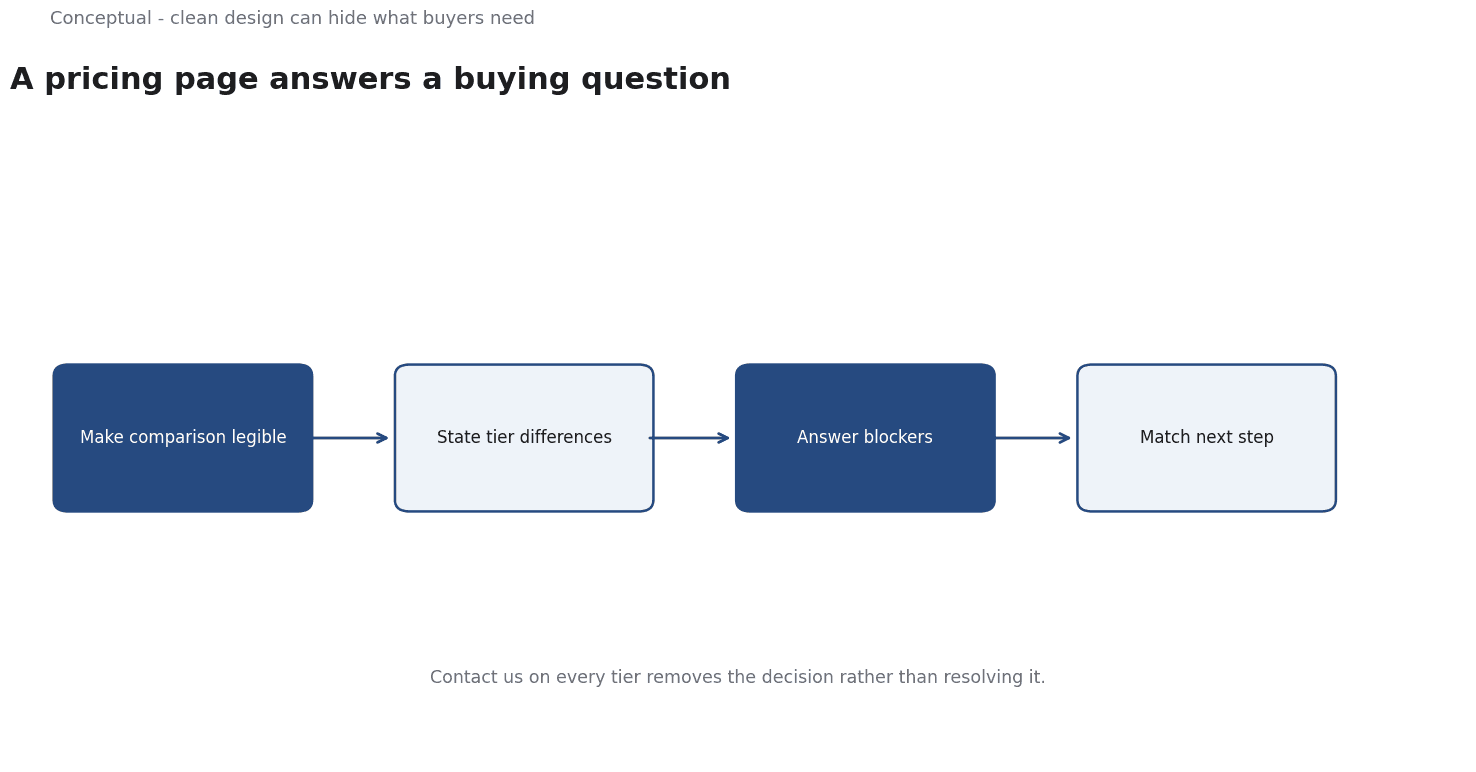
Four decisions to support
Which plan fits me? The page should give a reader a way to choose without a sales call. Usage limits, seat definitions, and included features need to be concrete.
What does it cost in my situation? If price depends on usage, show an example with a denominator. A number without a unit invites a buyer to assume the worst.
What is different between tiers? Differences should be about value and capability, not arbitrary feature counts. A tier matrix with twenty cosmetic differences hides the three that matter.
What if I choose wrongly? Migration, cancellation, and upgrade terms reduce the risk of deciding. These belong on the page or one click away.
A worked audit
The following is hypothetical and illustrative.
A B2B product has three tiers and 5,000 pricing-page visits a month. Demo requests are 150, and 30 close. An audit examines four points:
- Can a reader self-select? The tiers differ by "number of projects" and "priority support". If the buyer does not know how many projects they have or what priority support means, they cannot choose. Replacing those with observable descriptions — and a worked example — is a bounded change.
- Is the cost concrete? Prices are listed per seat per month, but the buyer is a team of 40. Adding a small calculator or an example total for 40 seats answers the real question.
- Are the differences meaningful? Three tiers with twelve feature rows obscure which capability changes behaviour. Reducing the matrix to the four differences that drive decisions makes the choice easier.
- Is the next step matched? Every tier says "Book a demo". Adding "Start a trial" for the lower tier gives small teams a proportional action.
Three measurements decide whether the changes worked:
- Qualified demo rate from the pricing page, not raw demo requests.
- Tier distribution among closed customers, to see whether self-selection matches the fit the page describes.
- Return visits to the page, which signal that a reader came back to decide.
Three cautions apply: the calculator must use real pricing rules, the simplified matrix must not omit a difference that matters to a segment, and the test must change one element at a time, as the A/B testing article explains.
What a pricing page cannot do
It cannot fix the wrong model. If customers create value in ways the tiers do not reflect, no page will make the pricing feel fair. That is a product and strategy question, which the pricing-strategy article covers.
It cannot create trust. Trust comes from delivered value, honest terms, and evidence from customers. A page can present those; it cannot manufacture them.
It cannot address every objection. A complex purchase involves security review and procurement. The page's job is to give the champion enough material to begin that process, not to complete it.
The counterargument — that pricing should be hidden to drive sales conversations — is valid for highly bespoke deals and wrong for self-serve products.
In a self-serve motion, hiding price adds friction without adding information, and the buyer simply leaves.
A decision test
- State the reader's three questions before editing the page.
- Make the tiers self-selectable with observable descriptions.
- Show a worked cost example with a denominator.
- Reduce the comparison to the differences that change behaviour.
- State what happens on cancellation or upgrade.
- Match the next step to intent — trial for small teams, demo for complex ones.
- Measure qualified demos and tier fit, not form fills.
For the pricing model, see Pricing Strategy; for the test method, see A/B Testing.
References & Further Reading
- Wikipedia contributors, 2026. Demand generation - Wikipedia — An overview of demand generation as a marketing discipline distinct from lead generation; secondary reference used with the lead-generation entry.
- American Association for Public Opinion Research, 2026. AAPOR — The professional association for public opinion and survey research; its standards and resources underpin the survey-design discussion.