Pricing Psychology Mistakes to Avoid
Avoid pricing psychology mistakes by testing reference points and framing, not tricks. Includes a worked example, a claim-status table, and clear limits.
Teams often treat pricing psychology as a set of tricks: charm prices, decoys, and anchors applied without asking what the buyer compares against. Pricing theory determines how a number is set, while behavioral research explains how people judge numbers in context. The common mistake is assuming that a technique transfers regardless of the reference point.
Direct answer:
Test how buyers perceive a price relative to a credible reference before applying a psychological tactic, and check that the framing informs rather than misleads.
Kahneman's prize lecture explains why context, reference points, and loss aversion shape judgment; pricing research explains how the number itself is determined.
Delta: This article adds a claim-status table beyond the two sources: it maps each pricing tactic to the judgment it relies on and the mistake to avoid, with claim status explicit.
The mechanism
Pricing is the process of setting what a seller receives in exchange for a product, and common approaches include cost-based, competition-based, and value-based methods. A number can be justified by costs, by the market, or by the value a buyer perceives. Psychological pricing is one approach among these, not a replacement for them. It operates on presentation and perception, which means it can change how a price is read without changing the underlying value exchange. That distinction is where most errors begin.
Kahneman's prize lecture describes judgment under uncertainty as dependent on context, with heuristics that are useful in many settings and systematic in their errors. Concepts such as reference dependence, framing, and loss aversion explain why the same number can feel different in different surroundings. A price is judged against a reference point, and losses relative to that reference weigh more heavily than equivalent gains. The practical implication is that perception is relational: changing the comparison changes the response, sometimes more than changing the number.
Mistakes follow from ignoring that relational structure. An anchor that is implausible can make the real price seem manipulative rather than reasonable. A charm price can signal low quality in a market where precision signals quality. A decoy can confuse buyers instead of clarifying a choice. Each tactic works through a judgment, and when the judgment is misread the tactic reverses. The mechanism is not magic; it is context sensitivity.
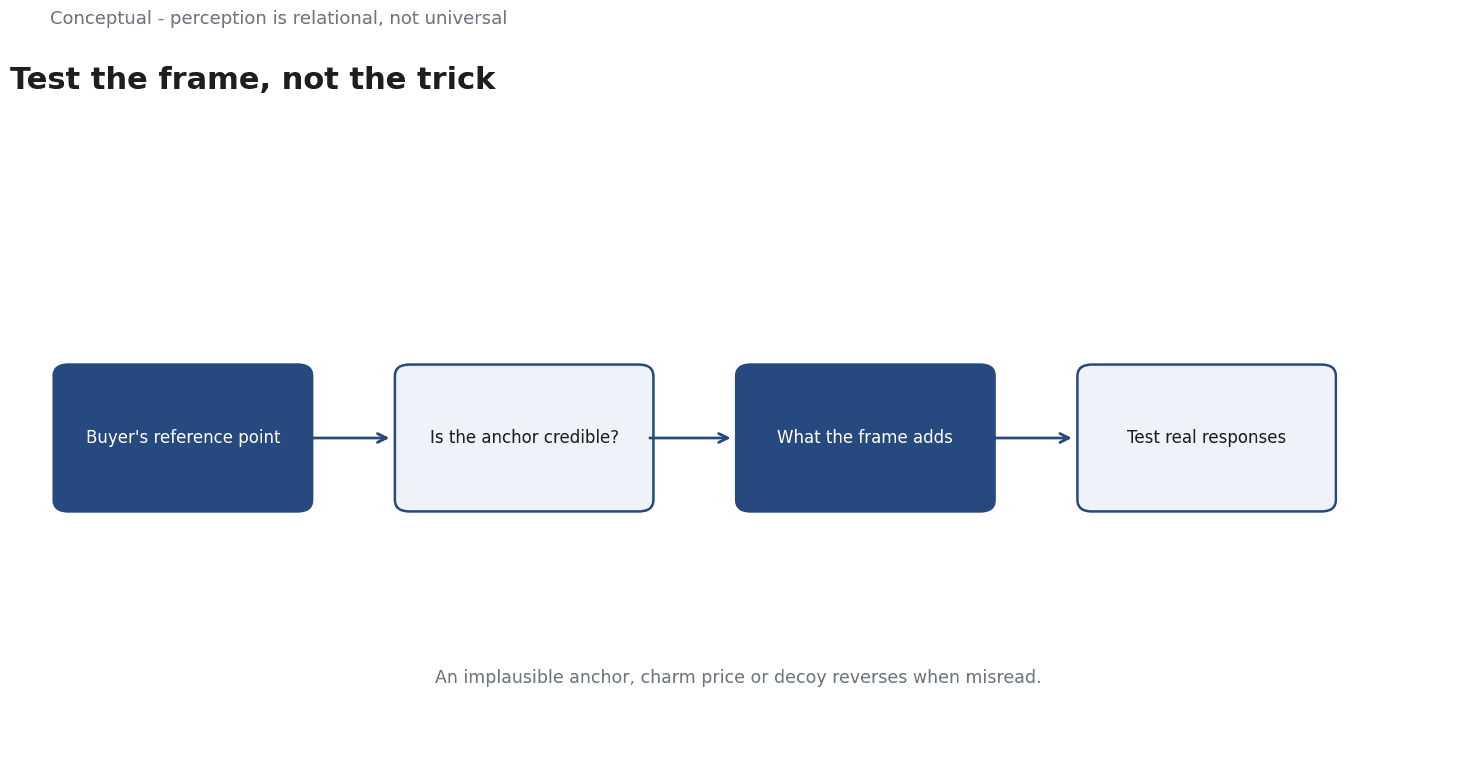
The consequence is to test the frame rather than to copy the tactic. Identify the reference the buyer is likely to use, check whether that reference is credible, and decide what information the framing adds. Then verify with real responses. A pricing decision that skips these steps treats a context-dependent effect as a universal rule, which is the definition of the mistake this article is about.
A worked example
The following is hypothetical and illustrative. A software team is considering a price increase and is weighing whether to present the new price with a comparison to the old one and a higher tier.
Three checks decide. First, what is the buyer's reference point, the current price, a competitor, or the value of the outcome? Second, is the higher tier a credible anchor, or will it look like a decoy with no real takers? Third, does the framing communicate the added value honestly, or does it rely on confusion about what is included?
The outcome is a tested change: the increase is tied to a stated improvement, the comparison uses a plausible alternative, and the higher tier is a genuine option rather than a prop. The scenario is hypothetical; the checking method is the contribution.
Evidence status
| Claim | Status | Source | Verified | Recheck when |
|---|---|---|---|---|
| Pricing sets what a seller receives and includes several approaches | source-reported | Wikipedia Pricing | 2026-11-18 | Pricing practice changes |
| Judgment under uncertainty depends on context and reference points | source-reported | Kahneman 2002 lecture | 2026-11-18 | Research consensus changes |
| Tactics should be tested against the buyer's reference | inferred | Derived from the sources | 2026-11-18 | Market or audience changes |
The first two rows report what the sources describe: the structure of pricing decisions and the context dependence of judgment. The inferred row connects them by proposing a test before a tactic is used. It is a recommendation drawn from the two descriptions, not a result either source reports.
What it cannot do
Pricing psychology cannot create value. It can change how a price is perceived, but a product that does not solve a problem will not become valuable because of a clever number. Teams sometimes reach for framing when the real issue is positioning or product quality, and the tactic then masks the problem rather than fixing it. The honest use is to communicate existing value more clearly, not to manufacture it.
It cannot replace research into willingness to pay. A frame can shift responses at the margin, but it cannot tell you what the market will bear. That requires evidence from customers, behavior, and competitors. Without it, a team is tuning presentation while the underlying price is wrong. The result is a well-framed number that still leaves money on the table or drives buyers away.
The effects are context-dependent and can reverse. A tactic that works in one market can fail in another because the reference point differs. An anchor that helps when buyers are unfamiliar can hurt when they know the market well. This is not a minor caveat; it is the central implication of reference dependence. Any claim that a tactic works universally should be treated as a hypothesis to test, not a rule to apply.
There is a hidden cost in trust. Framing that relies on confusion or a misleading comparison can produce a short-term gain and a long-term loss, because buyers notice when the frame does not match the product. Once trust is damaged, later price changes are interpreted through that history. The cost is slow to appear and expensive to repair, which is why it is easy to ignore in a test that only measures immediate conversion.
The failure mode is copycat pricing.
The competitor may have a different audience, brand, or cost structure, so the same number sends a different signal. The boundary is that these judgments are local, and the evidence for them comes from the specific market. A review should ask what changed in the audience or the alternatives whenever a pricing frame is reused.
The counterargument that simple heuristics are useful is fair for quick decisions and incomplete when a misplaced anchor misleads buyers about real value.
A decision test
- State the value the price is meant to capture.
- Identify the reference point the buyer is likely to use.
- Check that any anchor is credible in this market.
- Decide what information the framing honestly adds.
- Test the change against real buyer responses.
- Watch trust and repeat behavior, not just conversion.
- Recheck when competitors or audience change.
A pricing tactic is a hypothesis about perception, and a hypothesis needs a context. Before adopting one, write down the reference point it depends on and what would make it fail. Keep the test small and the measurement honest, so that a short-term lift is not mistaken for a durable result. For further reading, see Voice of Customer: Turning Feedback into Decisions.
References & Further Reading
- Wikipedia contributors, 2026. Pricing - Wikipedia — How prices are set and what they signal.
- Daniel Kahneman, 2002. Daniel Kahneman Prize Lecture - NobelPrize.org — The primary source for the bias taxonomy used in behavioural finance.