Pricing Psychology without the Hype
Pricing psychology is a set of bounded biases, not a pricing strategy. Read how framing maps to price decisions, a worked example, and where evidence stops.
Teams cite charm pricing and anchoring as if a suffix or a reference number decided demand on its own. The Wikipedia pricing entry describes how prices are set from costs, demand, and competition, while Kahneman's prize lecture documents framing and loss aversion in judgment. The real problem is that these psychological effects are bounded and context-dependent, yet they are routinely applied as universal rules.
Direct answer:
Pricing psychology studies how the presentation and framing of a price can influence perception, but it does not replace cost, demand, and competitive analysis.
Wikipedia's pricing entry covers the economic inputs, and Kahneman's lecture covers framing and loss aversion under uncertainty. Treat each effect as a hypothesis to test against a specific market, not as a rule that guarantees a higher willingness to pay.
Delta: This article adds a bounded mapping beyond the sources: it maps framing effects to specific pricing decisions, with claim status explicit.
The mechanism
The pricing entry describes a price as what a company receives in exchange for a product, set with reference to costs, demand, and competition. It catalogs approaches such as cost-plus, value-based, competitor-based, and dynamic pricing. The psychological layer sits on top of these approaches, not in place of them. The practical consequence is that a framing tweak cannot rescue a price that is far from the value delivered or from the alternatives a buyer can see. Economics sets the range within which presentation can matter; it does not make that range irrelevant.
Kahneman's prize lecture documents how judgment under uncertainty is shaped by heuristics and biases, and how the framing of the same situation changes the choices people make. Loss aversion is the observation that losses loom larger than equivalent gains. Applied to pricing, this means that an offer framed as avoiding a loss can be perceived differently from the same offer framed as gaining a saving, and that a reference price can anchor what counts as a good deal. The practical consequence is that presentation changes perceived value even when the underlying economics are unchanged.
Anchoring deserves separate attention because it concerns the order and context in which numbers appear. An initial price can shape subsequent willingness to pay, so the choice of which number to display as the reference is itself a decision. The practical consequence is that the same product can be judged differently depending on what is shown beside it. Neither source says which reference will work for a given product or segment, so any specific choice is local and must be marked as inferred rather than presented as a finding.
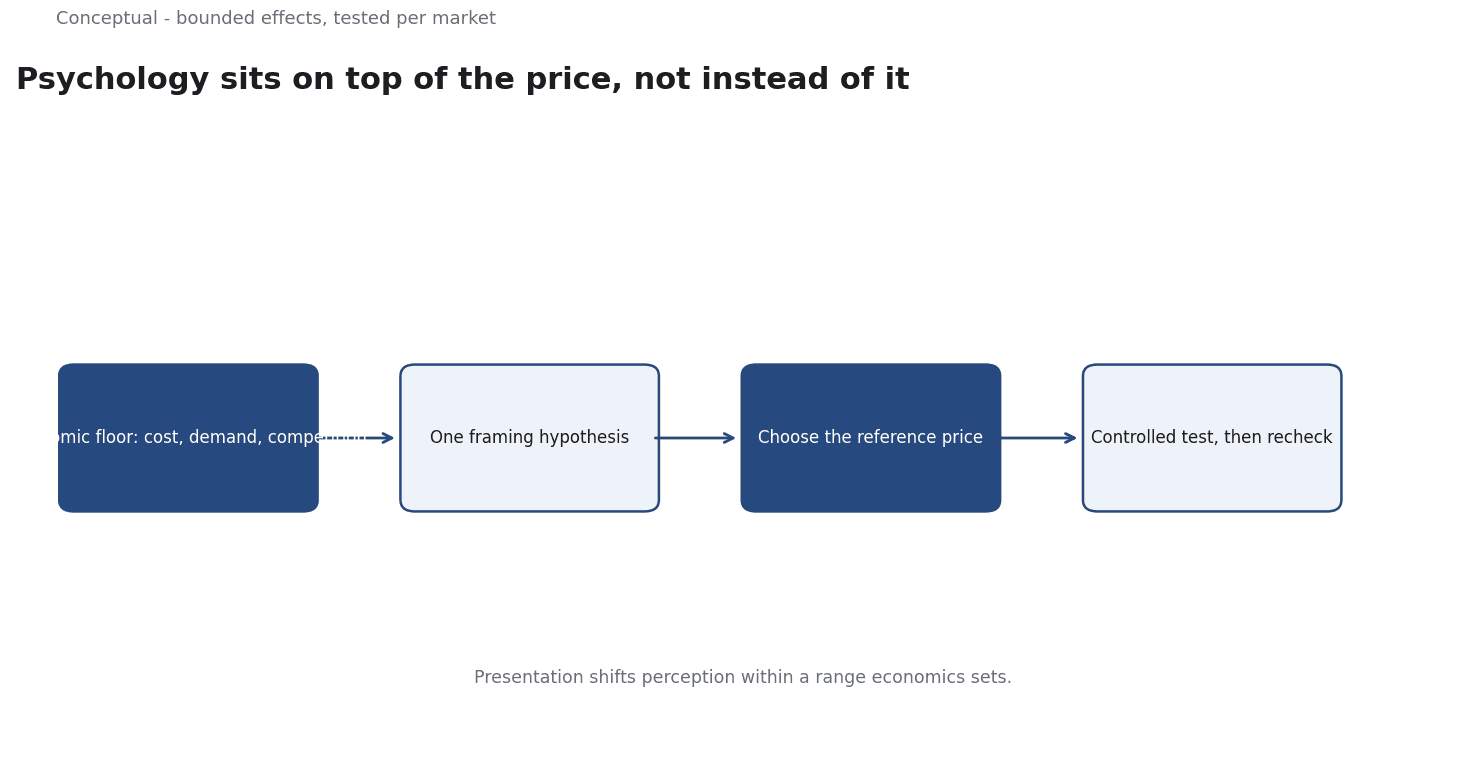
The output of the mechanism is a mapping from each pricing decision to an expected effect and a way to check it. Base level connects to cost and demand; the reference point connects to anchoring; the wording of a discount connects to framing; the layout of tiers connects to comparison. The decision instrument is not a rule that charm pricing always works, but a sequence: establish the economic floor, state one framing hypothesis, choose a reference, then test. Because markets and segments change, each hypothesis carries a recheck condition.
A worked example
The following is hypothetical and illustrative. A team is considering raising the price of a subscription and is weighing whether to change how the offer is presented. Three checks decide the approach. First, the economic floor: does the proposed price cover the cost to serve and sit within the range buyers already pay in this market? Second, the framing: is the offer shown as a saving against a reference, or as the avoidance of a loss, and does a credible reference price actually exist? Third, the test: can the team run a controlled comparison with a clear success threshold rather than assume an effect? The review shows the price is defensible on cost and demand but the reference is weak. The outcome is to keep the price anchored to delivered value and test the framing with a control before rolling it out. The numbers are hypothetical; the verification method is the contribution.
Evidence status
| Claim | Status | Source | Verified | Recheck when |
|---|---|---|---|---|
| Pricing is set with reference to costs, demand and competition | source-reported | Pricing - Wikipedia | 2026-11-18 | Pricing definitions or scope change |
| Framing and loss aversion influence judgment under uncertainty | source-reported | Kahneman prize lecture | 2026-11-18 | New evidence on effect sizes appears |
| Framing effects should be tested rather than assumed for a given product | inferred | Derived from the sources | 2026-11-18 | Product, segment or market changes |
The first two rows report claims made directly in the sources and are comparatively stable; the third is an inference about how a general bias should be applied locally. The implication is that the economic and judgment claims can be relied on as described, while the decision to test rather than assume is a practical rule that must be revisited when the product or the market changes. Each entry should carry its own recheck condition so a reader can see when the claim needs fresh evidence.
What it cannot do
Pricing psychology does not identify the right price. It describes how presentation can shift perception of a price that has already been chosen on economic grounds. It cannot tell you the value a customer assigns, the shape of demand at different price points, or how a competitor will respond. The sources cover the inputs to pricing and the structure of judgment under uncertainty; neither supplies a validated price for a specific product. Treating a framing effect as a substitute for demand research is a category error: it answers how a number is perceived, not whether the number is right. A team that needs a price still has to do the economic work.
The hidden cost is in testing. To know whether a framing effect works for a product, a team needs a controlled comparison, enough observations to distinguish a small effect from noise, and the discipline to keep everything else constant. That costs traffic, time, and analytical care. Chasing small presentation effects can distract from larger levers such as product quality, cost structure, or a misaligned value proposition. The cost is not the idea of framing, which is cheap to describe, but the evidence needed to apply it responsibly.
Loss aversion and anchoring are general tendencies, not guarantees about a specific market, culture, or category. A price suffix that reads as a bargain in one segment can read as a signal of low quality in a premium one. A reference price that is not credible can anchor nothing, or can anchor the buyer to a number that makes the offer look worse. The measure fails precisely when the context differs from the one in which the effect was observed, which is the usual case in practice.
There is a boundary around the method. It covers the economics of setting a price and the psychology of judging one; it does not cover long-run brand effects, competitor reactions, or the fairness perceptions that can follow a price change. The pricing entry describes methods and factors, and the lecture describes judgment biases; neither is a complete theory of consumer demand or a validated playbook for a particular industry. A team applying these ideas outside that boundary produces a plausible story that answers only part of the question.
Because contexts and markets change, these hypotheses need scheduled review. Each framing decision should be recorded with the reference used, the expected direction of the effect, and a recheck condition tied to the segment or the market. Without that record, a future reviewer cannot tell which presentation choices were tested and which were adopted on intuition. The price will still be on the page; the reasoning behind how it is shown is what makes the decision reviewable.
The counterargument that framing effects are too small to matter is fair for high-consideration purchases where specification dominates and incomplete for low-involvement choices where the presentation is most of what the buyer sees.
A decision test
- State the pricing decision and the objective it serves.
- Establish the economic floor from cost, demand, and competitors.
- Identify the reference price and decide how it will be shown.
- Choose one framing hypothesis to examine.
- Design a controlled test with a success threshold.
- Check that the effect is plausible for the specific segment.
- Record the result and recheck when the market changes.
A pricing-psychology practice is useful only when the economic floor and the framing hypothesis are both recorded. The test turns a presentation choice into a decision with a visible rationale, so a reviewer can see which number was the reference and when the claim must be rechecked. It fails when a suffix or a reference is treated as a guaranteed lift. For further reading, see Marketing Dashboards.
References & Further Reading
- Wikipedia contributors, 2026. Pricing - Wikipedia — How prices are set and what they signal.
- Daniel Kahneman, 2002. Daniel Kahneman Prize Lecture - NobelPrize.org — The primary source for the bias taxonomy used in behavioural finance.