Product Assortment in Practice
Assortment is where strategy meets finite shelf space and capital. Read how selection creates inventory, the common mistakes, and a decision test.
Assortment decisions are where a retailer's strategy meets a finite amount of shelf space and working capital. A buyer can add products indefinitely on a spreadsheet, but only a limited set earns a place in the store or catalogue. The real problem is that more variety is often treated as more value, when the practical constraint is that every added product consumes space, cash, and attention that another product could use.
Direct answer: Merchandising is the practice of selecting, presenting, and promoting products to customers, and assortment is its selection dimension, as the Wikipedia entry on merchandising frames it. Inventory is the stock that results from those choices, and it carries holding costs and obsolescence risk described in the Wikipedia entry on inventory. The boundary: an assortment is a finite set of bets, and adding a product is a decision to fund one bet at the expense of another.
Delta: This article adds a decision map beyond the sources: it maps assortment choices to the inventory consequences they create, with claim status explicit.
The mechanism
Wikipedia's "Merchandising" entry describes the discipline of getting the right products in front of customers, covering selection, presentation, and promotion. The assortment decision is the selection step: which products earn a place. The mechanism is a filter applied to a large set of possibilities under constraints of space and demand. The practical consequence is that assortment is a resource-allocation decision, not a catalogue of everything the buyer likes.
Every yes is also a no to something else, and the buyer who ignores that trade-off has not made a decision at all.
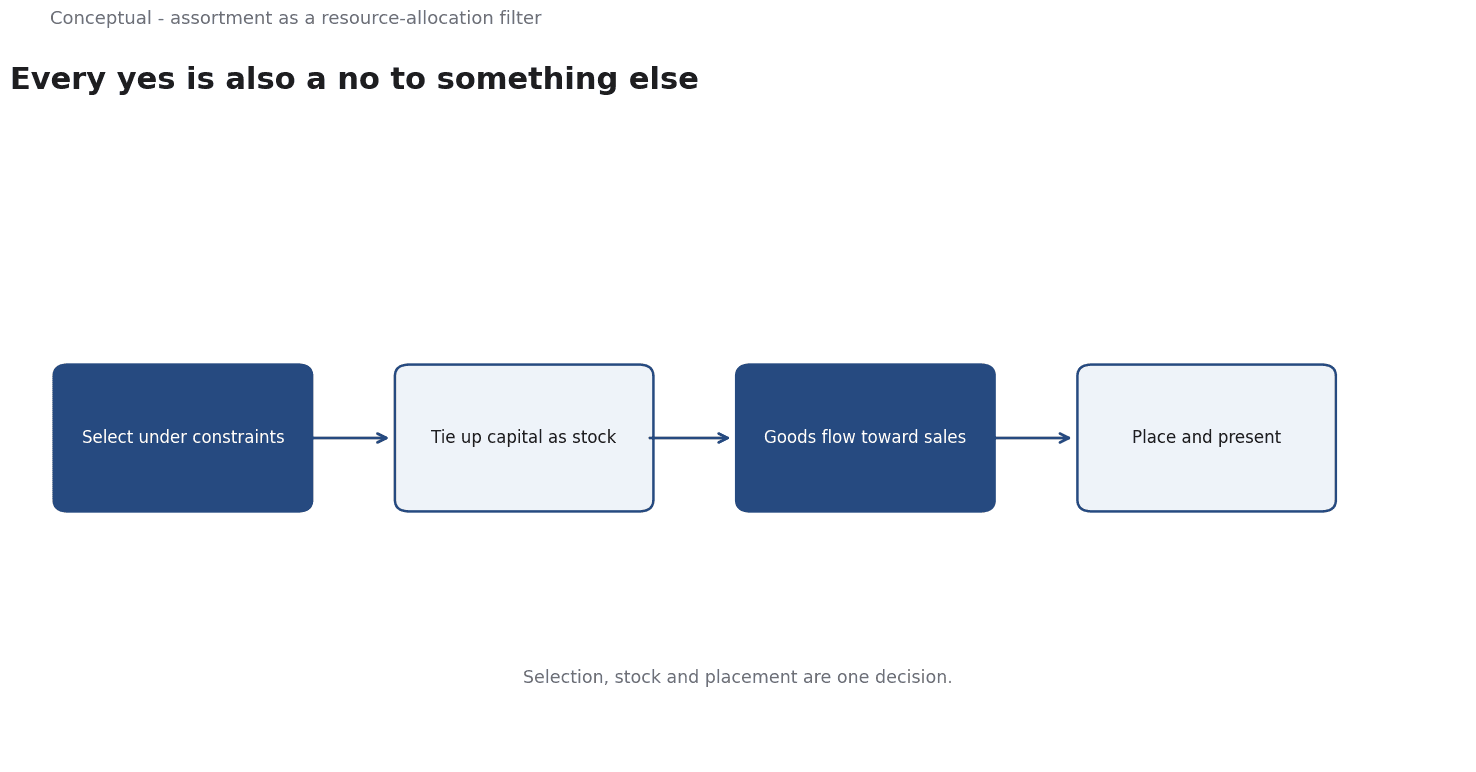
Wikipedia's "Inventory" entry defines inventory as the goods a business holds, including finished products ready for sale, and discusses the costs of holding stock and the risk of obsolescence. The mechanism here is that assortment choices create inventory: every product selected becomes stock that must be purchased, stored, and eventually sold or written down. The practical consequence is that the assortment decision and the inventory outcome are the same decision viewed from two sides. A buyer who ignores the inventory side is choosing costs they will have to explain later, when the capital is already tied up.
The same inventory entry notes that holding stock ties up capital and that slow-moving goods can become obsolete. The mechanism is the flow of goods over time: products enter as purchases, sit as stock, and leave as sales, and the speed of that flow determines how much capital is tied up. The practical consequence is that assortment breadth has a carrying cost that is invisible on a product list but visible in cash flow. A wider assortment is not free; it is a larger inventory position, and the difference shows up in the funding the business needs.
The merchandising entry also covers how products are displayed and promoted, because selection alone does not sell. The mechanism is that placement and presentation influence whether customers notice and choose a product. The practical consequence is that an assortment cannot be judged by the list alone; a product's position and the way it is presented are part of the same decision. A good product badly placed can underperform a mediocre one that customers actually see. Selection, stock, and placement are therefore one connected mechanism rather than three separate tasks.
A worked example
The following is hypothetical and illustrative. A regional retailer reviews a category of 200 products and considers adding 30 more. Three checks are run. First, the space each product occupies is measured against its sales, revealing that a tail of slow items consumes shelf space disproportionate to their contribution. Second, the inventory position of the proposed additions is estimated, including the capital tied up and the obsolescence risk if they do not sell. Third, the presentation of the existing products is reviewed, and several are found to be placed where customers rarely look. The outcome is to drop some slow items, add a smaller set of products with clear demand, and reposition the strongest sellers. The limiting condition is that these are estimates in an illustrative scenario, not measured results from an actual store.
Evidence status
| Claim | Status | Source | Verified | Recheck when |
|---|---|---|---|---|
| Merchandising covers selecting, presenting, and promoting products | source-reported | Wikipedia: Merchandising | 2026-11-18 | when the entry's scope is revised |
| Inventory carries holding costs and obsolescence risk | source-reported | Wikipedia: Inventory | 2026-11-18 | when the cost discussion changes |
| Adding a product consumes space and capital that another product could use | inferred | Derived from the sources | 2026-11-18 | when actual turnover data is available |
The first two rows summarize claims the entries make directly and can be checked against the cited pages. The third row is an inference from the scarcity of space and capital; it follows from the sources but is not phrased as a rule by them. Each recheck condition is tied either to a source revision or to data a retailer would need to collect, so the reader can see what would change the claim.
What it cannot do
Assortment discipline cannot create demand that does not exist. A perfectly rational selection of products will still fail if customers do not want the category. The merchandising entry is about presenting and selecting what can be sold; it does not claim that a better list manufactures customers. The limit matters because teams sometimes treat assortment as a substitute for understanding their market, when it is only a way of allocating a finite resource within that market. A better list can only arrange the demand that is already there.
There is a hidden cost in frequent assortment changes. Each revision triggers purchasing, repricing, relabeling, and retraining of staff, and it can confuse customers who relied on familiar products. The inventory entry's discussion of carrying costs captures part of this, but the operational churn is an additional expense that a spreadsheet comparison of products will not show. The cost is real even when the new assortment is better. A team that changes the range every season may be paying continually for the right products without ever keeping them long enough to benefit.
Buyers add products because variety looks like progress, and the assortment grows until space and capital are stretched thin. The outcome is a catalogue that is hard to navigate and an inventory position that is hard to fund. The practical symptom is strong products buried among weak ones, with the whole category appearing cluttered to customers. Once the range is cluttered, customers spend more effort searching and may leave without buying, which compounds the original mistake.
The boundary is that the two sources describe concepts, not a decision rule. Wikipedia defines merchandising and inventory and notes their costs; it does not prescribe the optimal number of products or guarantee that any selection will sell. Treating the definitions as a formula invites overconfidence. The useful move is to take the cost ideas seriously and apply them to local constraints that the sources cannot know. What works for one retailer's space and capital may fail for another's, and the sources do not resolve that difference.
Review is required because demand and costs shift. A product that earned its place last season may now tie up capital, and a new item may deserve space. Both entries describe activities that operate over time, so a one-off assortment decision will decay. A team that revisits the assortment against current sales and inventory levels keeps the selection aligned with reality; a team that sets it once will slowly accumulate dead stock. The review should ask not only whether a product sold but whether the space and capital it consumed would have been better used elsewhere.
The counterargument that a broader assortment is fair for attracting more customer segments is incomplete for funding those segments: breadth adds inventory cost and clutter, so the benefit must be weighed against the capital and attention it consumes.
A decision test
- List the products that earn their place by clear demand and contribution.
- Measure the space each product uses against what it returns.
- Estimate the inventory and capital tied up in any proposed addition.
- Check the obsolescence risk of slow-moving items before reordering.
- Review product placement and presentation before adding new items.
- Remove or reduce items whose space and capital are better used elsewhere.
- Revisit the assortment when sales or inventory levels change.
The steps turn assortment from an act of adding products into a set of checks that connect each product to a space and capital decision. That connection is the mapping this article adds. The goal is not the smallest range but the range whose every entry can justify the resources it occupies.
For further reading, see Data Quality in Practice.
References & Further Reading
- Wikipedia contributors, 2026. Merchandising - Wikipedia — Presentation and promotion of products in retail.
- Wikipedia contributors, 2026. Inventory - Wikipedia — The role of stock in operations and accounting.