Product-led Growth Explained
Product-led growth puts the product in the acquisition path. Read the loop, a worked example, and why self-serve is not the same as no work.
Product-led growth is often described as the product selling itself, which makes it sound like removing sales rather than changing the path to value. The actual mechanism is a loop: the product exposes value early, users reach an aha moment without a sales call, and satisfied users bring others, which the product-led-growth source frames as a growth model, as the funnel entry describes the stages a user passes through, as Freemium Conversion: Where the Free Boundary Should Sit treats the free boundary as a decision.
Direct answer: Product-led growth means the product is the primary path to acquisition, activation, and expansion, with the loop measured at each stage. Product-Led Growth is the primary source, and the purchase-funnel entry covers the stages. The boundary: self-serve does not remove the work of onboarding, support, or measurement, which the activation-email article treats as a cost, as the dashboard article argues for metrics tied to decisions, as the publication standard forbids guaranteed growth.
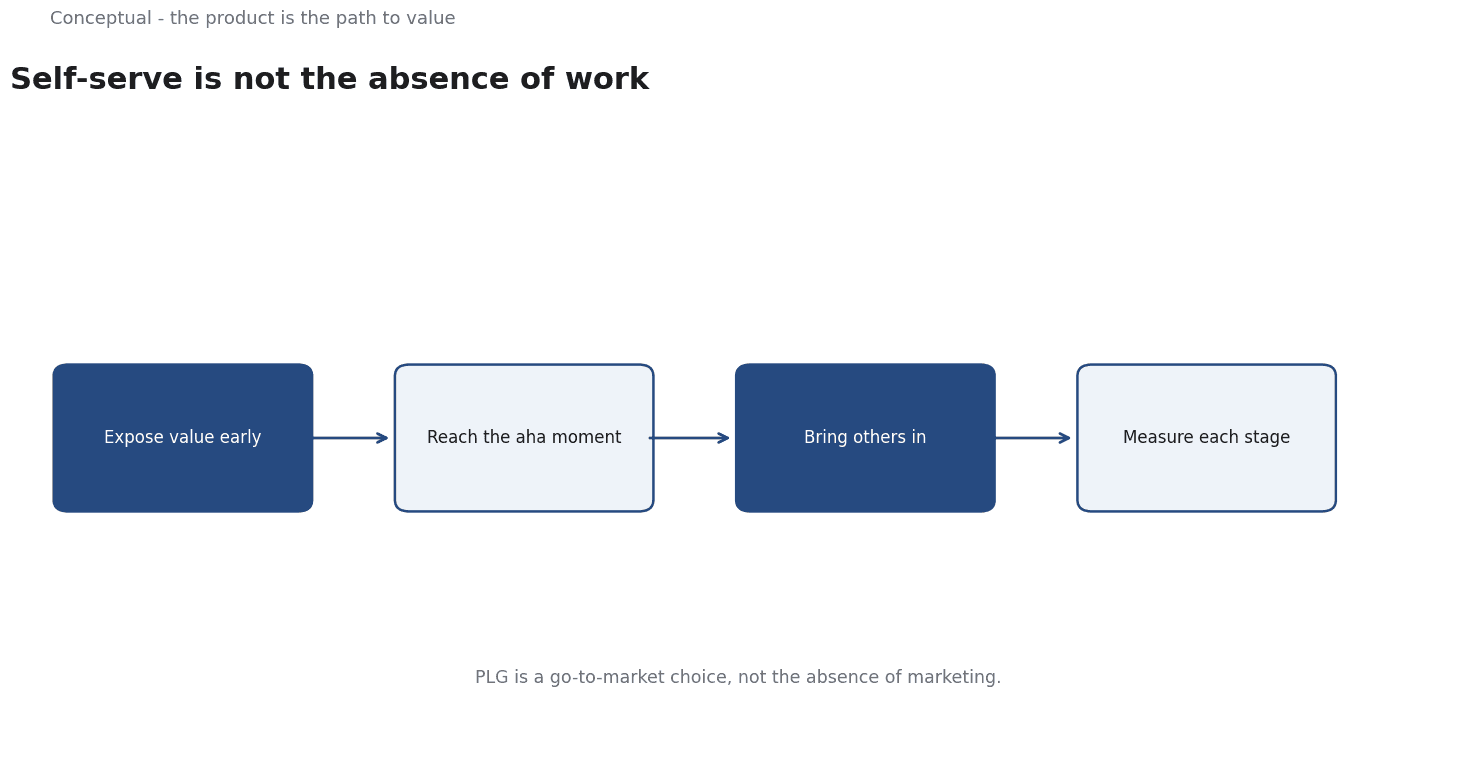
The loop
Acquisition through the product. A user arrives through a shared artefact, a free tier, or a template, which the viral-marketing entry describes for word-of-mouth growth, as the referral article treats incentives as a design, as Freemium Conversion: Where the Free Boundary Should Sit argues for a defined free boundary.
Activation without a sales call. The user reaches value on their own, which the activation-email article treats as a sequence that must be built, as the onboarding article advises for a path to value, as the evaluation-rubric article requires for a concrete aha moment.
Retention and expansion. The product must remain useful, which the retention article treats as an economic choice, as the PLG loops article describes expansion, as the retention-analytics article advises for grouping users by start period.
Measurement at each stage. The loop is only as good as its measured transitions, which the funnel entry describes, as the dashboard article advises for metrics tied to decisions, as the evaluation-rubric article requires for concrete criteria.
Three consequences follow.
PLG is a go-to-market choice, not the absence of marketing, which the go-to-market article treats as a process, as the product-marketing article advises for positioning.
It needs a free boundary that leaves value, which the freemium article argues, as the unit-economics article requires for contribution. And it should be reviewed at each stage, as the monitoring article treats as a trigger.
A worked example
The following is hypothetical and illustrative. A tool offers a free tier and hopes users will upgrade.
Three checks decide whether the loop works. First, can a new user reach value without help, as the activation-email and onboarding articles advise, with a defined aha moment, as the rubric article requires? Second, does the free boundary leave enough value to use and enough reason to upgrade, as Freemium Conversion: Where the Free Boundary Should Sit argues, with unit economics that still work, as the unit-economics article requires? Third, do retained users bring others, as the viral-marketing entry describes, with measured transitions, as the funnel entry advises?
Three conclusions follow. A free tier without activation is a cost centre, as the activation-email article warns.
And the result should be recorded with the stage measures, as the decision-memo article requires.
What product-led growth cannot do
It cannot fix a product that does not deliver value, which the value-proposition article treats as prior, as the product-marketing article advises for positioning. It does not remove sales for complex deals, which the founder-led-sales article treats as an early GTM path, as the go-to-market article advises for fit. And it cannot guarantee growth, which the publication standard forbids claiming, as the benchmarks article warns about broad results.
The counterargument that PLG eliminates the need for marketing is fair about the acquisition path and wrong about the work required, which the activation-email and dashboard articles advise, as the worked example shows.
A decision test
- Define the aha moment, as the rubric article requires.
- Check that users reach it without help, as the onboarding article advises.
- Set a free boundary with a reason to upgrade, as Freemium Conversion: Where the Free Boundary Should Sit argues.
- Measure each stage of the loop, as the funnel entry advises.
- Check retention and referral, as the retention and viral articles advise.
- Keep unit economics intact, as the unit-economics article requires.
- Record the decision and review at each stage, as the decision-memo article requires.
For the loops, see Product-Led Growth Loops; for the free boundary, see Freemium Conversion.
References & Further Reading
- Wes Bush, 2026. Product-Led Growth — The activation and engagement loop definition that PLG teams actually use.
- Wikipedia contributors, 2026. Purchase funnel - Wikipedia — The stages a customer moves through toward purchase.