Procurement Marketing Costs Explained
Selling to a procurement team adds time and documentation. Read where the cost sits, a worked example, and when to engage early.
Marketing to a large organisation does not end when the user says yes. A procurement process adds security review, vendor onboarding, legal negotiation, and a purchasing step, each consuming time on both sides. The cost of that process is a real part of customer acquisition and is often missing from a pipeline model.
Direct answer: Procurement costs are the time and resources required to satisfy a buyer's formal purchasing process — documentation, compliance, negotiation, and waiting. The procurement overview provides the context, and demand-generation principles explain which decision stage this belongs to. The boundary: procurement is a process, not a person to persuade with messaging, and a marketing campaign cannot replace the documentation a buyer requires, as the term-sheet article treats formal terms as the substance of a deal.
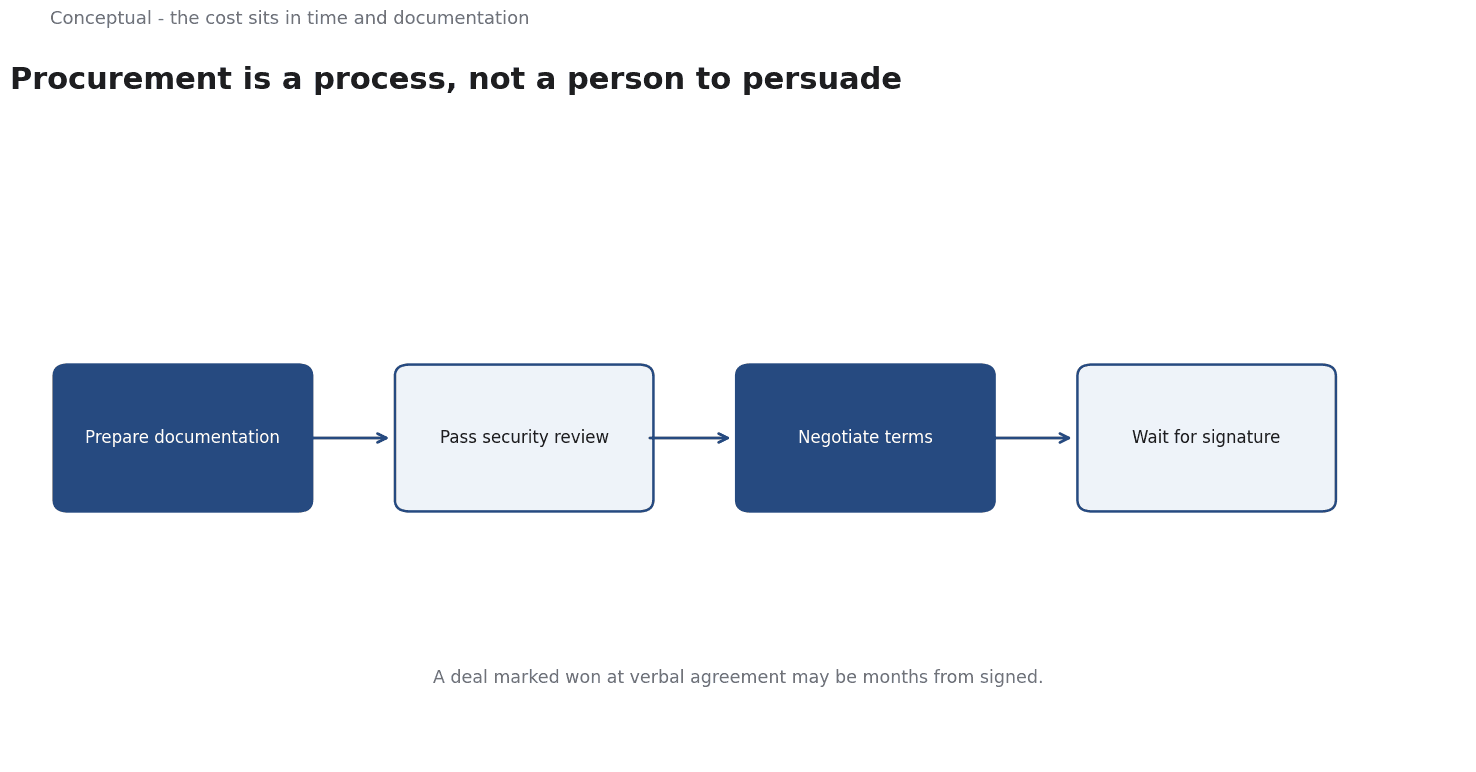
Where the cost sits
Documentation. Security questionnaires, data-processing terms, insurance certificates, and vendor forms. The work is largely repetitive, which the reporting-automation article treats as a candidate for a prepared, reviewed set of answers, with a human owner for accuracy.
Waiting. Procurement timelines are often outside the seller's control, which the cash-flow article treats as a timing gap between a decision and cash.
Negotiation. Terms on liability, data, and service levels change the economics, as the term-sheet article argues for reading terms rather than price. Legal time is a cost, which the cost estimator treats as a real expense on any channel.
Three consequences follow.
The acquisition cost of an enterprise customer is higher than a self-serve one, which the unit-economics article requires pricing into margin.
Sales cycles are longer, which the burn-rate article treats as a runway question. And the process itself is a signal about the buyer's seriousness, which the funnel article treats as a stage transition rather than noise.
A worked example
The following is hypothetical and illustrative. A deal has a 50,000 first-year value and a 40% gross margin, so 20,000 contribution. A self-serve deal of 5,000 has 2,000 contribution.
The enterprise deal consumes 30 hours of sales and legal time plus 10 hours of security work; at an internal cost of 100 per hour, that is 4,000. The self-serve deal consumes one hour, or 100. Net contribution is 16,000 versus 1,900, so the enterprise deal is better despite the higher cost — provided it closes. Three checks decide whether the comparison holds. First, what is the probability of closing after procurement starts, which the funnel article treats as a stage measure? Second, how long is the wait, which the cash-flow article treats as a timing cost? Third, does the customer retain and expand, as the customer-success article measures for enterprise accounts?
Three conclusions follow. The higher cost is justified by the margin when the deal closes, which the unit-economics article confirms. A low close rate changes the answer, as the attribution article treats credited outcomes carefully. And the documentation should be prepared once and reused, as the content-operations article recommends for repeated work.
What procurement marketing cannot do
It cannot bypass a buyer's obligations, which the procurement article treats as a formal process. It cannot replace product value, which the value-proposition article argues is the buyer's prior question. And it does not remove the need for a good relationship with the actual users, as Founder-Led Sales: Early-Stage GTM, Founder-Led Selling, and Hiring the First Sales Team describes for early-stage GTM.
The counterargument that procurement is a bureaucracy to avoid is fair for some targets and misses the point that a formal buyer has a budget, which the marketing-budget article treats as the basis of qualified demand.
A decision test
- Identify which deals trigger a formal procurement process, as the segmentation article advises.
- Prepare a reviewed documentation set with an owner, as the content-operations article recommends.
- Include sales and legal time in acquisition cost, as the cost estimator requires.
- Track stage conversion and timeline, as the funnel and cash-flow articles advise.
- Compare net contribution, not revenue, as Understanding Unit Economics: CAC, LTV, Churn, and Contribution Margin requires.
- Engage procurement early when the deal value justifies it, as the founder-led-sales article suggests for complex deals.
- Record the economics, as the decision-memo article requires.
For the enterprise motion, see Founder-Led Sales; for the cost frame, see Understanding Unit Economics.
References & Further Reading
- Wikipedia contributors, 2026. Procurement - Wikipedia — The process of acquiring goods and services, including sourcing and evaluation.
- Wikipedia contributors, 2026. Demand generation - Wikipedia — An overview of demand generation as a marketing discipline distinct from lead generation; secondary reference used with the lead-generation entry.