Project Management: a Decision Framework
Project management is a set of trade-offs, not a checklist. Read how scope and constraints map to decisions, a worked example, and the limits of a framework.
Teams often confuse project management with status reporting, then wonder why projects still miss their goals. The Wikipedia project management entry describes the application of processes and knowledge to meet objectives under constraints, and the decision-making entry describes how alternatives are chosen against criteria. The real problem is that managing a project is a sequence of decisions under constraint, not an exercise in documentation.
Direct answer: Project management is the application of processes, methods, skills, and experience to deliver a temporary outcome within agreed constraints of scope, time, quality, and budget. Wikipedia's project management entry defines that scope; the decision-making entry describes choosing among alternatives. Treat each project choice as a decision with explicit criteria rather than as a default that inherits the last plan.
Delta: This article adds a constraint-to-decision mapping beyond the sources: it maps project constraints to a decision sequence, with claim status explicit.
The mechanism
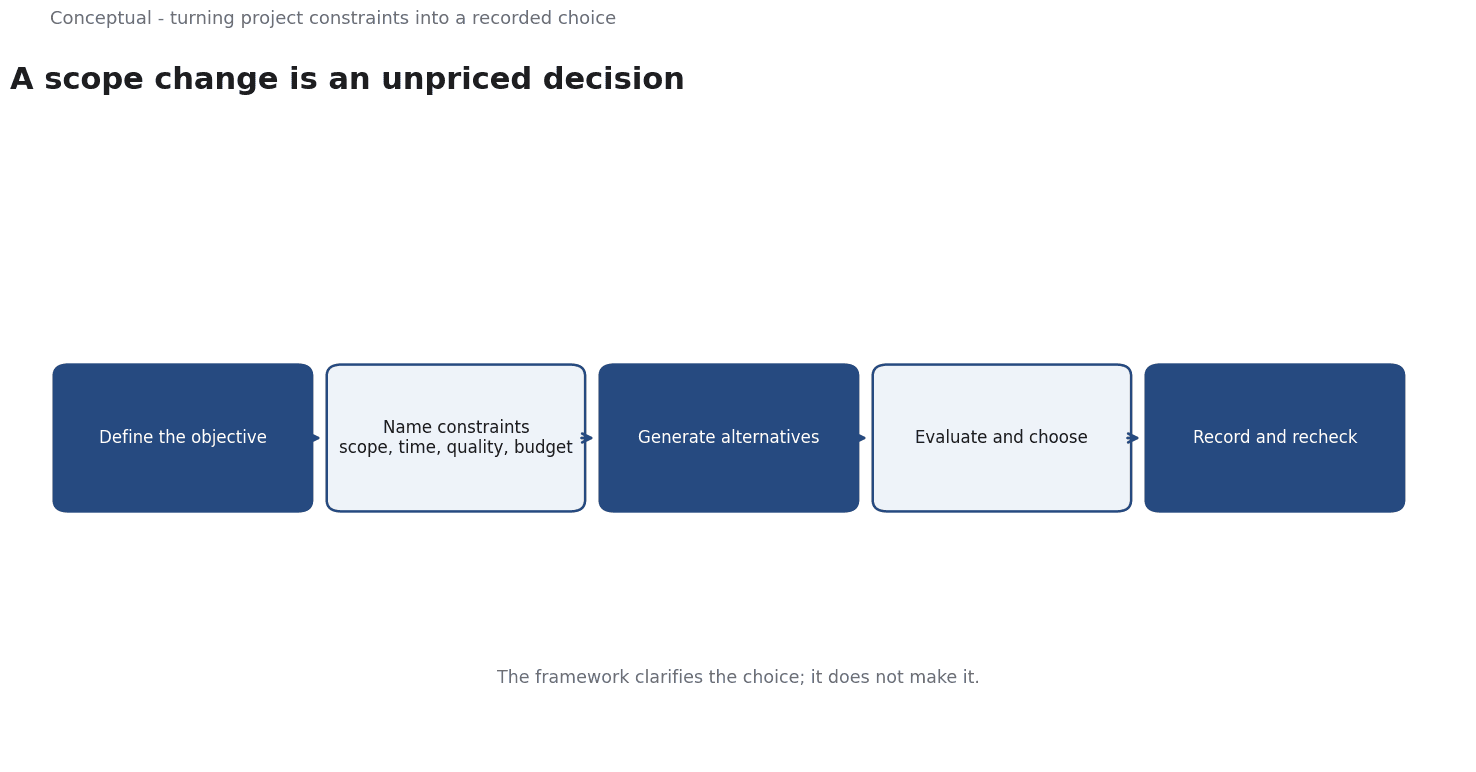
The project management entry describes the application of processes, methods, skills, knowledge, and experience to achieve project objectives within agreed parameters. Projects are temporary, with a defined beginning and end, and are commonly described through phases such as initiation, planning, execution, monitoring, and closure. The constraints of scope, time, quality, and budget interact: a change to one normally affects the others. The practical consequence is that a request to add scope without adjusting time or budget is not a free gain; it is an unpriced decision. Naming the affected constraint is the first step in handling it.
The decision-making entry describes the process of identifying and choosing alternatives based on the values and preferences of the decision-maker. It covers rational models as well as bounded rationality and satisficing, and it distinguishes conditions of certainty, risk, and uncertainty. The practical consequence is that project decisions rarely have complete information, so the honest approach is to state the criteria and the available alternatives, then choose the option that satisfies them. Pretending to optimize perfectly under uncertainty hides the judgment that actually took place.
The two sources connect at a point neither states directly. Project management supplies the constraints and the phases; decision-making supplies a method for choosing within them. A scope change becomes a decision when the criteria and alternatives are stated: accept it and extend time, accept it and add budget, or decline it. Neither source supplies the criteria for a specific project, so those criteria are local and marked inferred.
The mechanism produces a structure for judgment, not an answer key.
The output is a mapping from each project decision to its constraint, criteria, alternatives, and chosen option. That mapping is the decision instrument. The sequence is to define the objective, list the binding constraints, generate alternatives, evaluate them against criteria, choose, record, and monitor the result. Because project assumptions change, each decision carries a recheck condition rather than a permanent answer. A project tracked in this order can be reviewed later, because the constraint and the choice are recorded together.
A worked example
The following is hypothetical and illustrative. A team receives a request to add a feature partway through a project and must decide whether to accept it. Three checks decide the response. First, the constraint: which of scope, time, quality, and budget is actually flexible, and which is fixed by an external commitment? Second, the alternatives: can the feature be deferred to a later release, can the date move, or can additional budget buy the capacity? Third, the criteria: which option best serves the original objective, and how does uncertainty about the estimate change the answer? The review shows the date is fixed and the estimate is uncertain. The outcome is to defer the feature, record the decision and its reasoning, and set a trigger to revisit it if the estimate firms up. The numbers are hypothetical; the verification method is the contribution.
Evidence status
| Claim | Status | Source | Verified | Recheck when |
|---|---|---|---|---|
| Project management applies processes to meet objectives within constraints | source-reported | Project management - Wikipedia | 2026-11-18 | Project management standards are revised |
| Decision-making chooses alternatives against criteria under uncertainty | source-reported | Decision-making - Wikipedia | 2026-11-18 | Decision models are updated |
| Project constraints should become explicit criteria and alternatives | inferred | Derived from the sources | 2026-11-18 | Project objectives or constraints change |
The first two rows report claims made directly in the reference entries and are comparatively stable; the third is an inference about combining the two ideas in practice. The implication is that the definitions can be relied on as stated, while the decision rule should be revisited when the project's objectives or constraints change. Each entry should carry a recheck condition so a reader can see when a decision needs to be reopened rather than defended by habit.
What it cannot do
A decision framework does not make the decision for you. It organizes the judgment, but it cannot resolve a genuine conflict between stakeholders who value different outcomes. If one party prioritizes scope and another prioritizes cost, no framework supplies the preference that breaks the tie; it only makes the conflict visible. The sources describe project processes and decision methods; they do not arbitrate between competing values. Treating the framework as an automatic answer is a category error: it clarifies the choice rather than making it. A team still has to decide whose objective governs.
The hidden cost is that making every choice explicit is slower than making it implicitly. Writing criteria, listing alternatives, and recording a rationale take time that a fast-moving team may not have. That cost is only justified for consequential or hard-to-reverse decisions. For small, reversible choices, the overhead can exceed the value of the analysis, and a team that applies the full process to everything will bog itself down. The discipline is knowing when the framework is worth its cost, not applying it uniformly.
A team that assumes the date cannot move may never ask whether a later launch is acceptable, and a team that focuses only on budget may ship something that fails its objective. Another failure is hiding the assumption that scope can grow without a trade-off. The framework fails when the constraints are stated as facts rather than tested, because an unexamined constraint quietly removes options from the table.
There is a boundary around the method. The sources describe general concepts of project delivery and decision-making, not a validated method for a specific domain, and they do not cover team dynamics, organizational politics, or the execution skill needed to carry a plan out. A well-framed decision can still be implemented poorly. The approach can structure a choice and record its rationale, but it cannot supply technical expertise, negotiate stakeholders, or guarantee that the chosen option succeeds. Applying it outside that boundary produces a tidy decision log and no better outcome.
Because project assumptions change, decisions need scheduled review. Each choice should be recorded with the constraints it relied on and a recheck condition tied to those constraints. Without that record, a future reviewer cannot tell whether a decision still fits the project or whether it was inherited from an obsolete plan. The project will still be delivered; the link between constraint, alternative, and choice is what makes the decision reviewable. That link is the value of a decision framework.
The counterargument that formal decision framing is overhead is fair for small reversible choices and incomplete where a decision is costly to reverse, because an explicit record is what makes a later review possible.
A decision test
- State the project objective and why it matters.
- List the binding constraints of scope, time, quality, and budget.
- Identify the decision to be made and the available alternatives.
- Define the criteria that will choose between the alternatives.
- Note the uncertainties and what would change the choice.
- Pick the option that satisfies the criteria and record why.
- Set a recheck trigger for when assumptions shift.
A project decision framework is useful only when constraints and criteria are both recorded. The test turns a project choice into a sequence with a visible rationale, so a reviewer can see which constraint bound the decision and when it must be revisited. It fails when scope is added with no acknowledged trade-off. For further reading, see Decision Memos.
References & Further Reading
- Wikipedia contributors, 2026. Project management - Wikipedia — Planning, organising and managing projects.
- Wikipedia contributors, 2026. Decision-making - Wikipedia — Overview of decision processes, trade-offs and the distinction between the decision and its outcome; secondary reference.