Promotion Decisions for Beginners
A promotion is a decision about timing, margin, and signal. Read how to decide, a worked example, and why a sales spike can be borrowed demand.
Promotions are often decided by calendar or habit, which makes them hard to evaluate. The Wikipedia entry on sales promotion describes short-term incentives, and the discount entry explains price reductions. The decision is whether the promotion changes behaviour that would not have happened otherwise.
Direct answer: Decide a promotion by stating the behaviour it should change, measuring it against a baseline, and checking the margin after all costs. The sources define the instrument; the decision rule is a synthesis.
Delta: This article adds an explicit claim-status table and a worked decision example, separating what the sources state about incentives from the locally chosen evaluation rule.
The mechanism
Three points from the sources matter:
- An incentive is short-term. The sales-promotion entry describes incentives used for a limited period. That makes timing part of the design.
- A discount changes the reference price. The discount entry explains reductions. Repeated reductions can teach buyers to wait.
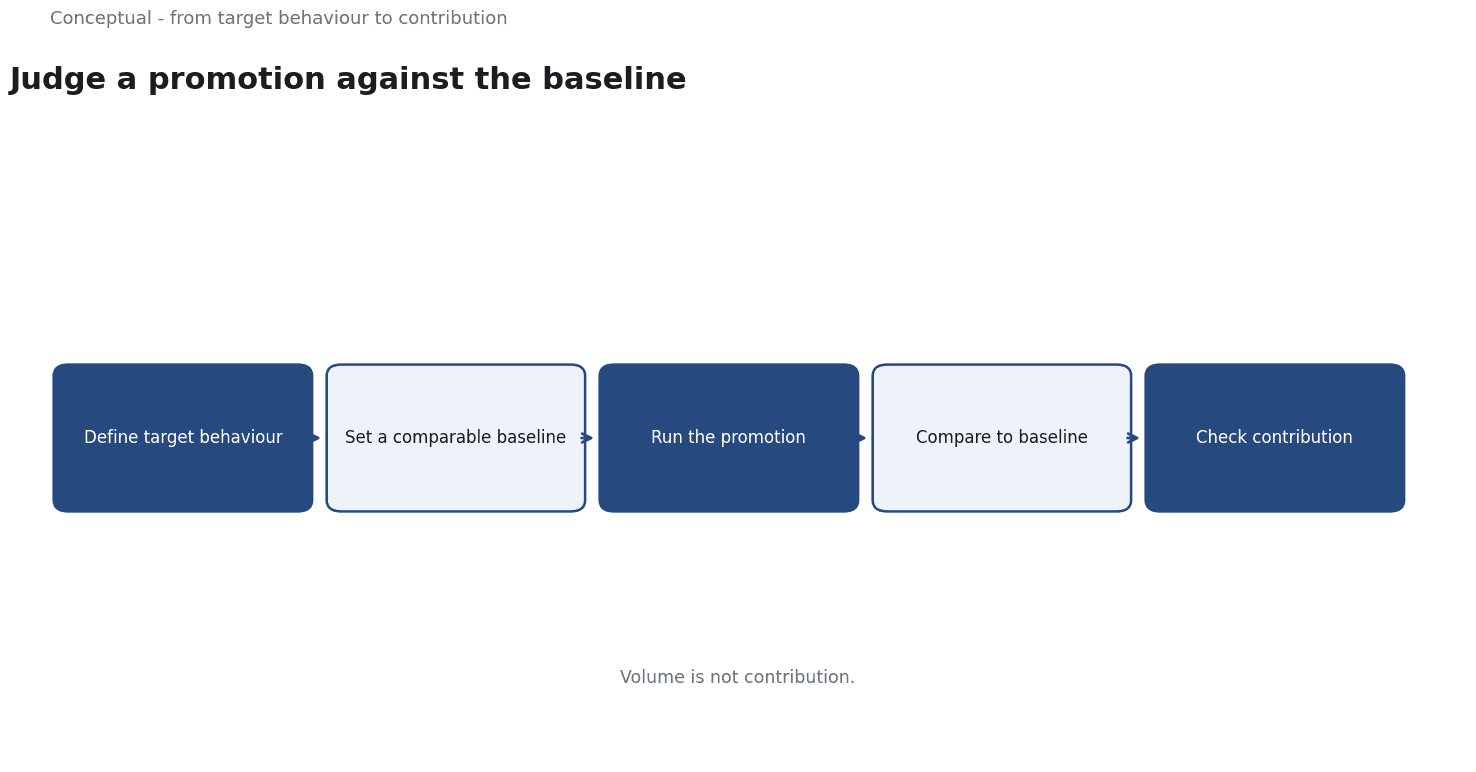
- Volume is not contribution. A higher volume at a lower price may produce less cash, which is an accounting question rather than a promotional one.
The decision sequence is therefore: define the target behaviour, set a baseline, run the promotion, compare, and check margin. Choosing the target behaviour is judgement, so that step is inferred; the existence of incentives and discounts is source-reported.
A worked decision
Illustrative. A retailer considers a weekend discount to lift a slow category.
Three checks decide. First, what behaviour is the target — additional transactions, or transactions merely moved forward from the following week? Second, what is the comparable baseline, with the same weekday pattern and no promotion? Third, after the discount and any operational cost, is contribution higher than the baseline?
The outcome is a decision to run or skip, with a recorded expectation of what would count as success. The numbers are hypothetical; the sequence is the contribution.
Why the baseline decides the result
A promotion is judged against what would have happened without it.
Without a baseline, the observed sales are a mixture of demand that existed anyway and demand the promotion created. The two cannot be separated after the fact from a single total, which is why the baseline belongs in the decision before the campaign starts.
Choosing the baseline is a practical problem. The comparison period should match weekday patterns, season, and channel mix.
A promotion during a holiday compared with an ordinary week has the same flaw. Matching the conditions costs attention, not tooling.
The measurement window is the second trap. A promotion can move purchases forward from the following week. If reporting stops at the end of the promotion, the borrowed sales count as incremental. Extending the window by one or two normal cycles makes the shift visible, and the result often changes.
The margin check is third. A higher volume at a lower price can produce less cash, especially once operational effort is counted. Contribution, not revenue, is the number that answers whether the promotion was worth running. This is an accounting question, but it is also a promotional one, because it decides whether the same campaign should be repeated.
None of this requires a complex model. It requires that the decision, the baseline, the window, and the margin rule be written before the promotion begins. Once the campaign is running, those choices are much harder to make honestly.
Evidence status
| Claim | Status | Source | Verified | Recheck when |
|---|---|---|---|---|
| Sales promotions are short-term incentives | source-reported | Wikipedia, Sales promotion | 2026-11-18 | Definition revised |
| Discounts are price reductions with strategic uses | source-reported | Wikipedia, Discount | 2026-11-18 | Definition revised |
| Evaluate incremental behaviour and contribution | inferred | Derived from the two definitions | 2026-11-18 | Measurement method changes |
Why timing matters more than it looks
A promotion that shifts sales forward looks successful in the short window and disappointing immediately after. Because the report usually stops at the end of the promotion, the borrowed demand is invisible. Extending the measurement window by one or two normal cycles is the simplest correction, and it costs nothing in tooling.
The second trap is the habit effect. When buyers learn that a discount recurs, they adjust their purchasing time. The promotion then becomes a permanent cost rather than an occasional intervention. A test that measures only the immediate lift cannot detect this; a comparison across several cycles can.
What it cannot do
It cannot create demand for a product nobody wants. It does not guarantee incremental volume, because timing and habit can explain the result. And it cannot remove the need to understand the buyer, which is a separate question.
The counterargument that a promotion always helps is fair for clearing stock and incomplete for a durable demand increase.
A decision test
- State the target behaviour.
- Define a comparable baseline.
- Set the measurement window beyond the promotion.
- Compute contribution after all costs.
- Check for a habit effect.
- Record the decision and what would change it.
For the costs, see Promotions Costs.
References & Further Reading
- Wikipedia contributors, 2026. Sales promotion - Wikipedia — The mechanisms and costs of short-term promotional incentives.
- Wikipedia contributors, 2026. Discount - Wikipedia — The mechanics of price reductions and their strategic use.