Promotions Costs Explained
A promotion is a paid change in behaviour, not free demand. Read the real costs, a worked example, and why a discount can train customers to wait.
A promotion looks like a simple cut in price, which hides the other costs: margin given away on sales that would have happened anyway, operational effort, and the habit of waiting for the next offer. The sales-promotion entry describes short-term incentives, as the demand-generation entry covers the stages a buyer moves through, as Discount and Coupon Strategy: Margin, Habit, and Signal warns about signals, as the unit-economics article requires for contribution, as the cash-flow article requires for the cash received.
Direct answer: Count a promotion's full cost — margin, cannibalisation, operations, and habit — and judge it by incremental contribution, not by the size of the discount. The sales-promotion entry provides the mechanism, and demand generation covers the buyer stages. The boundary: this is educational orientation, not a guarantee — customer response depends on context, as the evaluation-rubric article requires for concrete criteria, as the publication standard forbids guaranteed outcomes.
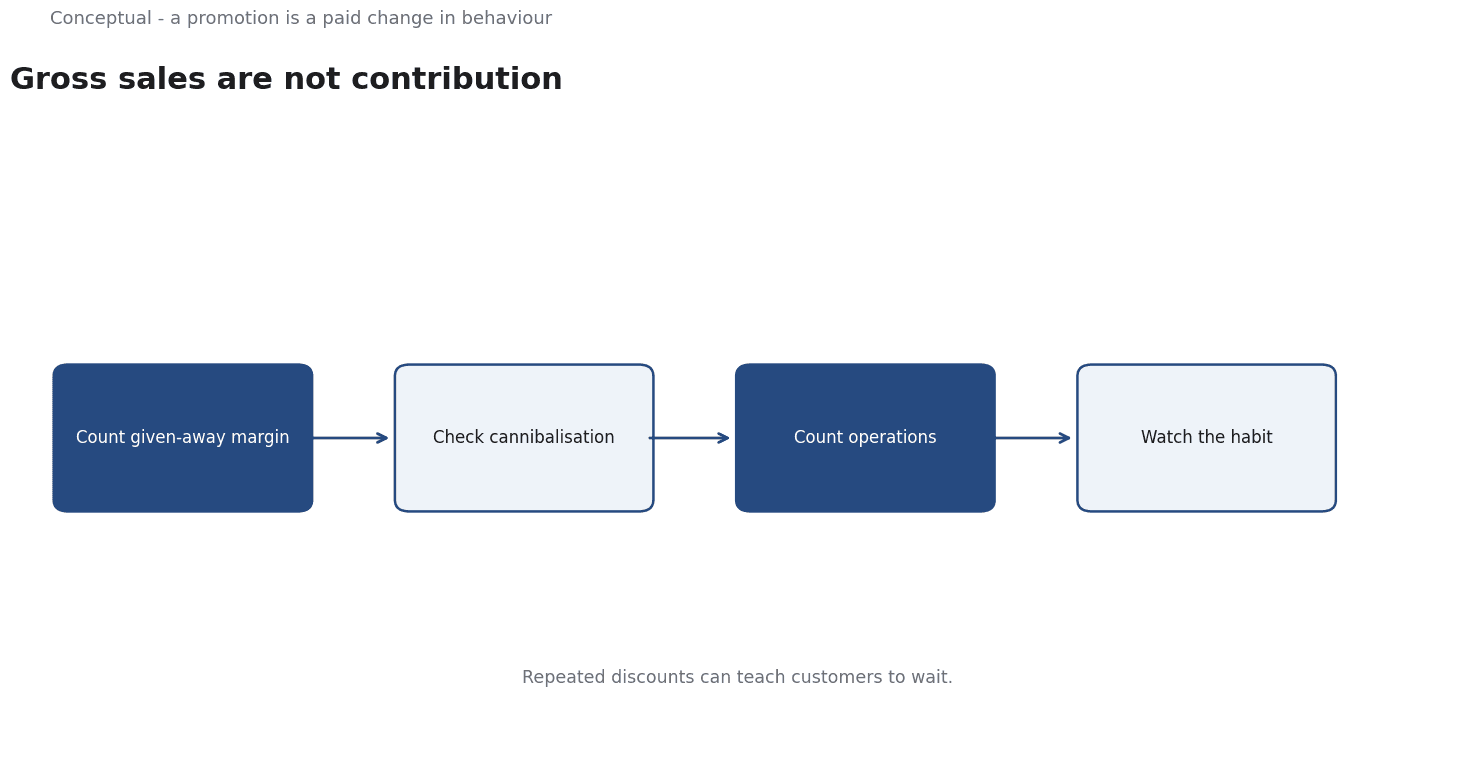
The costs
Margin given away. A discount reduces contribution on every unit, which the unit-economics article requires, as the pricing article treats margin as a constraint, as the profitability article explains for accounting layers, as the cash-flow article requires for the cash received.
Cannibalisation. A promotion can move sales forward from a later period rather than create them, which the promotion-decisions article treats as a timing question, as the time-series article warns about non-stationarity, as the attribution article warns about credit rules, as the decision-memo article requires for a recorded judgement.
Operational effort. Running a promotion costs work — setup, support, and fulfilment, which the operations article treats as the mechanism, as the cost estimator requires for spend, as the time-management article treats attention as a constraint, as the dashboard article argues for metrics tied to decisions.
Habit formation.
Three consequences follow. The baseline should be a no-promotion period, as the rubric article requires, as the geo-experiment guidance recommends for comparisons, as the causal-inference article treats attribution as a separate question. Incremental contribution should be the metric, as the unit-economics article requires, as the dashboard article argues, as the rubric article requires. And the result should be reviewed, as the monitoring article treats as a trigger, as the decision-memo article requires for a record.
A worked example
The following is hypothetical and illustrative. A retailer tests a 20% promotion for one week against a comparable quiet week.
Three checks decide whether it worked. First, what was the incremental volume beyond a comparable baseline, as the promotion-decisions and rubric articles require, with a comparison, as the experiment guidance recommends, as the attribution article warns? Second, what was the contribution after the discount and the operational effort, as the unit-economics and cost-estimator articles require, with the cash, as the cash-flow article requires? Third, did purchases shift from the following weeks, as the discount and time-series articles advise, with a habit check, as the monitoring article advises?
Three conclusions follow.
Gross sales are not contribution, which the checks reveal.
Timing matters, as the promotion-decisions and time-series articles advise. And the decision should be recorded with the estimate, as the decision-memo article requires.
What promotion analysis cannot do
It cannot prove causation from a sales spike, which the causal-inference article treats as a separate question, as the correlation article warns about association, as the experiment guidance recommends for comparisons. It does not guarantee a habit change, which the discount article treats as a risk, as the publication standard forbids guaranteed outcomes, as the risk article requires residual risk. And it cannot fix a weak value proposition, which the value-proposition article treats as prior, as the positioning article argues for direction.
The counterargument that a promotion always grows sales is fair for volume and incomplete for contribution and timing, which the worked example shows, as the unit-economics and promotion-decisions articles advise.
A decision test
- Set a no-promotion baseline, as the rubric article requires.
- Measure incremental volume, as Promotion Decisions for Beginners advises.
- Compute contribution after all costs, as the unit-economics article requires.
- Check timing and cannibalisation, as the time-series article advises.
- Check for habit formation, as Discount and Coupon Strategy: Margin, Habit, and Signal warns.
- Use a comparison for causal claims, as the experiment guidance recommends.
- Record the decision and residual risk, as the decision-memo and risk articles require.
For the decision frame, see Promotion Decisions; for the incentive risk, see Discount Strategy.
References & Further Reading
- Wikipedia contributors, 2026. Sales promotion - Wikipedia — The mechanisms and costs of short-term promotional incentives.
- Wikipedia contributors, 2026. Demand generation - Wikipedia — An overview of demand generation as a marketing discipline distinct from lead generation; secondary reference used with the lead-generation entry.