Prompt Caching Checklist
Caching is easy to enable and easy to get wrong. A checklist maps stable prefixes and cache boundaries to a real cost decision, with claim status explicit.
Teams send the same large context, such as system instructions, reference documents, and examples, on every model call and pay for it each time. Enabling prompt caching seems like a simple fix, yet many teams see no saving because a changing prefix silently prevents reuse. The two sources frame the mechanics: Anthropic documents explicit cache boundaries and OpenAI documents automatic caching of repeated prefixes.
Direct answer: Cache only context that is repeated, long enough to qualify, and byte-identical across calls. Place volatile fields after the cache boundary, then verify a real cache hit and measure net cost, since a write premium must be repaid by enough discounted reads.
Delta: This article adds a claim-status table beyond the sources: it maps caching mechanics to a deployment checklist decision, with claim status explicit.
The mechanism
Prompt caching reuses the result of processing a repeated prefix across calls, so the model does not recompute the same long context each time. Both providers describe a discount for reading cached tokens and a storage window, often called a time-to-live, after which the stored result expires. The practical consequence is that savings depend on repetition inside that window: a single one-off call gains nothing, and a call that arrives after expiry starts over.
The unit of reuse is the prefix. Only content that is byte-identical and positioned before the cache boundary is reused; a changed token early in the prefix invalidates everything after it. That is why stable, large content such as system instructions and reference documents belongs at the front, and why volatile fields belong after the boundary. A timestamp, a request identifier, or a reordering of retrieved passages placed too early can erase the benefit for the whole prompt.
The economics are asymmetric. Writing to the cache carries a premium over an ordinary token, while reading from it is discounted.
A team only breaks even when the same prefix is read often enough within the storage window to repay the write premium.
The practical consequence is that caching a short or rarely repeated prompt can increase total spend. The decision is a volume question as much as a technical one, and it should be tested against real request patterns rather than assumed.
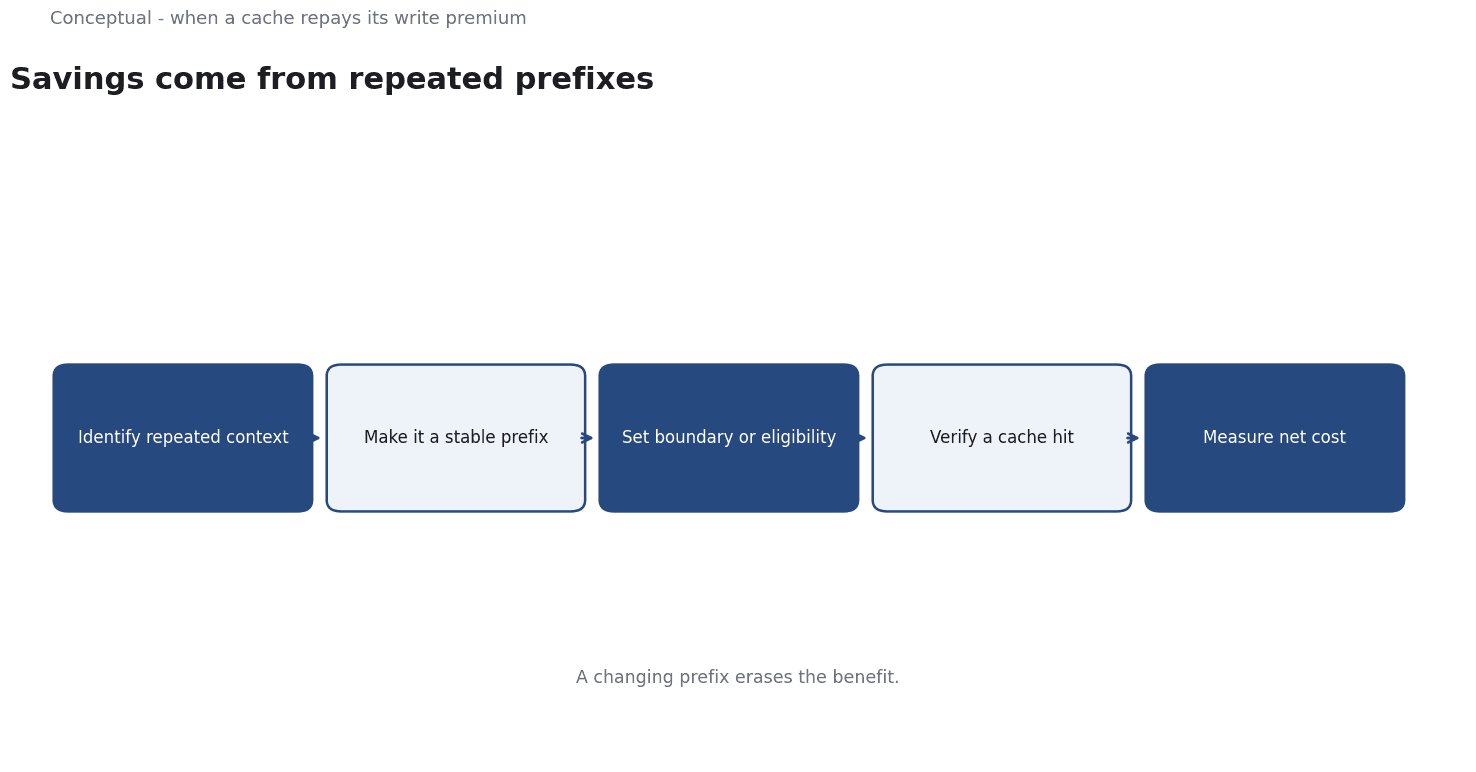
The two providers differ in approach: one relies on cache boundaries the developer places in the prompt, while the other applies caching automatically to sufficiently long prompts. The sequence for a team is: identify the repeated context, make it a stable leading prefix, set the boundary or confirm automatic eligibility, verify a cache hit on real traffic, and measure net cost. The mechanics are source-reported; the verification checklist is inferred.
A worked example
The following is hypothetical and illustrative. A team sends a long system prompt plus retrieved documents with every request and sees no saving after enabling caching. Three checks decide why. First, is the intended cached prefix byte-identical across calls, once a per-request timestamp or identifier is included? Second, are the static parts placed before the boundary and the volatile parts after it, and is the prefix long enough to qualify at all? Third, do cache reads actually occur within the storage window on representative traffic, or does the cache expire before the next request arrives? The team moves the timestamp out of the prefix and begins to see discounted reads on repeated calls. The scenario is illustrative; the need for a stable prefix is the point.
Evidence status
| Claim | Status | Source | Verified | Recheck when |
|---|---|---|---|---|
| Caching reuses repeated prefixes for lower cost | source-reported | Anthropic Prompt caching | 2026-11-18 | Pricing or API changes |
| Automatic caching applies to long prompts | source-reported | OpenAI Prompt caching | 2026-11-18 | Eligibility rules change |
| A changing prefix eliminates cache savings | inferred | Derived from the sources | 2026-11-18 | Provider behavior changes |
The first two rows describe what each provider documents and are source-reported, so they should be revisited if the pricing or eligibility rules are revised. The third row is inferred: the conclusion that a changing prefix removes the saving follows from the prefix-based mechanism but is a practical deduction. It should be rechecked whenever prompt structure, models, or provider behavior changes.
What it cannot do
Prompt caching reduces the cost and latency of repeated context; it does not make the model more capable. The unique portion of each request is still processed in full, and caching does not change the quality of the answer, the model's reasoning, or its access to information. A prompt that is almost entirely different on every call has almost nothing to cache, so a team hoping for a broad cost reduction from a highly variable workload will be disappointed. The benefit is narrow by design: it rewards repetition, not complexity.
The hidden cost is the break-even created by the write premium and the storage window. A short prefix, a low request volume, or traffic spread so thinly that the cache expires between calls can produce a net increase in spend. Engineering effort spent restructuring prompts and monitoring hit rates is a genuine cost too, and it is easy to overlook when a feature is described as a simple switch. Before committing, a team should estimate how often a stable prefix will actually be reused inside the window and compare that with the premium paid to store it.
A non-deterministic field, a changing ordering of items, a different serialization, or an identifier injected into the prefix changes the bytes and produces cache misses without any error message. The team believes caching is active while paying full price, and the lack of a failure signal makes the problem hard to spot. Diagnosing it requires checking cache-hit behavior on real traffic, not reading the code and assuming the prefix is stable. This is why verification is a step in the checklist rather than an afterthought.
There are boundaries to how far the mechanism applies. Caches are provider-side and are generally scoped to an account or project, so they should not be assumed to carry across regions, endpoints, or the moment of expiry. Sensitive content placed in a cached prefix also raises data-handling questions that a cost document does not resolve, and those questions belong with the team's privacy review. Caching does not alter what the model knows or guarantee that a cached result is reused in every circumstance; it is a cost optimization, not a correctness or capability feature.
Finally, the details need ongoing review. Minimum lengths, storage windows, boundary syntax, and token pricing differ between providers and change over time. A configuration that is correct today can quietly stop saving money after a model or pricing change. The team should watch hit rates and net cost on representative traffic and recheck the setup whenever prompts, models, or provider terms change, rather than treating caching as a one-time configuration.
The counterargument that caching is fair for high-volume, stable prefixes and incomplete for low-volume or highly variable ones is sound: the write premium can exceed the saving when repetition is rare.
A decision test
- Identify the context that is repeated on every call.
- Confirm the repeated prefix is long enough to qualify.
- Make that prefix byte-identical and place it first.
- Put volatile fields after the cache boundary.
- Set the boundary or confirm automatic eligibility with the provider.
- Verify a cache hit and measure net cost on real traffic.
- Recheck when prompts, models, or provider terms change.
The checklist keeps the emphasis on verification, because caching is one of those optimizations that can appear configured while delivering nothing. A measured hit rate and a net-cost comparison are the evidence that the decision worked. Without them, the team is paying a premium on the assumption of savings it has not confirmed.
For further reading, see Technical Writing: Documentation, API Docs, and Developer Experience.
References & Further Reading
- Anthropic, 2026. Prompt caching - Claude Platform Docs — Cache control semantics, breakpoints and the conditions under which a prefix is reused.
- OpenAI, 2026. Prompt caching | OpenAI API — How repeated prompt prefixes are cached and billed at a lower rate.