Proptech Best Practices
Proptech best practices mapped to the property lifecycle, with a worked pilot, an evidence table, and the limits of technology without a measured outcome.
Property technology is often sold as a set of tools rather than a way to improve how buildings are bought, sold, and managed. The Wikipedia entry on property technology describes the application of technology to property markets, while the real estate entry sets out the structure of those markets. The real problem is deciding which technology actually improves an operational outcome.
Direct answer: Adopt proptech by mapping each tool to a specific stage of the property lifecycle and a measurable operational outcome. The two Wikipedia entries provide the domain context: what property technology is and how real estate markets are structured. A tool that cannot be tied to a decision or a cost is a purchase, not a practice.
Delta: This article adds an operations-facing map beyond the sources: it maps property lifecycle stages to technology decisions, with claim status explicit.
The mechanism
Property technology, as the Wikipedia entry describes it, is the use of technology to improve how property is used, managed, and transacted. The real estate entry supplies the setting: a market characterised by long-lived assets, many participants, and transactions that are infrequent but high value. Together they explain why technology in this domain is less about novelty and more about the flow of information between parties who do not naturally share it.
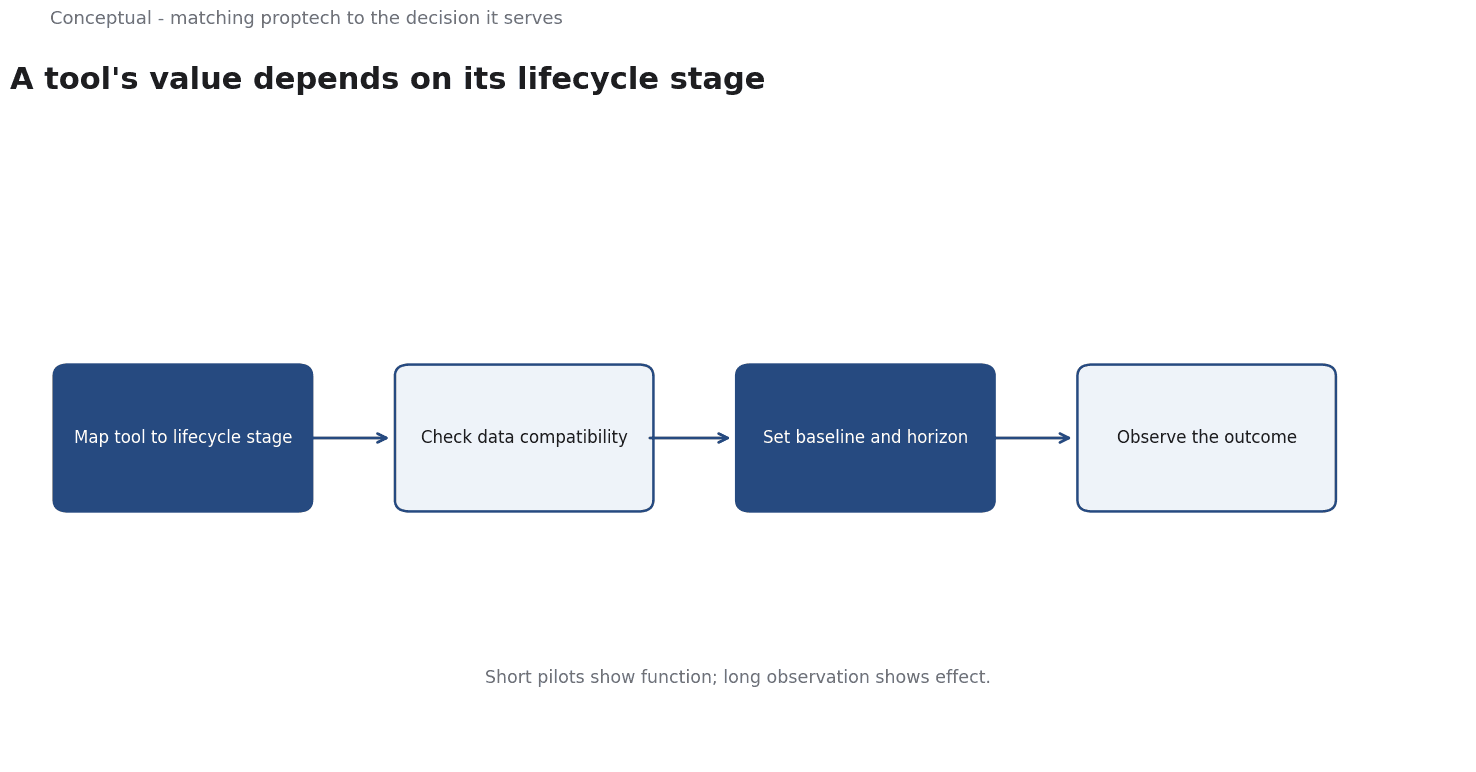
The practical consequence is that a tool's value depends on where it sits in the lifecycle. A listing platform, a building management system, and a transaction workflow each address a different stage, and each produces data in a different form. The mechanism is that property decisions are distributed across owners, managers, tenants, and advisors, so a technology that improves one handoff may create friction at another. Mapping the tool to the stage is what makes its benefit visible and its side effects measurable.
Because these assets are long-lived and transactions are slow, the evidence needed to judge a tool accumulates gradually. A dashboard that looks useful in a demo may not change an outcome over a full leasing or maintenance cycle. The real estate structure therefore sets the evaluation horizon: short pilots can show that a system works technically, but only longer observation shows whether it changes cost, occupancy, or speed of transaction. Patience is part of the method, not a delay in it.
The synthesis is to treat each adoption as a lifecycle decision rather than a product purchase. The sources describe the domain and the market; deciding which stage a tool serves and what outcome it should change is local judgement. That mapping is marked as inferred below, kept separate from the descriptive claims the entries make. A practice that forgets this separation starts to sound like a vendor pitch rather than a decision method.
A worked example
The following is hypothetical and illustrative. A property manager is considering a smart building platform that promises lower energy costs. The first check is lifecycle fit: does the platform address an actual stage of building management, and which participants does it require to share data? The second check is compatibility: can it work with the existing leasing and maintenance records without duplicating them? The third check is measurement: is there a baseline for energy use and a horizon long enough to observe a change? The outcome is a staged pilot with a defined metric and an owner, not a fleet-wide rollout. The scenario is invented; the domain context comes from the sources.
Evidence status
| Claim | Status | Source | Verified | Recheck when |
|---|---|---|---|---|
| Property technology applies technology to property markets and management | source-reported | Property technology - Wikipedia | 2026-11-18 | Entry or terminology changes |
| Real estate markets involve long-lived assets and infrequent high-value transactions | source-reported | Real estate - Wikipedia | 2026-11-18 | Entry revised |
| Each tool maps to a lifecycle stage and a measurable outcome | inferred | Derived from the sources | 2026-11-18 | Portfolio or process changes |
The first two rows summarise what the entries describe. The third is a local decision method and is therefore marked inferred, since the entries do not prescribe a practice. It should be rechecked when the portfolio or the process changes, not only when the source entries are edited. The table keeps the descriptive and the practical claims apart so that neither is mistaken for the other.
What it cannot do
Property technology cannot fix a bad property decision. The Wikipedia entries describe a domain and a market; they do not claim that technology corrects poor location analysis, weak underwriting, or a misjudged tenant mix. A tool can make information flow faster, but it cannot supply the judgement about what the information means. Teams that adopt software expecting it to compensate for a weak strategy will find that the software faithfully reproduces the weak strategy at greater speed and with better charts.
Technology amplifies the quality of the decision it serves.
The hidden cost is fragmentation. Property markets involve many participants, and each new tool can add another place where data lives. A platform that improves one workflow may leave records inconsistent with the systems used by managers, tenants, or advisors. The cost is not the licence fee but the ongoing effort to reconcile data across systems. Because the real estate structure involves long periods and many parties, this cost compounds quietly rather than appearing in a single invoice. It is discovered at the next handoff, when figures no longer agree.
A common failure mode is measuring adoption instead of outcomes.
The property technology entry describes applications, not results, so it cannot tell a manager whether a particular tool works. Without a baseline and a horizon long enough to cover a maintenance or leasing cycle, a pilot can report activity while leaving the underlying outcome unchanged. Activity is easy to count; the outcome is harder and therefore more useful to track.
The boundary is between the technology and the market it serves. The real estate entry describes a market with distinctive structure: long-lived assets, high-value transactions, and many participants. Technology operates within that structure, not outside it. A tool that ignores how ownership, tenancy, and transactions actually work will not fit the workflow, however elegant its interface. Good practice therefore starts with the property process and asks where technology helps, rather than starting with the technology and looking for a problem to justify it.
Finally, these decisions need review. The Wikipedia entries are descriptive and can change, and the tools themselves change faster than the assets they are applied to. A platform that fit a portfolio last year may not fit it after an acquisition or a change in how space is used. Tying each adoption to a lifecycle stage and a metric, then revisiting that tie, is what prevents a one-time purchase from becoming an unexamined standard. A dated review condition is the simplest way to keep that tie alive.
Counterargument: "The counterargument that proptech best practices are just generic change management is fair for software selection and incomplete for a domain where long asset lives and many parties shape the data."
A decision test
- Name the property lifecycle stage the tool would affect.
- State the operational outcome it is meant to change.
- Check compatibility with existing records and systems.
- Identify which participants must share data.
- Set a baseline and a horizon long enough to observe change.
- Run a staged pilot with a defined metric and owner.
- Review the tie between tool and outcome after each cycle.
The test keeps the property question first and the technology second. Each step asks whether a tool fits a real stage of the lifecycle and whether its effect can be observed, rather than whether it is impressive. Because the market structure is slow-moving, patience is part of the method. A pilot that passes is a reason to keep measuring, not a reason to buy for every site at once.
For further reading, see Data Governance: Managing Data as an Asset.
References & Further Reading
- Wikipedia contributors, 2026. Property technology - Wikipedia — Technology applied to property markets.
- Wikipedia contributors, 2026. Real estate - Wikipedia — The structure of property markets and ownership.