Promotions Mistakes to Avoid
Promotions fail when a sales spike is mistaken for a result. Read the common mistakes, a worked evaluation example, and a promotion-to-decision test.
Promotions are often judged by the sales spike during the offer, which cannot separate new demand from purchases pulled forward. The sales promotion entry describes short-term incentives, and the pricing entry describes how price shapes demand and revenue. The real problem is that a promotion can raise revenue while destroying margin and training customers to wait.
Direct answer: The main mistakes are measuring the spike instead of contribution, ignoring timing effects, and resetting the customer's reference price. The sources describe promotion mechanics and pricing; the review rule is a synthesis. A promotion should be judged on incremental contribution over a window long enough to reveal borrowed demand.
Delta: This article adds a claim-status table and a promotion-to-decision test beyond the sources: it maps each common mistake to a pre-agreed check, with claim status explicit.
The mechanism
Sales promotion covers short-term incentives designed to stimulate a faster or larger purchase, such as discounts, coupons, and displays. The entry frames these as tactical tools with defined costs and objectives rather than as simple giveaways. The practical consequence is that every promotion has an explicit objective and a price. When the objective is left unstated, the promotion is judged by whatever metric happens to be reported, which is usually revenue during the offer. That metric cannot answer whether the promotion was worth running.
The pricing entry supplies the second half of the mechanism. Price changes affect both demand and revenue, and the effect depends on how sensitive customers are to price. The practical consequence is that a discount can increase units sold while reducing contribution, because the margin lost on each unit may exceed the margin gained from extra volume. A promotion evaluated on revenue alone will look successful even when it loses money. Contribution, which nets out the discount and the operational cost, is the measure that matches the decision.
The two sources combine into a set of checks that neither states as a rule. A promotion should be assessed against a comparable baseline, over a window that extends beyond the offer, and on contribution rather than revenue. The sources also imply the reference-price risk: repeated discounting can change what customers consider a normal price, so future full-price sales suffer. Neither source prescribes a specific baseline, window, or discount depth. Those are local choices and must be marked as inferred. Keeping that boundary visible lets a reviewer see which part came from an established concept and which part was a judgement.
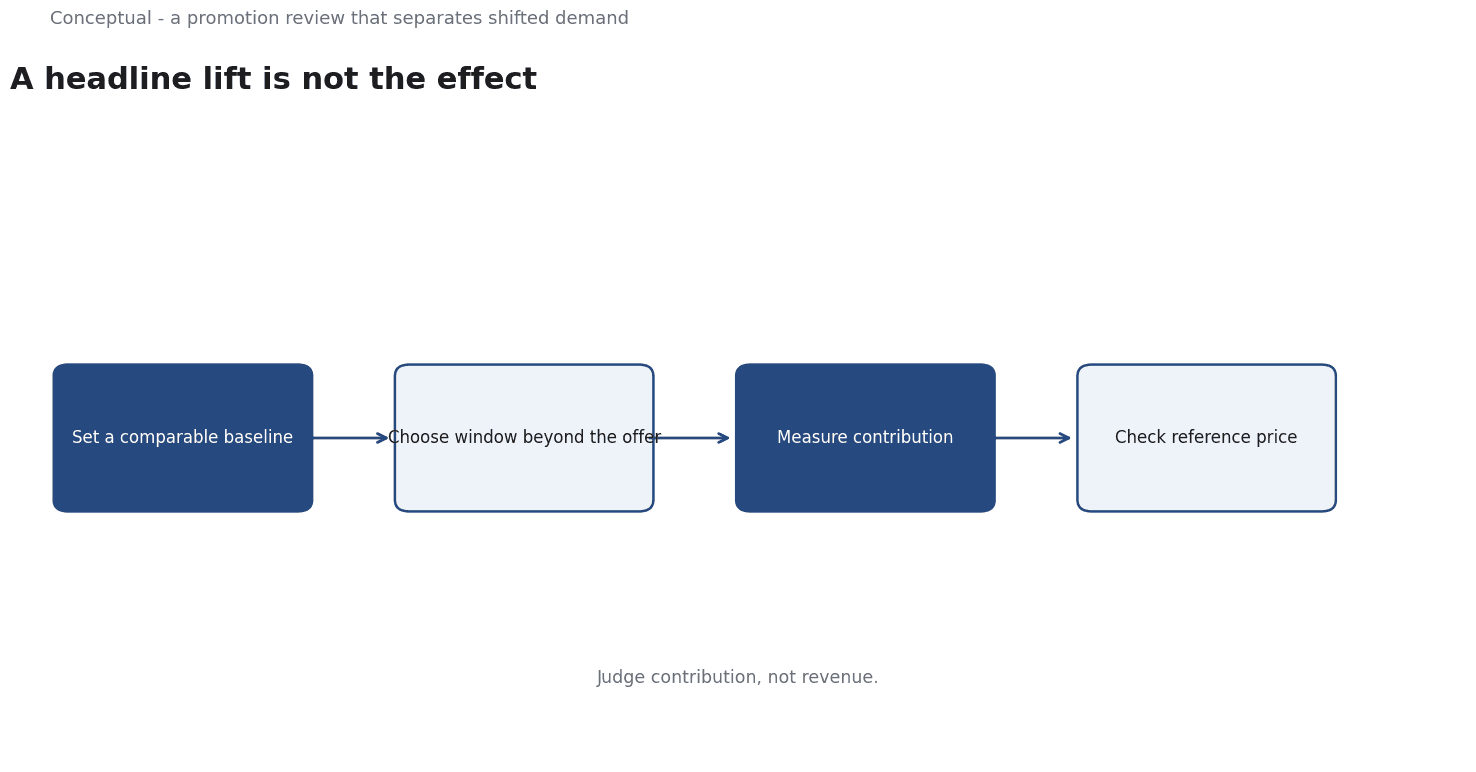
The output is a comparison between the incremental contribution and the costs of the promotion, plus a note on the reference-price effect. That comparison, rather than a headline lift, is the decision instrument. It shows where a promotion created demand and where it merely shifted it in time. The value lies in the sequence: set the baseline, choose the window, measure contribution, then check for habit formation. A decision made in that order can be explained later, because the evidence and the choice are recorded separately.
A worked example
The following is hypothetical and illustrative. A retailer runs a weekend discount and reports a strong sales lift. Three checks decide the review. First, is the baseline comparable in season and channel? Second, did sales in the following week fall, suggesting demand was borrowed from later? Third, what happened to contribution after the discount and extra staffing were counted? The review shows the lift came mostly from purchases pulled forward and that contribution fell once costs were included. The retailer narrows the promotion and records the reason. The outcome is a decision-quality improvement, not a claim about future demand. The numbers are hypothetical; the verification method is the contribution.
Evidence status
| Claim | Status | Source | Verified | Recheck when |
|---|---|---|---|---|
| Promotions are short-term incentives with costs | source-reported | Wikipedia, Sales promotion | 2026-11-18 | Definition changes |
| Price changes affect demand and revenue | source-reported | Wikipedia, Pricing | 2026-11-18 | Definition changes |
| Judge promotions on incremental contribution and timing | inferred | Derived from the sources | 2026-11-18 | Calendar changes |
The first two rows are factual claims drawn directly from the sources. The third is an inference about evaluation, because neither source sets a baseline or a measurement window. Recheck the definitions when the source entries change, and the inferred claim when the product calendar or the cost structure changes.
What it cannot do
A promotion review does not prove exactly what would have happened without the offer. The counterfactual is unobserved, so any baseline is an approximation. A defensible comparison is the goal, not an exact one. The sources describe promotion and pricing mechanics, not a causal method. Treating a measured lift as a precise effect is a category error: it answers how sales compared with a chosen baseline, not what the promotion caused. A report that presents a lift without naming its comparison is harder to challenge than one that states its assumptions.
The hidden cost is the operational load that rarely appears in a sales report. Extra staffing, support, fulfilment, and the administrative work of running the offer are real costs, and a lift that ignores them can be negative in contribution terms. The sources describe the costs of promotion in general but do not quantify them for a specific case. That cost is paid at the time of the offer and is easy to overlook when the headline number is strong. Making the full cost list a required field in the review is what keeps the assessment honest.
The main failure mode is reading a spike as a result.
A spike measures activity during the offer, while the result is the change in contribution over a window long enough to show whether demand was created or moved. A promotion that shifts sales forward will look successful inside the offer window and weak immediately after.
The relevant question is what happened in the periods around the offer, not just during it.
There is a boundary around the method. It covers the promotion as run, not the competitive response or the broader demand environment. It does not model a competitor's matching discount, a shift in seasonality, or a supply constraint. It does not replace customer research, because it draws on observed sales rather than explaining why customers acted. A promotion review cannot tell a team which offer to design; it can only show whether the offer that ran was worthwhile under the chosen comparison. That is a narrower contribution than it is often made out to be.
Because the source entries and the cost structure evolve, the review needs a refresh and the assumptions need periodic review. Each assumption should be recorded with a recheck condition, and the baseline and window should be treated as local policy decisions rather than numbers the sources supply. Without that record, a future reviewer cannot tell which choices were deliberate and which were habits. The promotion will still be in the archive; the reasoning behind its evaluation is what makes the review possible.
The counterargument that a sales spike is fair for a quick read is incomplete for a decision to repeat the promotion.
A decision test
- State the promotion's objective before it runs.
- Choose a comparable baseline and record it.
- Set a window that extends beyond the offer.
- Count the full operational cost.
- Measure incremental contribution, not revenue alone.
- Check the following period for borrowed demand.
- Record the decision and the recheck condition.
A promotion review is useful only when the baseline and the cost list are both owned. The test turns a spike into a sequence of decisions with a visible rationale, so a reviewer can see which comparison was used and when the choice must be revisited. For further reading, see Marketing Dashboards.
References & Further Reading
- Wikipedia contributors, 2026. Sales promotion - Wikipedia — The mechanisms and costs of short-term promotional incentives.
- Wikipedia contributors, 2026. Pricing - Wikipedia — How prices are set and what they signal.