Public Speaking Pitfalls
Speaking is judged by what the audience takes away. Read the pitfalls, a worked example, and why more slides are not more clarity.
Public speaking is often prepared as a performance, which optimises the speaker's comfort rather than the audience's understanding. The Wikipedia entry describes speaking to an audience, and the marketing-communications entry treats a message as something received. The pitfalls concern that gap.
Direct answer: Prepare a talk around one idea the audience should take away, then check whether they can repeat it. The sources describe the channel; the method is a synthesis.
Delta: This article adds a claim-status table and a worked example, separating documented speaking practice from local choices about content.
The mechanism
The speaking entry describes the act of addressing an audience, but the content should follow the idea, not the other way around. A deck built first tends to accumulate points, and a talk with many points is hard to remember.
The second pitfall is measuring the wrong thing. The marketing-communications entry treats a message as received, which means the test is what the audience understood, not how the speaker felt. A talk can feel smooth and leave no clear idea behind.
The third pitfall is ignoring the room. An audience arrives with existing knowledge and a reason for being there, and a talk that ignores both will lose attention. Asking who they are and what they need is the first preparation step, and it is the one most often skipped.
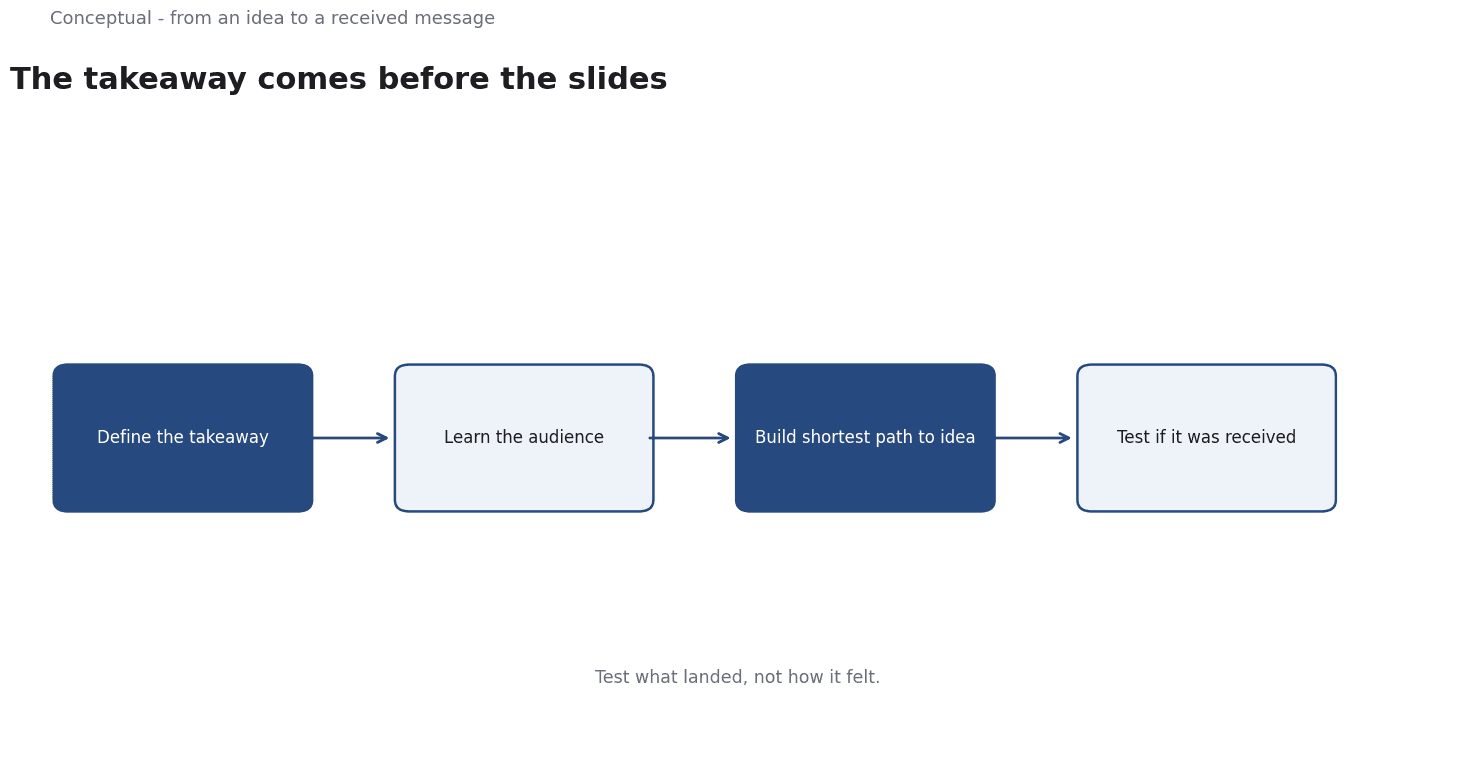
The sequence is: define the takeaway, learn the audience, build the shortest path to the idea, then test whether it was received. Each step is local work, so the conclusions are inferred; the channel is source-reported.
A worked example
Illustrative. A team presents a project review with twenty slides and receives no follow-up questions.
Three checks decide. First, can the audience state the one idea the talk was meant to convey? Second, did the slides support that idea, or did each introduce a new one? Third, what would the audience need in order to act on the result?
The outcome is a shorter talk with a clear takeaway. The scenario is hypothetical; the method is the contribution.
Evidence status
| Claim | Status | Source | Verified | Recheck when |
|---|---|---|---|---|
| Public speaking addresses an audience | source-reported | Wikipedia, Public speaking | 2026-11-18 | Definition changes |
| Messages are received, not just sent | source-reported | Wikipedia, Marketing communications | 2026-11-18 | Practice changes |
| Test the takeaway, not the performance | inferred | Derived from reception | 2026-11-18 | Audience changes |
Why more slides reduce clarity
Each slide invites a new point, and a talk with many points leaves the audience to decide which mattered. Cutting slides is not about brevity for its own sake; it is about reducing the number of choices the listener must make about what to remember.
A further pitfall is filling silence. A speaker who is uncomfortable with pauses will add words, and the audience loses the time it needs to absorb a point. Silence is part of the structure of a talk, not a failure of delivery, and preparing for it is as useful as preparing the next sentence.
The speaker should also recognise that a talk is an event in a longer process. The audience will forget most of it, and the material that survives is usually one idea repeated in a few forms. Planning what should remain a week later is a better test than planning what to say in the moment.
Finally, feedback after a talk is often polite, which makes it a weak signal. Asking a specific question about what the listener took away produces more useful evidence than a general rating, and it is the answer that should shape the next version.
A talk should be designed around what the audience will remember, not around everything the speaker knows.
The measure of a talk is what the audience can repeat afterwards, not how complete the deck felt to the speaker.
Preparation should end with a check of what the audience will remember.
What it cannot do
It cannot guarantee that the audience agrees. It does not replace a good idea. And it cannot remove nerves, which are a normal part of the activity.
The counterargument that a detailed deck is more informative is fair for reference and incomplete for a talk whose purpose is understanding.
A decision test
- Define the takeaway.
- Learn the audience.
- Build the shortest path.
- Test comprehension.
- Remove points that do not support the idea.
- Record what changed.
For the background, see Presentation Skills.
References & Further Reading
- Wikipedia contributors, 2026. Public speaking - Wikipedia — Speaking to an audience and how it is prepared.
- Wikipedia contributors, 2026. Marketing communications - Wikipedia — The coordination of messages across channels and the distinction between consistent and identical communication.