Remote Work Trade-Offs
Remote work trades commuting and autonomy for weaker spontaneous coordination and culture transmission. A worked example, evidence table, and decision test clarify the choice.
Teams adopt remote work for autonomy and cost savings, then discover that coordination does not disappear; it moves into slower, written channels. The hard part is not whether remote work is possible but which trade-offs a given team can absorb. Without naming those trade-offs, a policy gets judged by mood rather than by fit.
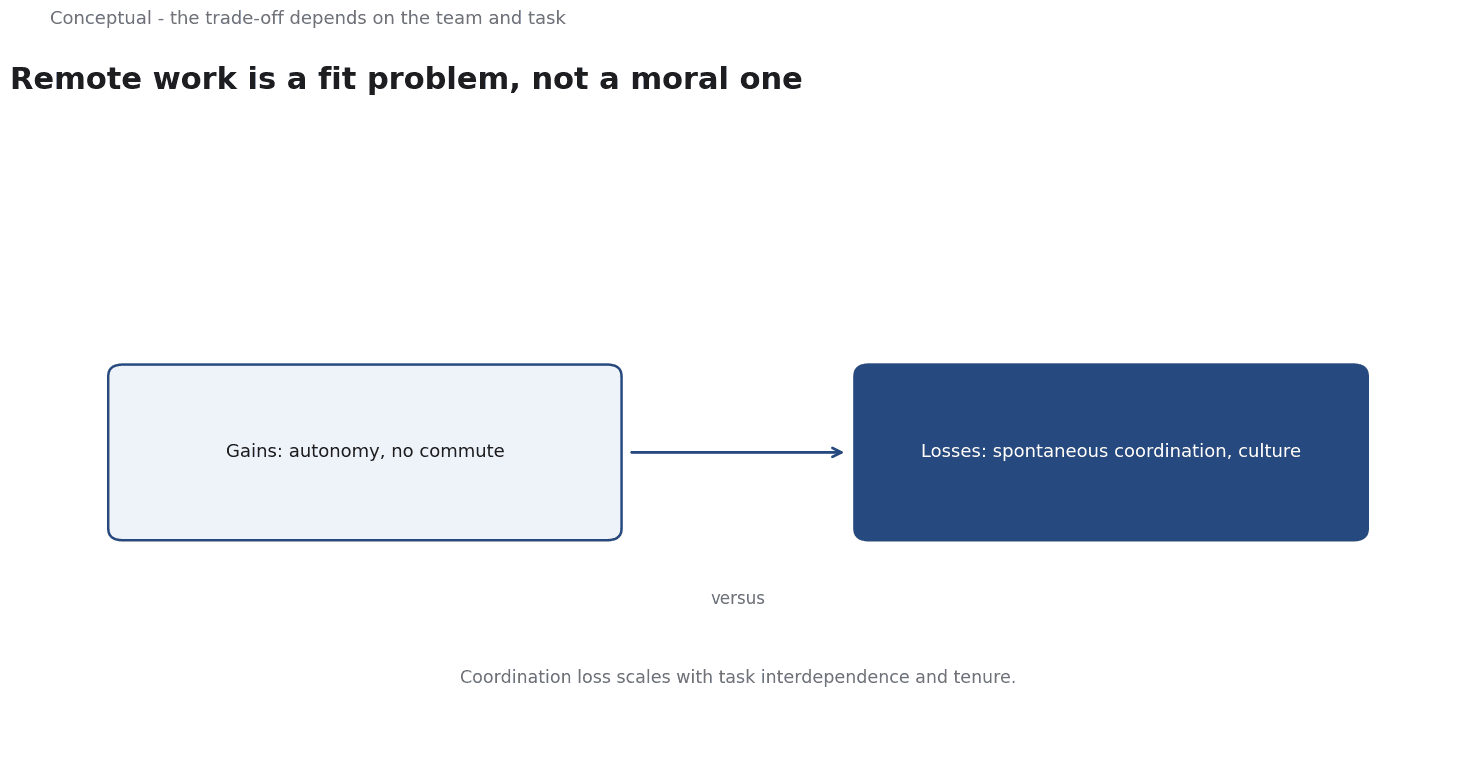
Direct answer: Remote work is a work arrangement in which employees perform duties away from a central workplace, often using digital tools to stay connected. The core trade-off is autonomy and reduced commuting against the loss of spontaneous, high-bandwidth interaction that organizational culture relies on.
Remote work is a set of trade-offs to manage, not a binary benefit.
Delta: This article adds a decision framing beyond the sources: it maps the remote-versus-colocated choice to a small set of team-level conditions, with claim status explicit.
The mechanism
Remote work, described in the literature as telecommuting or telework, is an arrangement in which employees carry out their duties away from a central office and rely on information and communication technologies to remain connected. The practical consequence is that the workplace stops being a shared physical place and becomes a set of tools and agreements. Once that shift happens, anything that used to be handled by proximity - overhearing a conversation, tapping a colleague on the shoulder, reading a room - must be made explicit or it stops happening at all.
Organizational culture is the system of shared values, beliefs, and norms that shapes how people in an organization behave and interpret events. In a colocated setting, culture is transmitted largely by observation: new members absorb how meetings run, how disagreement is expressed, and what gets rewarded simply by being present. Remove the shared space and that transmission weakens. Culture does not vanish, but it has to be carried by artifacts that can travel - written norms, documented rituals, and deliberate onboarding - rather than by ambient exposure.
The mechanism behind most remote-work friction is bandwidth and timing. Face-to-face interaction carries tone, immediacy, and rapid feedback, which makes ambiguous work fast to resolve. Remote interaction leans on text and scheduled calls, which are slower for ambiguity but excellent for tasks that benefit from a written record and asynchronous participation. A team doing routine, well-specified work may lose little and gain focus; a team doing novel, interdependent work loses the cheap feedback loops that proximity provided, and the cost shows up as longer decision cycles and more meetings scheduled to compensate.
The trade-off is therefore conditional, not universal. It depends on how much a team's work relies on tacit knowledge, how new its members are, and how much the task requires spontaneous coordination. A mature team with clear interfaces can be highly effective at a distance; a team in formation, or one reorganizing, often needs the density of a shared space. Treating remote work as a single policy applied to every function hides this variation and produces decisions that are right for some roles and wrong for others.
A worked example
The following is hypothetical and illustrative. A twelve-person product team is deciding whether to go fully remote. Rather than debate the policy in the abstract, the lead runs three checks. First, a task-interdependence check: they map the last quarter's work and find that two of five projects required frequent, unresolved design decisions, the kind that benefited from quick hallway conversation. Second, a culture-transmission check: three members joined within the last six months and report that they learned norms mainly by proximity, not from documents. Third, a coordination-cost check: the team already spends significant time in scheduled calls, suggesting text alone is not covering ambiguity. The outcome is a hybrid policy: remote by default, with two fixed overlap days for the interdependent projects and a written onboarding guide to carry culture. The decision is not "remote works" or "remote fails" but a specific arrangement matched to the checks.
Evidence status
| Claim | Status | Source | Verified | Recheck when |
|---|---|---|---|---|
| Remote work relies on digital tools to connect employees away from a central workplace | source-reported | Wikipedia: Remote work | 2026-11-18 | Terms or definitions change |
| Organizational culture is transmitted through shared values and norms | source-reported | Wikipedia: Organizational culture | 2026-11-18 | Culture model is revised |
| Coordination loss scales with task interdependence and team tenure | inferred | Derived from the sources | 2026-11-18 | New team-level evidence appears |
The two source-reported claims describe what remote work and culture are; they do not rank outcomes. The inferred claim connects the two concepts into a decision rule and is the article's own synthesis, not a sourced finding. Recheck it when team-level studies or internal measurements can replace reasoning with observation.
What it cannot do
This framing has a hard limit: the underlying sources are descriptive. They explain what remote work and organizational culture are, but they do not quantify how much performance changes under one arrangement or the other. Any claim about the size of the effect, the optimal number of overlap days, or the productivity impact of a specific team is an inference, not something the sources establish. Treat the decision test as a way to structure judgement, not as a model that produces a score.
A hidden cost is that remote work does not eliminate coordination expense; it relocates it. The money saved on office space can reappear in tooling, in the time spent writing things down, and in the deliberate effort required to transmit culture to new members. These costs are diffuse and rarely appear in a budget line, so a policy can look cheaper than it is. A team that adopts remote work without funding its written infrastructure - onboarding documents, decision logs, clear norms - tends to pay the cost later in confusion and rework.
Informal mentoring, spontaneous feedback, and the rapid correction of misunderstandings often depend on proximity. When those vanish, newer or more junior members lose the most because they have the weakest informal networks. A second failure mode is proximity bias within a hybrid setup, where colocated members receive more visibility and opportunity, quietly creating a two-tier team. Neither failure is visible in a headcount or a cost sheet.
The boundary is scope. Much of the remote-work discussion concerns knowledge work that can be performed with a laptop and a connection. Roles that require physical presence, specialized equipment, or hands-on supervision do not fit the same frame, and applying a single remote policy across an entire organization flattens real differences. Even within knowledge work, the right arrangement varies with the task and the team's stage of development, so a policy that suits a stable maintenance team may not suit one in the middle of a redesign.
Finally, the decision needs review. A team's composition, tools, and work mix change over time, and an arrangement that fit last year can drift out of fit. Set a review date and a few observable signals - decision latency, onboarding time, meeting load - that would trigger reconsideration. Without that, a remote policy becomes a permanent fixture judged only by how people feel about it, which is exactly the vague evaluation the framing was meant to replace.
The counterargument that remote work is uniformly more productive for focused individual work is fair for tasks that are well specified and mostly independent, and incomplete for work that depends on novelty, tacit knowledge, and rapid feedback.
The two situations call for different arrangements, so the honest answer is conditional.
A decision test
- Name the decision. State whether the choice is full remote, hybrid, or colocated, and for which team.
- Map task interdependence. Identify work that needs frequent, ambiguous, face-to-face resolution.
- Check culture transmission. Ask how new members currently learn the norms and whether that path survives distance.
- Price the hidden costs. Include tooling, documentation, and the time needed to make coordination explicit.
- Check equity. Look for proximity bias and for members whose informal networks are weakest.
- Define signals and a review date. Choose observable measures that would trigger reconsideration.
- Match the arrangement to the checks. Pick the option that fits the findings, not the one that wins the debate.
A remote-work choice is a fit problem, not a moral one. The tests turn a vague preference into a set of conditions that can be argued about and revised. If the checks point in different directions, split the difference by function rather than pretending one policy fits every role, and write down why.
For further reading, see Decision Memos That Survive Review.
References & Further Reading
- Wikipedia contributors, 2026. Remote work - Wikipedia — Distributed and asynchronous ways of working.
- Wikipedia contributors, 2026. Organizational culture - Wikipedia — The study of shared values and behaviours in organisations.