Remote Work Mistakes to Avoid
Remote work fails at the seams of communication, not the location. Read the common mistakes, a worked example, and the management practices that prevent them.
Remote work is often discussed as a question of location, which hides the management problem underneath. The Wikipedia entry on remote work describes working away from a central workplace using technology, and Google re:Work describes management practices such as norms, goals, and check-ins. The real problem is that distance amplifies small failures in communication and coordination.
Direct answer:
Remote work mistakes cluster around unclear norms, weak written communication, and infrequent feedback.
The sources describe remote work and management practices; the link between them is a synthesis. Avoiding the mistakes requires explicit practices, not better tools.
Delta: This article adds a claim-status table beyond the sources: it maps remote-work friction to a management decision, with claim status explicit.
The mechanism
The remote work entry describes an arrangement in which employees work away from a central location, relying on technology to communicate. It notes both benefits and challenges, including isolation and communication difficulty. The practical consequence is that, without a shared physical space, information that used to pass informally must now be written down or it is lost.
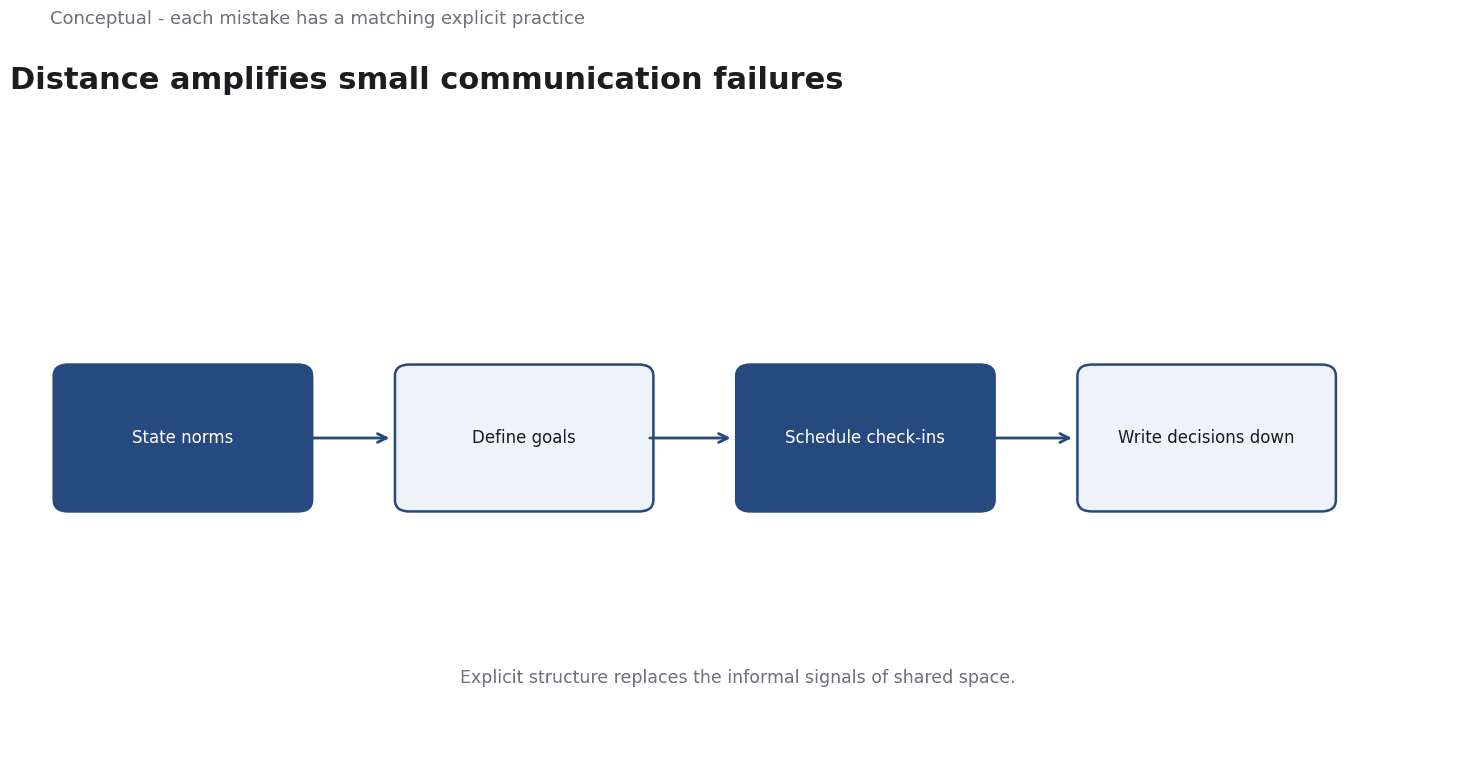
The Google re:Work management practices material describes concrete practices such as setting team norms, defining clear goals, and holding regular check-ins. The practical consequence is that these practices replace the informal signals that co-located teams take for granted, turning expectations into something stated and revisable.
Combining them, the mistakes follow from a mismatch. Remote work removes informal contact, while good management supplies explicit structure. When that structure is absent, teams assume a shared understanding that does not exist. Written communication, agreed norms, and scheduled feedback are the substitutes, and each one must be deliberate rather than incidental.
The practical sequence is to state norms, define goals, schedule check-ins, and write decisions down. Because the sources describe the arrangement and the practices but do not enumerate mistakes, naming the mistakes is an inference. The value is that each mistake has a matching practice, so the response to a problem is concrete rather than generic advice to communicate more.
A worked example
The following is hypothetical and illustrative. A distributed team misses a launch date, and the manager assumes the cause is low motivation. Three checks decide. First, look at goal clarity: if team members describe different definitions of done, the failure is alignment, not effort. Second, inspect check-in records: if one-on-ones were irregular, feedback about blockers had no reliable channel. Third, review written decisions: if key choices exist only in chat threads with no summary, new members could not follow the reasoning. The outcome is a set of practices, including a written definition of done and a recurring check-in cadence, rather than a motivational push. The scenario is hypothetical; the diagnostic sequence is the contribution.
Evidence status
| Claim | Status | Source | Verified | Recheck when |
|---|---|---|---|---|
| Remote work relies on technology to bridge distance | source-reported | Wikipedia, Telecommuting | 2026-11-18 | Work arrangements or research change |
| Management practices include norms, goals, and check-ins | source-reported | Google re:Work, Management practices | 2026-11-18 | Guidance is revised |
| Explicit practices reduce the friction of distance | inferred | Derived from the sources | 2026-11-18 | New studies become available |
The first two rows are documented in the sources. The third is an inference from combining them, since neither source claims that a specific practice prevents a specific mistake. Recheck it if guidance changes or if evidence links particular practices to measurable outcomes.
What it cannot do
A list of mistakes cannot tell a manager which one is active in a given team. Two teams can show the same symptom, such as missed deadlines, for different reasons. The practices narrow the field but do not diagnose the cause, and applying the wrong practice can add process without fixing anything. The list is a prompt for investigation, not a verdict.
A hidden cost of heavy coordination is meeting load. When every uncertainty is met with another check-in, the time available for focused work shrinks.
More structure is not always better structure, and the cost appears in lost concentration.
A common failure mode is relying on informal messages as the record. Decisions made in passing chat are hard to find later, and new members cannot reconstruct the reasoning. This failure is quiet because work continues; it surfaces only when someone asks why a choice was made and no one can point to a stable source. The absence of a record is easy to overlook until it is needed.
The boundary is the type of work. Practices suited to independent, asynchronous tasks may fit poorly with work that needs tight real-time collaboration. The sources describe remote work and management practices in general terms, so applying them requires judgement about the specific team and its dependencies. A practice that helps one group can hinder another with a different workflow.
These practices need review as the team changes. New members, shifting time zones, and changed goals alter which norms work. A cadence that suited a small co-located group may fail for a larger distributed one, so the practices should be revisited and dated rather than treated as fixed. Recording when a norm was set makes it possible to judge whether it still fits.
The counterargument that remote work removes office distractions is fair for focused individual tasks and incomplete for coordination, where the loss of informal contact must be replaced deliberately.
A decision test
- State the team's working norms explicitly.
- Define a clear, written definition of done for key work.
- Schedule regular one-on-one and team check-ins.
- Record decisions in a written, findable place.
- Protect blocks of time for independent work.
- Revisit norms when membership or time zones change.
- Date each practice so its relevance can be judged later.
These steps turn a set of cautions into a reviewable practice. They will not remove every difficulty of distance, but they address the failures that come from assuming shared understanding. The result is a team that can point to how it works rather than relying on memory. For further reading, see decision memos that survive review.
References & Further Reading
- Wikipedia contributors, 2026. Remote work - Wikipedia — Distributed and asynchronous ways of working.
- Google, 2026. Google re:Work — A large company's published people practices, including hiring and growth frameworks.