Retail Media for Beginners
Retail media uses a retailer's own audience data. Read how it works, a worked example, and why a click does not prove incremental sales.
Retail media places advertising on a retailer's properties using the retailer's knowledge of shoppers. The Wikipedia entry describes the channel, and the IAB material covers its measurement. The difficulty is that the same retailer often sells the product, which makes attribution unusually tempting and unusually misleading.
Direct answer: Treat retail media as a channel with its own measurement rules: define the outcome, use a comparison where possible, and separate platform-reported credit from incremental effect. The sources describe the channel; the measurement rule is a synthesis.
Delta: This article adds a claim-status table and a worked example, separating the documented structure of the channel from the local choices that decide whether a campaign was worth running.
The mechanism
Three properties matter:
- The retailer owns the audience. The Wikipedia entry describes advertising near the point of purchase. That gives the retailer data the advertiser cannot see elsewhere.
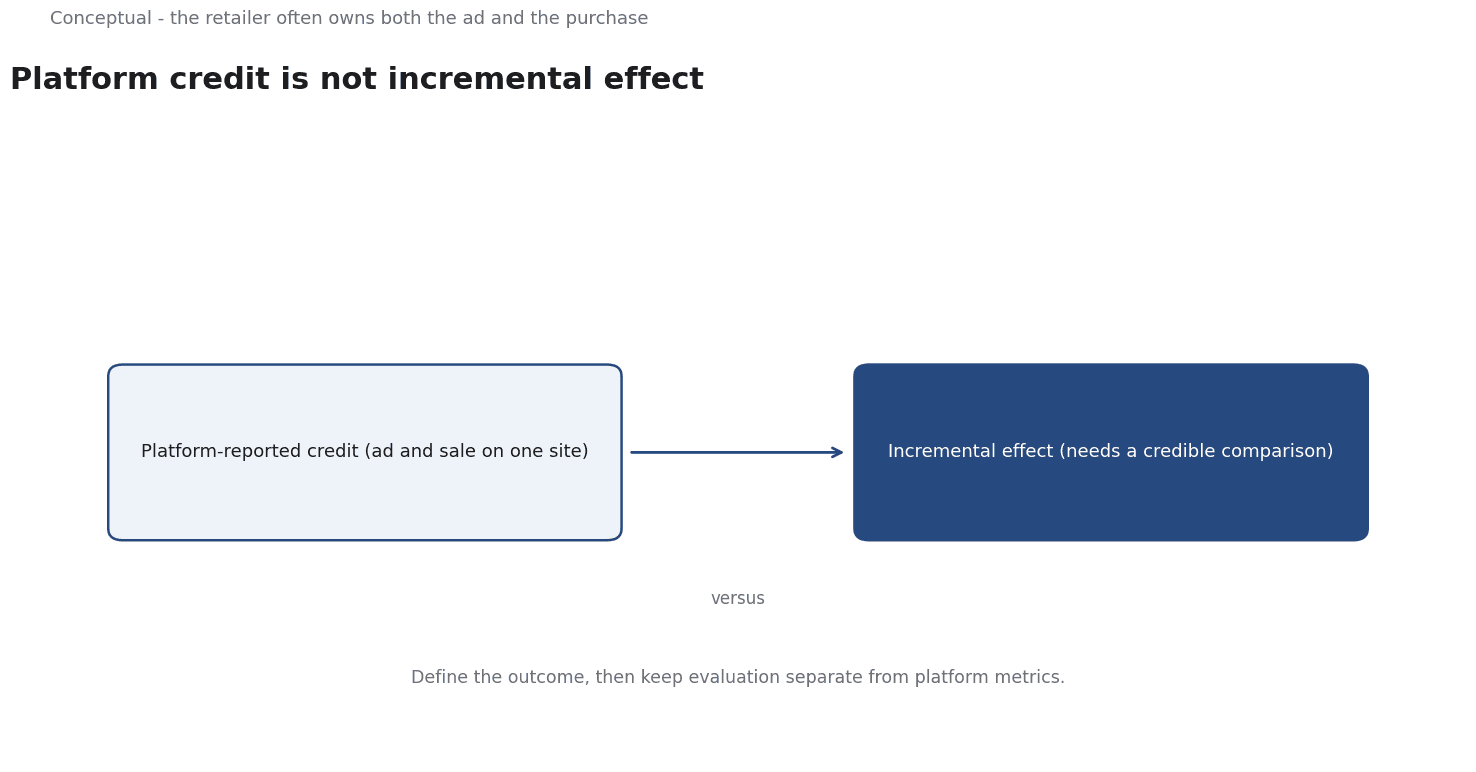
- The retailer often owns the sale. When the same platform reports both the ad and the purchase, its attribution is not independent evidence.
- The metric must be chosen. The IAB material covers measurement in the channel, but the choice of outcome remains a decision for the advertiser.
The sequence is: define the outcome, decide what comparison would be credible, and keep platform metrics separate from the evaluation. Choosing the comparison is judgement, so it is inferred; the channel structure is source-reported.
A worked example
Illustrative. A brand runs a campaign on a retailer's site and receives a report showing a high return on ad spend.
Three checks decide. First, is the reported sale the same customer the platform exposed, or does the credit rule assign purchases that would have happened anyway? Second, is there a comparable period or region without the campaign? Third, after fees and any price discount, what is the contribution rather than the gross sales?
The outcome is a qualified assessment, not a platform score. The numbers are hypothetical; the separation of credit from effect is the contribution.
Why the contract is part of the measurement
Retail media contracts decide what data the advertiser can see, which attribution window applies, and whether a holdout is possible. Those terms are measurement decisions made in a commercial document.
The most important clause is usually the one describing credit. If the platform counts every purchase by an exposed customer within a fixed window, the reported return will include buyers who needed no advertising. That does not make the platform dishonest; it means the number answers a different question from the one the advertiser is asking. Knowing the rule is the precondition for interpreting the result.
Data access matters for the same reason. A campaign that cannot export event-level data cannot be joined with the advertiser's own records, which are often the only independent reference available. Aggregate dashboards can show a trend, but they cannot show whether the trend is incremental.
What a credible evaluation needs
A credible evaluation combines the platform's view with an external reference. The reference can be simple: a comparable region, a period without spend, or a category with similar demand. It has to be chosen before the campaign so that the comparison is not selected to fit the result. When the two views disagree, the disagreement is the useful finding.
Evidence status
| Claim | Status | Source | Verified | Recheck when |
|---|---|---|---|---|
| Retail media uses retailer properties and data | source-reported | Wikipedia, Retail media | 2026-11-18 | Definition revised |
| The channel has developed measurement standards | source-reported | IAB retail media guidance | 2026-11-18 | Standards updated |
| Separate platform credit from incremental effect | inferred | Derived from attribution logic | 2026-11-18 | Measurement method changes |
Why attribution is the central problem
A platform that can see both the advertisement and the transaction can report a clean path between them.
That path is real as a record, but it is not the same as a causal effect.
Customers who see an ad for a product they already intended to buy will be counted as conversions, and the campaign appears more effective than it is.
A comparison is the practical correction. It need not be elaborate: a holdout region, a period without spend, or a matched category can all provide a reference point. The choice should be made before the campaign, because selecting a comparison after seeing the result invites the same bias the measurement was meant to remove.
What it cannot do
It cannot guarantee incremental sales. It does not replace a value proposition, which the buyer evaluates. And it cannot remove the need to read the contract terms, which decide what is measured and who owns the data.
The counterargument that a high reported return is sufficient is fair for a rough screen and incomplete for a decision to scale spend.
A decision test
- Define the outcome.
- Choose a comparison before launch.
- Keep platform credit separate from effect.
- Compute contribution after fees.
- Check the contract terms.
- Record the decision and the recheck condition.
For the buying context, see Getting Started with Retail Media.
References & Further Reading
- Wikipedia contributors, 2026. Retail media - Wikipedia — Overview of retail media channels, first-party data and the reported ~21% share of global digital ad spend in 2024; secondary reference used with IAB and NRF material.
- IAB, 2026. Retail Media Archives - IAB — The IAB topic hub for retail media, including the Rise of Retail Media Networks resources; evidence that this is an established industry category.