Retail Technology without the Hype
Retail technology spans point-of-sale systems and reverse logistics. Learn how to tie each tool to a decision, with sources, limits, and claim status explicit.
Retail technology is often sold as a catalogue of tools, from point-of-sale terminals to returns systems. The point-of-sale entry describes systems that record transactions at the moment of sale, and the reverse logistics entry describes the flow of goods back from the customer. The real problem is deciding which of these systems changes a decision, because a tool that records an event is not the same as a tool that improves an outcome.
Direct answer: Point-of-sale systems capture transaction data at the point of sale, and reverse logistics manages the return flow of goods, reusable packaging, and unsold stock. The sources describe what these systems do; the rule that a technology earns its place only when it changes a decision is a synthesis. Adoption should follow the decision, not the feature list.
Delta: This article adds a claim-status table and a decision-linked technology test beyond the sources: it maps each retail system to the decision it supports, with claim status explicit.
The mechanism
A point-of-sale system is the place where a sale is recorded. The source describes hardware and software that capture the transaction, update inventory records, and often handle payment. The practical consequence is that the system creates a data record at the moment of exchange: what sold, when, at what price, and through which channel. That record is an input to later decisions about replenishment, pricing, and staffing. If the record is incomplete or delayed, every downstream decision inherits the gap. The technology's value therefore lies less in the terminal itself than in the reliability of the record it produces.
Reverse logistics covers the flow of goods from the customer back toward the seller. The source describes returns, reusable packaging, and unsold-goods flows, including the handling and disposition steps that decide whether an item is resold, refurbished, recycled, or discarded. The practical consequence is that a return is not the end of a transaction but the start of a second process with its own costs. A retailer that tracks the forward sale but not the return flow knows only half of the product journey. Decisions about sourcing, pricing, and inventory all change when returned goods re-enter the system at uncertain quality and timing.
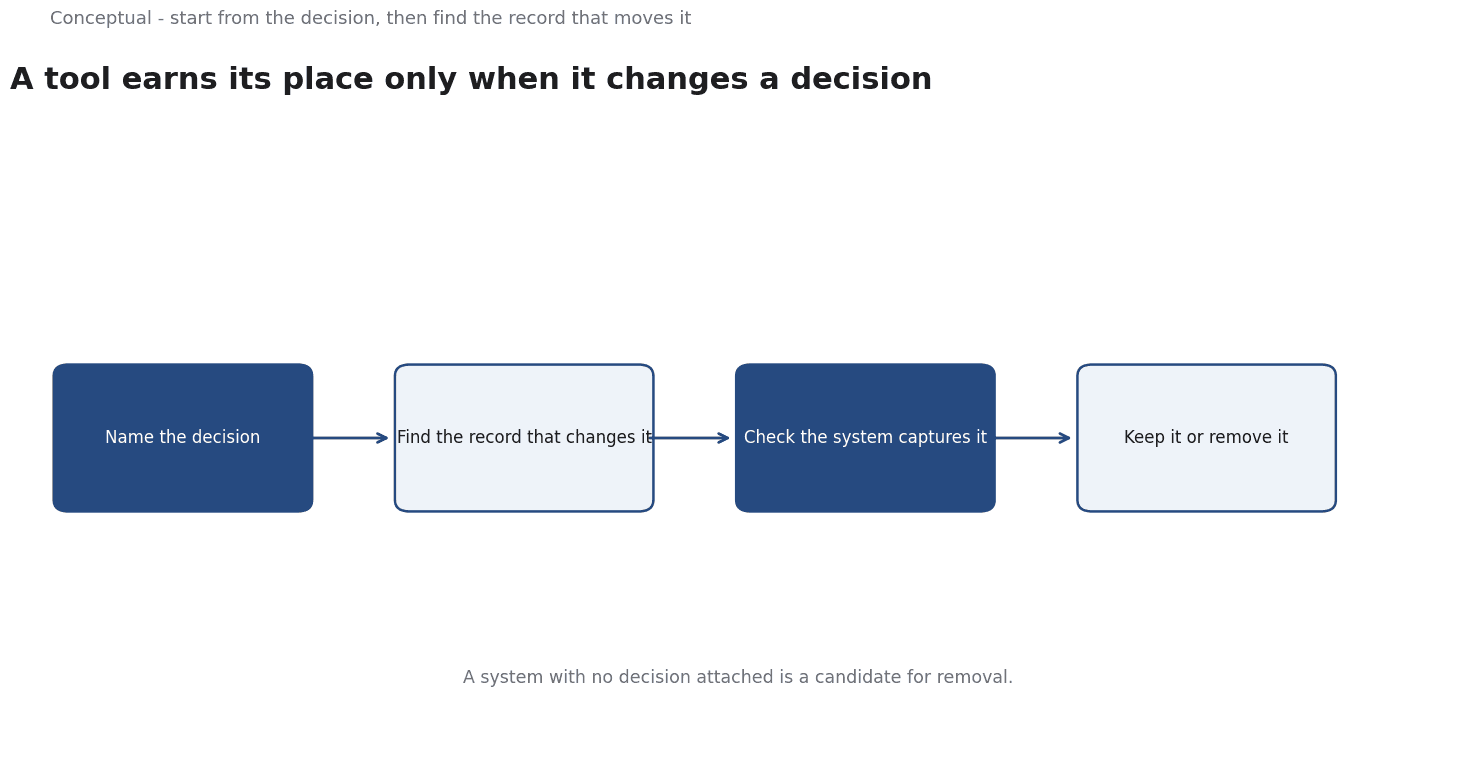
The two sources describe transactions and return flows separately; neither says which system a particular retailer should buy. That choice is inferred, not source-reported. A useful discipline is to begin with the decision and ask which record would change it. If the decision is how much stock to reorder, the relevant input is accurate sales data from the point of sale, adjusted for returns. If the decision is how to dispose of a returned item, the relevant input is the condition and routing information captured in reverse logistics. Starting from the decision prevents a common failure in which a retailer installs a system and only later asks what it is for.
The practical consequence is that retail technology should be evaluated by the decisions it improves, not by the category it belongs to.
A point-of-sale upgrade that produces cleaner transaction records can change replenishment and pricing decisions, while a returns system that captures disposition quickly can change recovery and sourcing decisions. Each system should have an owner, a defined record, and a decision it serves. A system with no decision attached is a candidate for removal, because it consumes budget and attention without improving a choice. The same logic applies when new tools appear: the question is not whether the technology is impressive but which decision becomes better.
A worked example
The following is hypothetical and illustrative. A regional retailer considers replacing its point-of-sale terminals and adding a returns-tracking module before a seasonal peak. Three checks decide the review. First, which decision would each system change, and is that decision made often enough to matter? Second, does the current point-of-sale record capture the fields needed for replenishment, including price and channel, or would the new system only change the interface? Third, does the returns module record disposition and timing so that returned goods can be reintroduced into inventory decisions? The review finds that the terminals would not change any decision, because the existing records are already accurate, while the returns module would change how much new stock is ordered after the peak. The retailer defers the terminal purchase and pilots the returns module. The numbers are hypothetical; the verification method is the contribution.
Evidence status
| Claim | Status | Source | Verified | Recheck when |
|---|---|---|---|---|
| Point-of-sale systems record transactions at the point of sale | source-reported | Wikipedia, Point of sale | 2026-11-18 | Definition revised |
| Reverse logistics handles returns, packaging and unsold goods | source-reported | Wikipedia, Reverse logistics | 2026-11-18 | Definition revised |
| Tie each retail system to a decision it changes | inferred | Derived from the sources | 2026-11-18 | Decision process changes |
The first two rows restate definitions found in the sources. The third row is a synthesis, since neither source prescribes an adoption rule. Recheck the definitions if the source entries change, and recheck the inferred claim when the retailer's decision process or the set of available systems changes.
What it cannot do
Retail technology cannot by itself improve a decision. A point-of-sale system records what happened; it does not decide what to do next. The point-of-sale source describes capture and recording, not judgment about replenishment or pricing. A retailer can install a new terminal and continue making the same ordering decisions with cleaner inputs but no better rule. The technology supplies a record, and a person or a separate process still has to interpret it. Treating the tool as the decision maker mistakes the input for the choice.
The hidden cost is maintenance and integration. Every system needs its records kept accurate, and definitions drift when products, channels, or pricing rules change. A point-of-sale record that once captured channel may stop doing so after a channel rename, and the dashboard built on it will keep reporting a stable number. Reverse logistics adds its own burden: returned goods arrive with variable condition and timing, and a system that records the return but not the disposition leaves the recovery decision unmade. Integration between the two systems is where most of the work sits, and the sources do not describe that work.
The main failure mode is tool-first adoption.
This produces systems that are used for reporting but not for decisions, and it creates a data landscape in which the same event is recorded twice with different definitions. The result is not more insight but more reconciliation. Because both sources describe functions rather than adoption outcomes, this risk is an inference drawn from the gap between recording and deciding.
There is a boundary around what these systems cover. Point-of-sale data covers recorded transactions only, excluding unrecorded sales, cash leakage, and conversations that never reach a terminal. Reverse logistics covers goods that come back, not goods that are written off in place. Neither system captures competitor actions, brand perception, or the reasons a customer returned an item. A retailer that treats the combined record as the whole picture will miss the causes that live outside the recorded flow.
Because definitions and product flows change, both systems need periodic review. Each record should be checked against the decision it serves and changed if it no longer informs one. Owners and recheck dates should be recorded next to the system, and any claim that a tool improved an outcome should be tested against a decision that actually changed. Without that record, a new manager cannot tell why a system exists or whether it still earns its budget.
The counterargument that modern retail technology is easy to adopt is fair for setup and incomplete for value, since a working system still has to change a decision.
A decision test
- Name the decision the technology is meant to change.
- List the systems currently in place and the records they produce.
- For each system, ask which decision would change if the record were better.
- Check that the point-of-sale record includes the fields that decision needs.
- Check that the returns record includes condition, timing, and disposition.
- Remove or pause systems that inform no decision.
- Assign an owner, a recheck date, and a decision link to each remaining system.
Retail technology is worth its cost only when it changes a choice. The test ties each system to a decision and makes the record explicit, so a reviewer can see what the tool captures and when its value should be questioned. For further reading, see Data Governance: Managing Data as an Asset.
References & Further Reading
- Wikipedia contributors, 2026. Point of sale - Wikipedia — Systems for recording transactions at the point of sale.
- Wikipedia contributors, 2026. Reverse logistics - Wikipedia — Overview of product returns, reusable packaging and unsold-goods flows; secondary reference used with NRF and Census data.