Getting Started with Retail Media Buying
Retail media uses a retailer's data at the point of purchase. Read how to buy it, a worked example, and the measurement that keeps it honest.
Retail media lets a brand advertise on a retailer's site using the retailer's first-party purchase data. It is attractive because it reaches a shopper near a decision and can be measured against sales in the same system. It is also a channel where the platform sells the inventory and reports the result, which is a reason for careful measurement rather than blind trust.
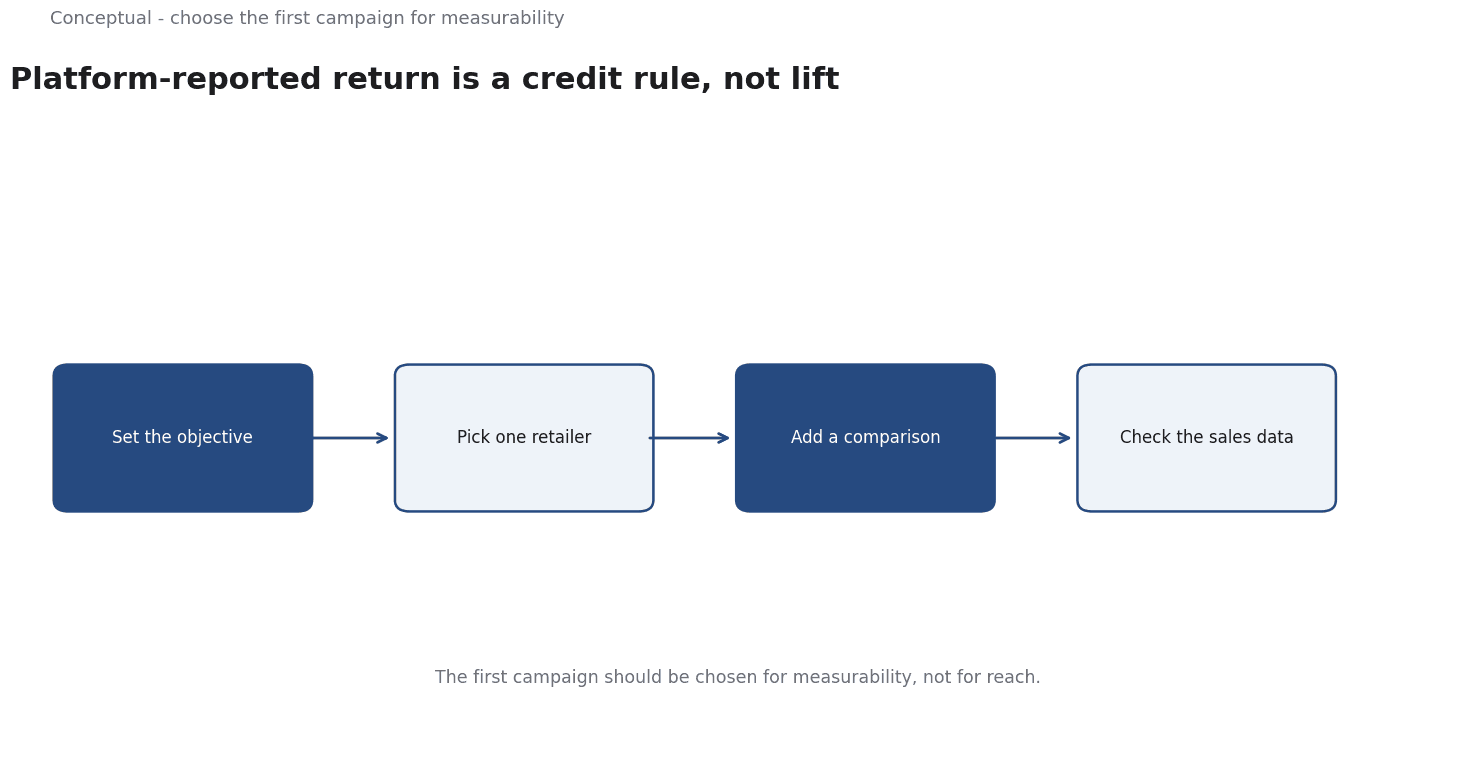
Direct answer: Start with a clear objective and a narrow test on one retailer, using the retailer's own sales data with a comparison group where possible. The IAB retail-media resources and the retail-media overview provide channel context. The boundary: platform-reported return is a credit rule, not incremental lift, which the attribution article explains, and no tactic guarantees a sales outcome, as the publication standard states.
How the buying works
Placements. Sponsored results on search pages, product-display ads, and placements on the retailer's other properties, as the retail-media overview describes for channels near the point of purchase. Each has a different intent and should be judged against a different outcome.
Targeting. The retailer's first-party data — past purchases, browsing, and category interest — is the advantage, as the IAB resources explain for why the channel grew with cookie deprecation. A brand cannot take that data elsewhere, which creates dependency on the platform.
Measurement. Sales reported inside the retailer's system, which is direct and detailed, and a comparison design to estimate what would have happened otherwise, as the geo-experiment guidance recommends for any material spend.
Three consequences follow. The channel is strongest for brands already sold by that retailer, which the retail-media article treats as the context of the purchase. The data advantage is real but partial, as the retail-media discussion of what the numbers measure explains. And the reporting is provided by the seller, which the attribution article treats as a claim to examine, not proof.
A worked example
The following is hypothetical and illustrative. A brand spends 50,000 on sponsored search placements with one retailer and sees 200,000 in attributed sales.
Three checks decide whether to expand. First, what is the margin on those sales, as the unit-economics article requires for contribution rather than revenue? If gross margin is 30%, the contribution is 60,000 against 50,000 spend, before other costs. Second, are the sales incremental, which the geo-experiment guidance addresses with a holdout? If 40% would have occurred anyway, the incremental contribution falls to 36,000 and the campaign loses 14,000. Third, did the placement affect other channels, as Marketing Attribution: Multi-Touch Models, Incrementality, and Budget Allocation warns about credit across touchpoints?
Three conclusions follow. The headline return was misleading without incrementality, as Marketing Attribution: Multi-Touch Models, Incrementality, and Budget Allocation explains. A narrow test with a holdout is worth more than a broad rollout, which the AI-integration blueprint recommends for bounded experiments. And the decision should be recorded with the assumptions, as the decision-memo article requires.
Choosing the first placement
The first campaign should be chosen for measurability, not for reach.
Sponsored search on a retailer's own site is usually the best starting point because the shopper's intent is visible in the query and the sale is recorded in the same system, as the retail-media overview describes for placements near the point of purchase. A display placement higher in the funnel is harder to judge and easier to over-credit, which the attribution article warns about for credit rules.
The brand should also be ready operationally. If the product is frequently out of stock or the price is uncompetitive, advertising will send shoppers to a poor experience, which the inventory article treats as an operating decision. The retailer's data can target precisely, but it cannot fix the offer, as the value-proposition article argues for the buyer's real evaluation.
Finally, the test should have a stop condition. A defined budget, a margin-based outcome, and a comparison group make it possible to decide whether to expand, which the decision-memo article requires for a recorded judgement. A campaign that continues because the dashboard looks active is a habit, not a decision, as Marketing Attribution: Multi-Touch Models, Incrementality, and Budget Allocation warns about allocating by activity instead of return.
What retail media cannot do
It cannot create demand that does not exist, which the demand-generation article treats as prior preference building. It cannot be compared across retailers on a single number, because each platform's attribution and audience differ, as the retail-media measurement article explains. And it does not remove the need for a good product and price, which the value-proposition article treats as the buyer's real evaluation.
The counterargument that the channel is efficient because it is performance-based misses the cost of mis-attribution, which the worked example shows can reverse the conclusion.
A decision test
- Choose one retailer and one placement tied to a clear objective.
- Check the product is actually sold there, as Retail Media Networks: When the Retailer Becomes the Advertising Channel advises.
- Define the outcome with a margin, not revenue, as the unit-economics article requires.
- Use a holdout or matched comparison where spend is material, as the geo-experiment guidance recommends.
- Treat platform-reported return as an upper bound, as Marketing Attribution: Multi-Touch Models, Incrementality, and Budget Allocation warns.
- Compare carefully across retailers, as the measurement article advises.
- Record the result and the decision, as the decision-memo article requires.
For the channel, see Retail Media Networks; for the measurement, see Marketing Attribution.
References & Further Reading
- IAB, 2026. Retail Media Archives - IAB — The IAB topic hub for retail media, including the Rise of Retail Media Networks resources; evidence that this is an established industry category.
- Wikipedia contributors, 2026. Retail media - Wikipedia — Overview of retail media channels, first-party data and the reported ~21% share of global digital ad spend in 2024; secondary reference used with IAB and NRF material.