Retail Media Networks: When the Retailer Becomes the Advertising Channel
Retailers sell access to shoppers at the point of decision. Read the first-party data mechanism, a worked margin example, and the measurement trap.
A brand that wants to reach shoppers used to buy advertising from media companies and hope it influenced a purchase somewhere else. A retailer can now sell the same brand a placement on its own site, at the moment the shopper is choosing between products — and measure the sale that followed. That shift has turned the retailer's store and website into an advertising channel with its own economics.
Direct answer: Retail media is advertising placed on a retailer's own properties, using the retailer's first-party data about shopping behaviour. IAB maintains a dedicated retail-media topic area and a "Rise of Retail Media Networks" resource collection, and the practice is described as reaching audiences "at or near the point of purchase". Wikipedia's overview reports that retail media "use of first-party data has made it an appealing option for targeted advertising" following the deprecation of third-party cookies, and that retail media advertising represented "approximately 21% of global digital advertising spending as of 2024".
The boundary: the retailer's data advantage is real, but the attribution of sales to ads is a measurement choice, not an observed fact.
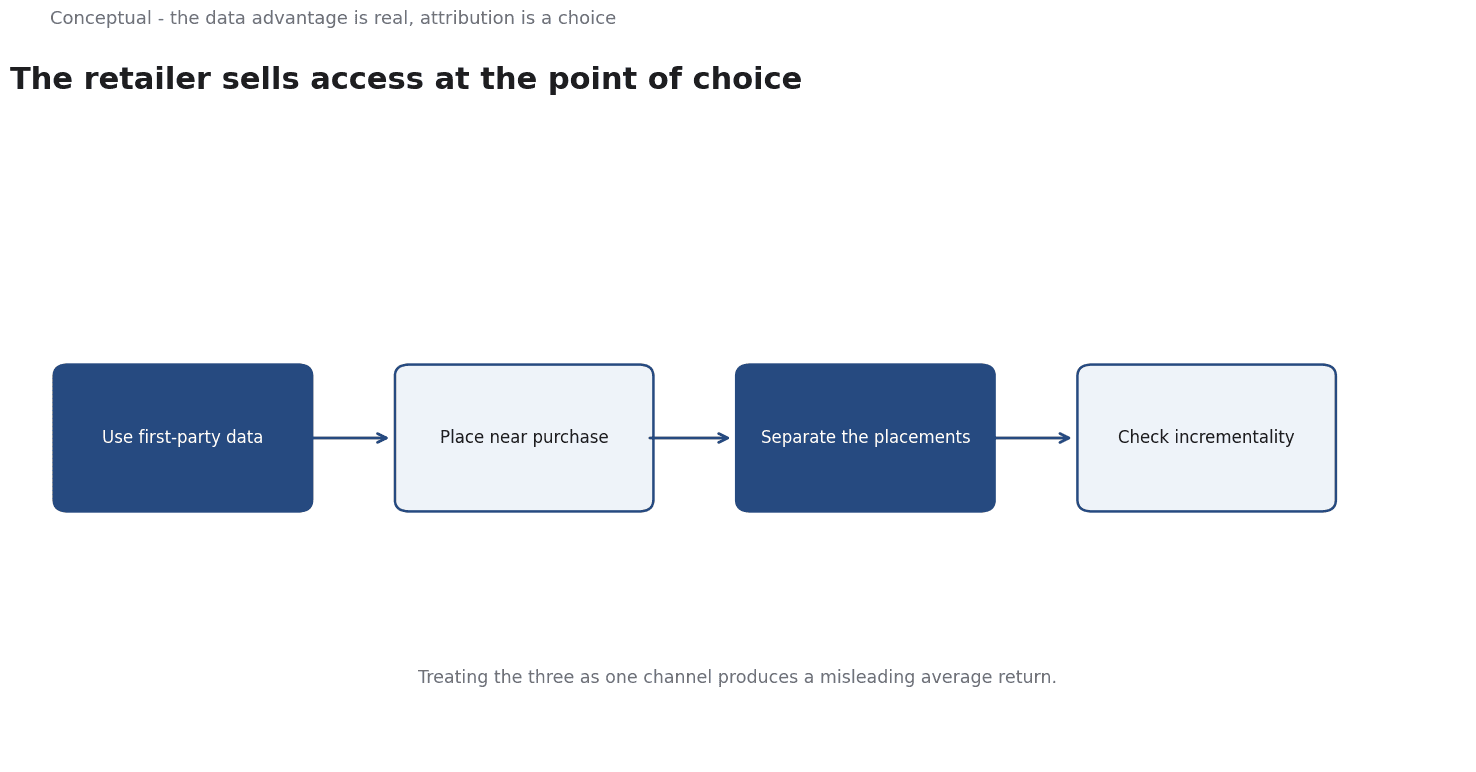
Why the retailer has an advantage
Three assets make the model work:
First-party purchase data. The retailer knows what was bought, by whom, and when — with the shopper's direct relationship rather than a third party's inference. As third-party tracking cookies have been deprecated, that first-party signal has become more valuable.
The point of decision. A placement on a search results page or product listing sits next to the choice it hopes to influence. The distance between seeing the ad and making the purchase is short, which makes the causal story plausible.
A closed loop. The retailer can observe the sale in its own system. That makes measurement cheaper and more concrete than advertising measured through external panels, though not automatically more correct.
IAB's retail-media topic hub reflects the category's maturity; its "Rise of Retail Media Networks" resources treat the networks as an established form of media rather than an experiment. NRF press releases are useful primary material for what the retail industry says about the channel, but they are statements by an industry body and should be read as perspectives on conditions.
A worked example of retail media economics
The following numbers are hypothetical and illustrative.
A grocery retailer has 10 million monthly active shoppers on its site and app. It sells a sponsored placement on the search results page for "coffee".
- Inventory: 2,000,000 searches for that term a month; the top sponsored slot appears on all of them.
- Pricing: sold on cost-per-click at 0.40, with a 5% click-through rate. Clicks = 100,000; ad revenue = 40,000 a month.
- Cost to serve: the placement uses existing infrastructure, so incremental cost is small — say 2,000 for ad operations and review. Gross margin on the placement is roughly 38,000, or 95%.
Three things matter beyond the clean margin:
- The placement competes with the shopping experience. If sponsored results crowd out relevant products, shoppers may trust the results less. That cost does not appear in the ad revenue line.
- The 5% click-through rate is an assumption. It varies by category and by how well the ad matches the query. A rate that looks strong in aggregate may hide poor performance on the searches that matter.
- Incrementality is unknown. Some of the attributed purchases would have happened without the ad, because the shopper already intended to buy that brand. A retailer selling "your ad drove 5,000 purchases" is reporting correlation event data, not a counterfactual.
A defensible measurement design holds out a matched set of searches where the placement is not shown and compares purchase rates. Without that, the reported return is an upper bound.
Onsite, offsite, and the boundary
Retail media is not one product. Three placements sit at different distances from the purchase:
Onsite — ads on the retailer's own site and app: search results, category pages, product detail pages. These have the clearest context and the shortest path to a sale, and they are the most limited in reach.
Offsite — the retailer's audience targeted on other platforms using its first-party data. This extends reach beyond shoppers already on the site, but the measurement loop is weaker because the purchase happens in a different environment.
In-store — signage, shelf displays, and digital screens. The context is strong and the measurement is typically the weakest of the three, often relying on promotions rather than individual-level attribution.
The distinction matters for a brand deciding where to spend. Onsite inventory is closest to a measurable sale, which is why it commands a premium; offsite inventory is bought for reach and should be judged by different metrics.
Who wins and who pays
Retailers gain a high-margin revenue stream that does not require selling more goods. The strategic risk is degrading trust in the shopping experience, which is the asset the revenue depends on.
Brands gain access to shoppers near the decision and to measurement inside the retailer's system. The risk is paying for purchases that would have occurred anyway, and becoming dependent on a channel whose rules the retailer controls.
Shoppers may see more relevant results, or more paid placement disguised as relevance. The difference is a design and disclosure question, not a technical one.
The counterargument that retail media is simply advertising with better targeting is too simple. It is also a change in who owns the customer relationship and the measurement of it.
A brand that cannot see the underlying data is buying a report from the party that also sells the ad.
What the model cannot promise
Three limits deserve clear statement.
The data is first-party, not complete. A retailer sees purchases in its own stores and site. It does not see what the shopper did elsewhere, and its "first-party" view is partial. Calling it a complete picture overstates it.
Attribution is a rule. Multi-touch and last-click models distribute credit by convention; the statistical agencies and measurement bodies have long warned against treating such outputs as causal. The retailer's closed loop makes the measurement cheaper, not causal by default.
Ad load has a ceiling. A site with too much sponsored inventory loses the usefulness that brought shoppers there. The 95% margin on a placement is attractive only while the placement does not damage the underlying business.
A decision test
- Name the shopper decision the placement sits next to, and check that the ad is relevant to it.
- Ask what data the retailer actually has — purchases in its own channels only, or a broader view.
- Demand a holdout or matched comparison before accepting an incrementality claim.
- Check how sponsored results are labelled so the experience stays trustworthy.
- Price the trust cost of additional ad load, not only the revenue.
- Treat platform-reported return as an upper bound until tested.
- Keep the brand's own measurement independent of the retailer's reporting.
For the channel economics, see E-commerce vs Brick and Mortar; for the measurement discipline, see Marketing Attribution.
References & Further Reading
- IAB, 2026. Retail Media Archives - IAB — The IAB topic hub for retail media, including the Rise of Retail Media Networks resources; evidence that this is an established industry category.
- Wikipedia contributors, 2026. Retail media - Wikipedia — Overview of retail media channels, first-party data and the reported ~21% share of global digital ad spend in 2024; secondary reference used with IAB and NRF material.
- National Retail Federation, 2026. NRF Press Releases | Latest Statements & Announcements | NRF — Primary retail-sales and channel data for sell-in versus sell-out definitions.