Retail Technology Best Practices
Retail tech succeeds when it serves the store and the customer. Read the operating principles, a worked example, and why novelty is a poor criterion.
Retail technology is often bought as a category — a point-of-sale system, a loyalty app, an analytics platform — and judged by features. The better question is whether it changes an operating decision that matters: what to stock, how to price, how to serve a customer. Technology that does not reach a decision is a cost with a demo.
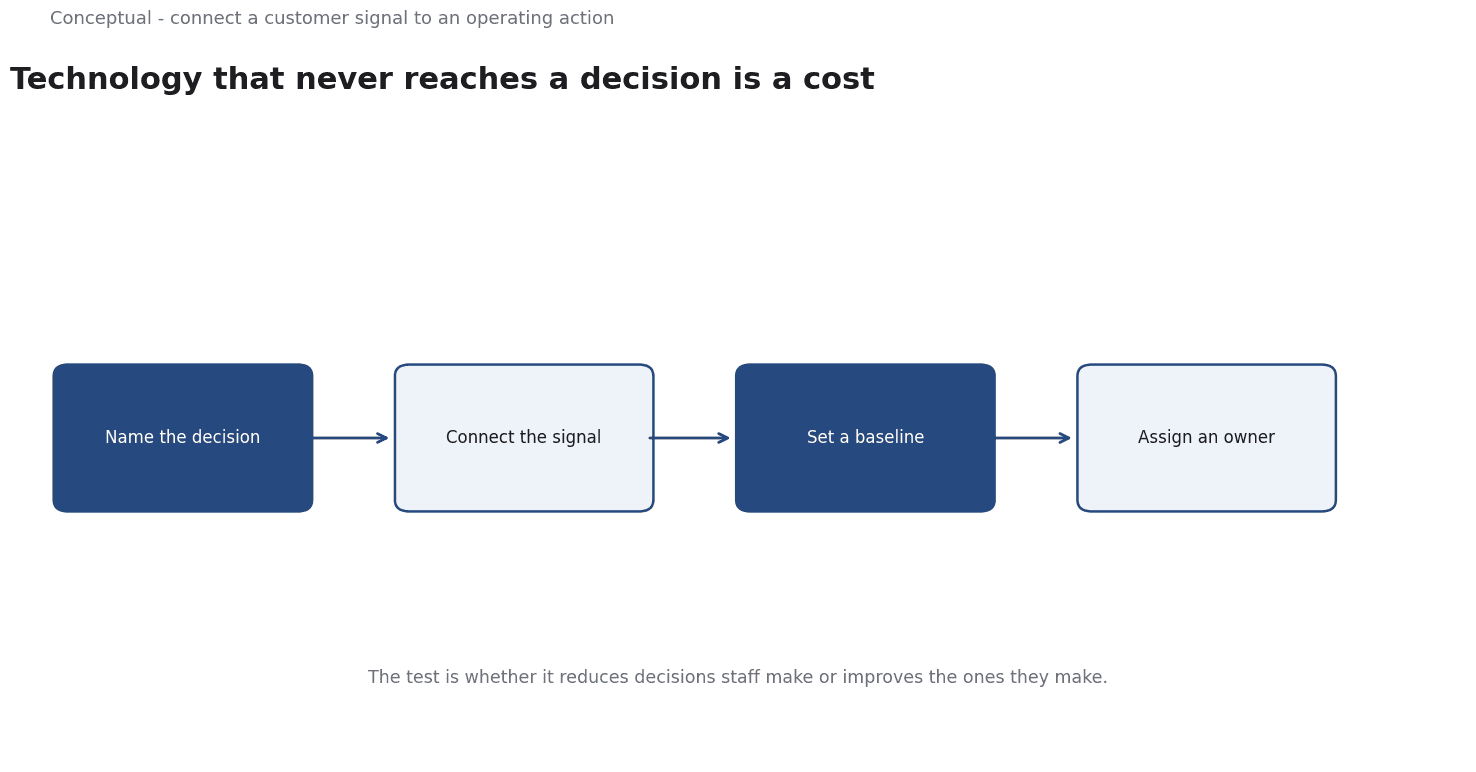
Direct answer: Adopt retail technology when it connects a customer signal to an operating action, with a defined baseline and an owner. The retail-media overview provides channel context, and NRF statements offer primary industry perspectives on conditions. The boundary: a tool cannot fix a weak assortment or a broken supply chain, which the product-assortment and inventory articles treat as the underlying decisions, and no structure guarantees a commercial result.
Operating principles
Start with the decision. What choice should the technology improve — replenishment, pricing, placement, or service? The merchandising article explains how these decisions interact, which is why the target must be named before the tool is chosen.
Connect signal to action. A dashboard that reports a trend without changing an order or a price is not an operating system, which the observability article argues for signals where decisions happen. The data-pipeline article covers the integration work that connects a signal to an action, as the infrastructure that makes it real.
Measure against a baseline. If the store already knows its stockout rate or basket size, the technology must change those figures, which the evaluation-rubric article requires for concrete evidence. A vendor's case study is a claim, as Retail Media Networks: When the Retailer Becomes the Advertising Channel treats platform-reported results as one input.
A worked example
The following is hypothetical and illustrative. A retailer considers a shelf-analytics system that claims to detect out-of-stocks from camera images.
Three checks decide whether to adopt it. First, does the store already have a reliable signal from point-of-sale data, which the sell-in versus sell-out article explains for what a transaction can and cannot show? If the data already flags a stockout, the camera adds cost without a new decision. Second, does the detection lead to an action with an owner — a replenishment task, a staff alert — as the incident-response article requires for a signal that changes something? Third, does a pilot reduce stockouts against a matched set of stores, which the geo-experiment guidance recommends for comparison?
Three conclusions follow. The technology earns its place only if it changes a decision, as the operating principle above requires. The cost includes integration and staff time, which the cloud-cost article treats as part of any workload. And the result should be recorded with the baseline, as the decision-memo article requires.
Why the store context decides
Technology that works in one store can fail in another because the operating context differs. A busy urban store has different stockout dynamics from a suburban one, which the inventory article treats as a question of demand variability and lead time. A tool that assumes a uniform process will produce recommendations that staff learn to ignore, as the human-in-the-loop article warns about controls that do not fit the people using them.
This is why a pilot should be judged in the environment where it will run, not in a controlled demonstration, which the AI-integration blueprint argues for bounded real-world tests. Staff behaviour, store layout, and local demand patterns are part of the system, as the merchandising article explains for placement and promotion.
The final consideration is the cost of attention. A retail team already manages assortment, pricing, inventory, and service, as the merchandising article describes for how those decisions interact. A new tool that adds a dashboard without removing a decision increases cognitive load, which the observability article warns about for signals that do not lead to action.
The right test is whether the technology reduces the number of decisions staff must make or improves the ones they already make.
What retail technology cannot do
It cannot fix a bad assortment, which the product-assortment article treats as a strategy decision. It cannot create demand, which the demand-generation article distinguishes from capture. And it does not remove the need for staff judgement — a recommendation that ignores local conditions is a failure, as the human-in-the-loop article argues for meaningful review.
The counterargument that competitors are adopting similar technology is a positioning argument, not evidence of value, which the competitive-positioning workshop article treats as a claim to test.
A decision test
- Name the operating decision the technology should change.
- Check whether existing data already supports it.
- Connect the signal to an action with an owner.
- Pilot against a matched baseline, as the geo-experiment guidance recommends.
- Include integration and staff cost, as the cloud-cost article requires.
- Keep human judgement where local context matters, as the oversight article advises.
- Record the decision, as the decision-memo article requires.
For the channel context, see Retail Media Networks; for the operating decisions, see Inventory Management.
References & Further Reading
- Wikipedia contributors, 2026. Retail media - Wikipedia — Overview of retail media channels, first-party data and the reported ~21% share of global digital ad spend in 2024; secondary reference used with IAB and NRF material.
- National Retail Federation, 2026. NRF Press Releases | Latest Statements & Announcements | NRF — Primary retail-sales and channel data for sell-in versus sell-out definitions.