Runway Extension Trade-Offs
More runway buys time, not certainty. Read the options, a worked comparison, and why the cheapest extension is not always the best.
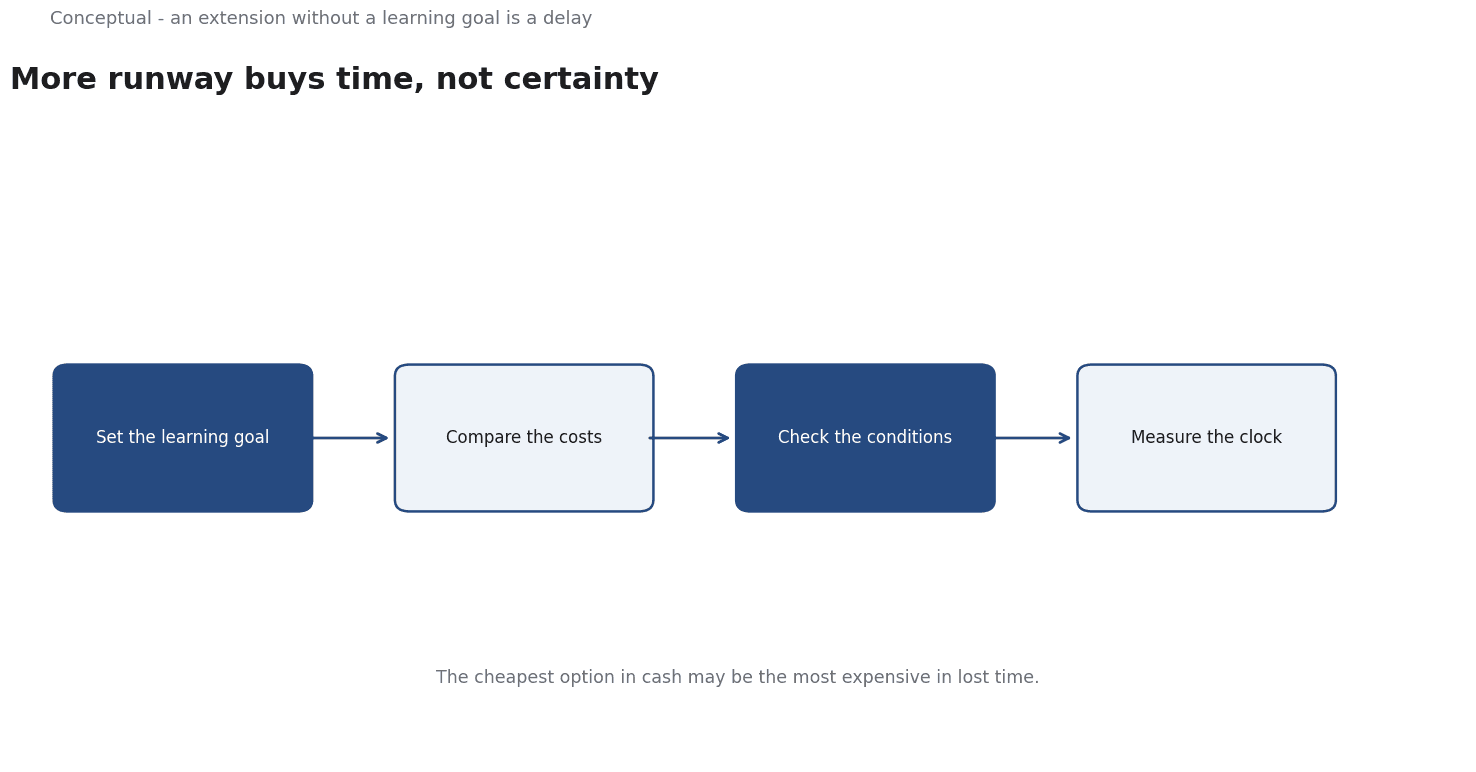
When a company extends its runway, it is buying time to learn. The question is what that time costs and what must be true by the end of it. A runway extension without a learning goal is a delay, and delay has a price in dilution, interest, or lost focus, as Burn Rate and Runway: The Founder's Daily Number treats runway as a deadline rather than a comfort.
Direct answer: Compare extensions by cost, conditions, and what they allow the company to prove, using the burn-rate calculation as the baseline. Investor education is explicit that returns are not guaranteed, and Damodaran's valuation work treats funding as a conditional decision. The boundary: an extension cannot create product-market fit, which the startup-validation article treats as the prior question, and it cannot remove a structural cash problem, which the working-capital article addresses as a business-model issue.
The options
Raise equity. Dilution but no repayment obligation, with a valuation that depends on evidence, as the startup-valuation article explains for conditional estimates.
Venture debt. Less dilution but a fixed obligation and covenants, which the venture-debt article treats as the central risk, as the debt-restructuring article explains for breaches.
Cut burn. Extends runway without external capital but may remove the capacity to learn, which the operating-model article treats as a cost of reducing scope.
Increase collections or price. Improves net burn from the revenue side, as the working-capital article explains for cash conversion, without the conditions of external funding.
Three consequences follow. Each option changes what the company can prove, which the 13-week cash-flow article treats as an operating question. Each has a time limit, which the burn-rate article makes explicit. And the choice should be recorded with the assumption that justifies it, as the decision-memo article requires.
A worked comparison
The following is hypothetical and illustrative. A company has 3 million in cash, a net burn of 500,000 a month, and six months of runway. It needs fifteen months to reach a milestone that would support a larger round.
Three options are considered. Cut burn to 300,000 by delaying two hires, which gives ten months but may slow the milestone, as the product-management article warns about capacity for the wrong problem. Raise 4 million of equity, which gives fourteen months at current burn with dilution set by the current valuation, as the cap-table article models. Raise 2 million of venture debt, which gives ten months with interest and a covenant to raise within eighteen months, as Venture Debt Best Practices describes. Three checks decide. First, which option preserves the ability to reach the milestone, which the cash-flow article treats as the use of funds? Second, what is the cost in dilution, interest, and lost capacity, as the unit-economics article requires for a comparison? Third, what if the milestone slips, which the scenario-analysis article treats as a downside case?
Three conclusions follow.
The cheapest option in cash may be the most expensive in lost time, which the burn-rate article implies for a longer runway.
The equity option preserves flexibility at a dilution cost, as the cap-table article explains. And the decision should be recorded with the milestone assumption, as the decision-memo article requires.
What a runway comparison cannot do
It cannot guarantee the milestone, which the startup-validation article treats as a hypothesis. It cannot remove market risk, which investor education states explicitly.
And it does not decide strategy: buying time for the wrong goal is still the wrong goal, as the strategy article argues for positioning before execution.
A decision test
- State the milestone the extra time must reach, as the startup-validation article advises.
- Compute runway and forward burn, as Burn Rate and Runway: The Founder's Daily Number requires.
- Compare cost in dilution, interest, and capacity, as the unit-economics article demands.
- Model what happens if the milestone slips, as the scenario-analysis article recommends.
- Check covenants if debt is involved, as Venture Debt Best Practices advises.
- Preserve the ability to learn, not just to wait, as the product-management article argues.
- Record the decision and the assumption, as the decision-memo article requires.
For the baseline, see Burn Rate and Runway; for the funding instrument, see Venture Debt Best Practices.
References & Further Reading
- U.S. Securities and Exchange Commission (Investor.gov), 2026. Introduction to Investing — Primary regulator guidance on market mechanics and investor protection.
- Aswath Damodaran, 2026. Damodaran Online: Home Page for Aswath Damodaran — Publicly maintained datasets for industry averages, WACC, and valuation.