Sales-led Growth Best Practices
A source-grounded look at sales-led growth, linking sales-process discipline and CRM hygiene to pipeline decisions, with every claim explicitly labeled.
Sales-led growth is often reduced to activity quotas and CRM dashboards, but the harder problem is deciding which pipeline signals deserve trust. When stages are loosely defined and customer records are incomplete, forecast and coaching decisions rest on noise. This article separates what the sources actually describe from what a team must infer to act on it.
Direct answer: Sales-led growth works best when a defined sales process is paired with disciplined customer relationship management data. The sources describe sales as a staged process and CRM as a system for organizing customer interactions; they do not prescribe a universal playbook. The practical answer is to make stage definitions and data quality explicit before treating pipeline metrics as decision inputs.
Delta: This article adds a decision mapping beyond the sources: it maps sales-process structure and CRM hygiene to concrete pipeline decisions, with claim status explicit.
The mechanism
The encyclopedic treatment of sales frames it as a process rather than a single event, spanning prospecting, qualification, presentation, handling objections, closing, and follow-up. This matters because a process can be instrumented: each stage is a point where a deal either advances or stalls. The practical consequence is that a team should define stage entry and exit criteria so that the word pipeline means the same thing to every reviewer, instead of reflecting individual intuition.
Customer relationship management is described as the strategies and systems organizations use to manage interactions with current and potential customers, often supported by technology that centralizes contact history, activity, and opportunity data. The practical consequence is that CRM is the substrate that makes the sales process observable. Without consistent capture, the funnel becomes a narrative that each rep tells differently rather than a measurement that can be audited.
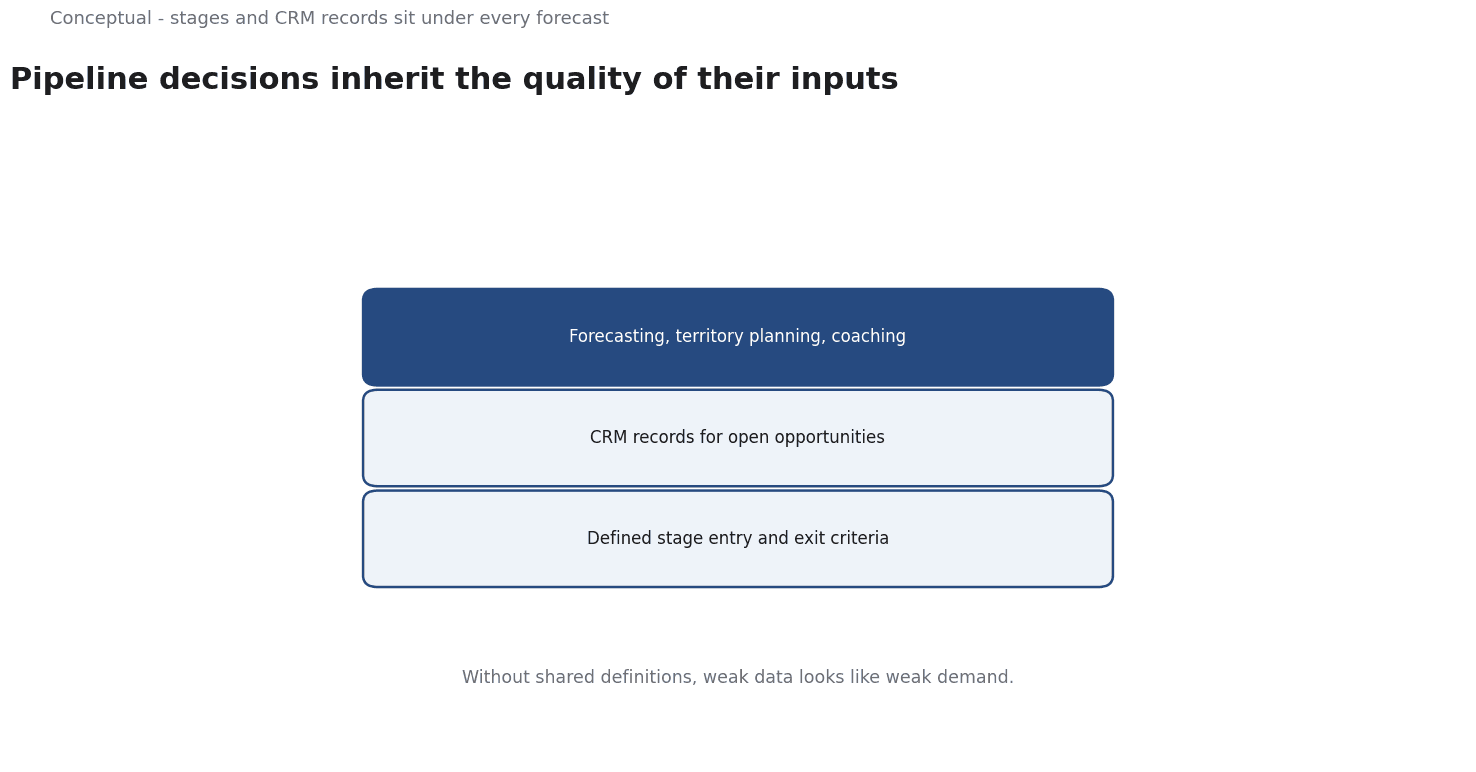
The two concepts combine into a simple operational logic: the process supplies the stages, and the CRM supplies the records that populate them.
Forecasting, territory planning, and coaching are downstream decisions that inherit the quality of both inputs. A team that cannot state its qualification criteria or show complete records for open opportunities cannot reliably distinguish a weak pipeline from weak data, and will likely misdiagnose one as the other.
Best practice therefore reduces to a few enforceable disciplines: explicit stage definitions, qualification rules, timely data capture, and review of both activity and outcome measures. These are choices a team can inspect and revise, not slogans posted on a wall. The sources justify the structure; the team must supply the thresholds and the enforcement.
A worked example
The following is hypothetical and illustrative. A mid-market software team reported a healthy pipeline yet missed two consecutive quarters. Three checks were applied. First, stage definitions were reviewed: qualified had no written exit criterion, so deals advanced on rep intuition. Second, CRM completeness was sampled: roughly a third of open opportunities lacked a next step or close date. Third, qualification criteria were compared across reps and found inconsistent. The outcome was not a demand problem but a measurement problem: once stages were redefined and record completeness enforced, the forecast narrowed and the team could see which deals were genuinely stalled. This scenario is illustrative, not a measured case.
Evidence status
| Claim | Status | Source | Verified | Recheck when |
|---|---|---|---|---|
| Sales is commonly described as a multi-stage process from prospecting through closing and follow-up | source-reported | Sales Wikipedia | 2026-11-18 | When the sales process taxonomy is revised |
| CRM systems centralize customer interaction data and support pipeline visibility | source-reported | CRM Wikipedia | 2026-11-18 | When CRM product categories shift |
| Stage definition and CRM hygiene determine the reliability of pipeline decisions | inferred | Derived from the sources | 2026-11-18 | When instrumented pipeline data is available |
The two source-reported rows describe concepts the references state directly: sales as a process and CRM as interaction management. The inferred row is the bridge this article adds, connecting data quality to decision reliability. Recheck conditions are concrete so the claims can be retired when better evidence arrives rather than assumed indefinitely.
What it cannot do
The sources are encyclopedic descriptions, not prescriptive studies or benchmarks. They summarize what sales and customer relationship management are, not which practices cause better outcomes. Any claim about effectiveness is therefore inferred rather than sourced, and the confident tone of a reference work should not be mistaken for causal evidence. A team cannot cite these sources to prove that a given cadence or qualification framework will improve results; it can only cite them to justify the structure being tested.
CRM discipline also has a hidden cost. Data entry consumes selling time, process rigidity can slow unusual but valuable deals that do not fit standard stages, and teams tend to optimize for fields rather than for customers. A pipeline that looks clean in a report may have been cleaned for the report. The very instrumentation that makes the process observable creates an incentive to present activity favorably, which is why completeness checks must be independent of the reps being measured.
Calls logged and emails sent are easy to count and easy to inflate, yet they say little about whether customer problems are being solved.
A team can appear disciplined while its pipeline quietly deteriorates.
The reverse failure is equally real: a well-documented process can become a ritual that everyone follows while nobody examines whether the stage criteria still match how buyers actually decide.
There is a boundary on transfer as well. The sources are generic across industries, deal sizes, and sales motions. They do not address enterprise versus transactional selling, inside versus field sales, or how cultural context changes buyer expectations. What counts as a qualified opportunity in one market may be meaningless in another, so the framework must be adapted rather than copied.
Finally, stage definitions and data quality degrade as products and markets change, so the mapping needs scheduled review. Pricing and packaging shifts alter the meaning of a qualified lead, and a new segment can invalidate old criteria without any obvious signal. Assign ownership for the definitions and revisit them on a fixed cadence.
The counterargument that a lightweight, informal process is fair for small teams is reasonable, but it is incomplete for forecasting: without shared definitions and complete records, pipeline numbers cannot be compared across reps or across periods.
A decision test
- Write an entry and exit criterion for every pipeline stage.
- Define qualification rules and verify every rep applies them the same way.
- Sample open opportunities for record completeness.
- Separate activity metrics from outcome metrics in reporting.
- Check whether the forecast changes when data quality is corrected.
- Review stage definitions after any pricing or product change.
- Label each pipeline claim as sourced or inferred before acting on it.
These steps turn a soft concept into an auditable routine. The point is not to add ceremony but to make the limits of the data visible before a decision depends on it. When the checks fail, fix the measurement before escalating the target. For further reading, see Data Quality in Practice.
References & Further Reading
- Wikipedia contributors, 2026. Sales - Wikipedia — Activity of selling goods or services.
- Wikipedia contributors, 2026. Customer relationship management - Wikipedia — Systems for managing customer relationships.