Search Intent Mapping Metrics that Matter
Intent mapping is a hypothesis about why someone searched. Read the metrics that test it and why a rank cannot validate a guess.
Search intent mapping assigns a query to a stage — informational, commercial, transactional — and builds a page to serve it. The map is a hypothesis about a person's decision, not a property of the words. The metrics that matter are therefore the ones that test whether the hypothesis was right, not the ones that report a ranking.
Direct answer:
Test intent mapping with stage-matched outcomes — engagement with the next step, qualified conversion, and progression — using a fixed question set and a comparison where possible.
AAPOR's standards govern survey wording, and geo-experiment guidance covers comparisons. The boundary: no structure guarantees a ranking, which the publication standard states for SEO, and a SERP observation is evidence of what currently ranks, not proof of what a searcher meant, as the keyword-research article warns.
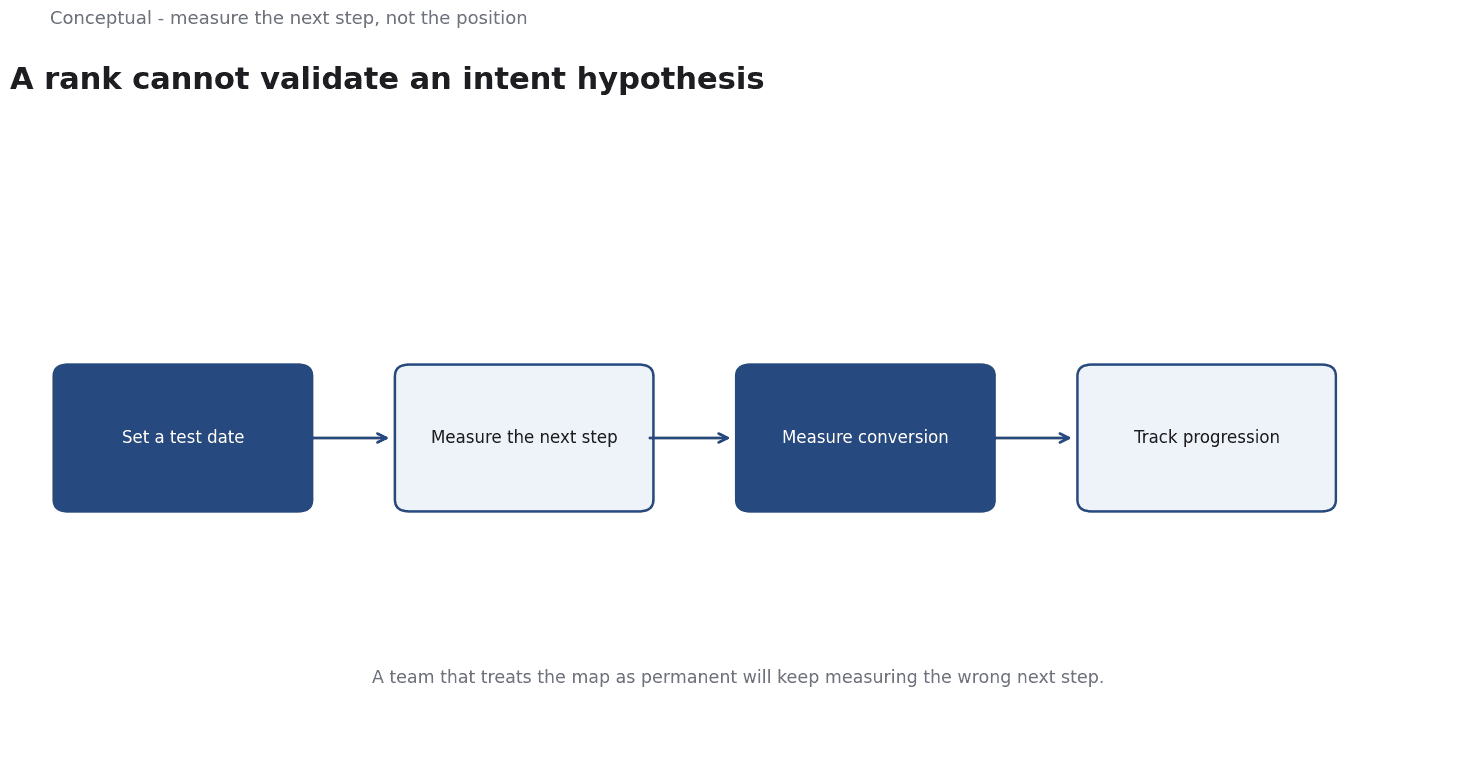
Why the map needs a test date
An intent map is a hypothesis about a moment in time. The SERP for a query changes as competitors publish, as engines change how they interpret queries, and as the product enters new categories, which the keyword-research article treats as a reason to check current results rather than rely on a stored map. A page mapped as informational a year ago may now face commercial pages, and a next step that made sense then can be premature or timid now, as the funnel article explains for stage transitions.
The practical discipline is to give each mapping a date and a review trigger tied to evidence — a change in what ranks, a shift in stage-matched conversion, or a new product, as the monitoring article advises for maintained standards.
Finally, the map should be recorded alongside the evidence that supported it, as the decision-memo article requires for consequential judgements. When the next review happens, the question is not whether the page ranks but whether the original reasoning still holds, which the keyword-research article frames as checking the observable signals again.
What to measure
Stage-matched next step. A page serving an informational question should lead to a relevant guide, not an immediate demo, which the funnel article treats as a stage transition. Measure whether the next step is taken, which the email-metrics article argues for downstream signals over opens.
Qualified progression. Did the visitor become a qualified opportunity, which the demand-generation article treats as capture, and does the rate differ by mapped stage, as the segmentation article advises for real differences?
Dwell and return behaviour. Time on page and return visits are leading signals that the content answered the question, which the product-analytics article treats as observed behaviour. They are not outcomes, as the evaluation-rubric article warns about proxy metrics.
A fixed question set. AAPOR's standards require consistent wording for comparable measurement, which the AI-search keyword article applies to observed queries, as the measuring-GEO article recommends for dated observations.
Three consequences follow. Metrics should be tied to the mapped stage, as the funnel article advises. They should have a baseline, which the geo-experiment guidance supports for comparisons. And they should be reviewed when the SERP changes, as the monitoring article treats as a change trigger.
A worked example
The following is hypothetical and illustrative. A company maps three queries to three stages and publishes one page each: an explainer, a comparison, and a pricing page.
Three checks decide whether the mapping was right. First, does each page produce its intended next step, as the funnel article measures transitions? Second, do qualified rates differ by stage, which the segmentation article treats as evidence of a real difference? Third, would a different mapping perform better, which the A/B testing article tests by swapping the next step on one page?
Three conclusions follow. A page can rank and still fail its stage, which the publication standard warns about treating visibility as an outcome. A stage with no progression indicates a wrong hypothesis, as the decision-memo article requires for a recorded judgement. And the map should be revised with evidence, not a reshuffle of keywords, as the keyword-research article advises.
What intent metrics cannot do
They cannot read a searcher's mind, which AAPOR's standards treat as a question of what can be asked and answered. They do not guarantee a ranking, which the publication standard forbids claiming. And they cannot establish causation from a before-and-after chart, as the attribution article warns about credit rules.
The counterargument that a SERP tells you the intent is partly true and incomplete, which the keyword-research article treats as an observation to combine with behaviour, as the measuring-GEO article advises for multiple signals.
A decision test
- Map each query to a stated stage with reasoning, as the decision-memo article requires.
- Choose one next-step metric per stage, as the funnel article advises.
- Measure qualified progression, as the demand-generation article requires.
- Use a fixed question set with AAPOR-style wording.
- Compare against a baseline, as the geo-experiment guidance recommends.
- Revise the map on evidence, as the keyword-research article advises.
- Record the decision, as the decision-memo article requires.
For the method, see Search Intent Mapping; for the comparison, see How to Measure Brand Lift.
References & Further Reading
- American Association for Public Opinion Research, 2026. AAPOR — The professional association for public opinion and survey research; its standards and resources underpin the survey-design discussion.
- Brian Vaver and Koehler, 2011. Measuring Ad Effectiveness Using Geo Experiments — Geo experiments for incrementality, the cleanest way to attribute marketing spend.