Sales Enablement Metrics that Matter
Enablement is not content volume. Read the metrics that test whether sellers actually change behaviour and win better deals.
Sales enablement is often measured by what it produces — decks, battlecards, training sessions — which is activity rather than effect. A team can publish dozens of assets and still have sellers who improvise every pitch. The useful metrics ask whether the material is used and whether it changes a deal outcome.
Direct answer: Measure adoption of the material, its contribution to a specific conversation, and the downstream qualified outcome, with a baseline. O*NET's role descriptions help define what a seller actually does, and geo-experiment guidance offers a comparison design for a material intervention. The boundary: no metric guarantees a sale, which the publication standard states for commercial claims, and credit rules are not causal measurements, as the attribution article warns.
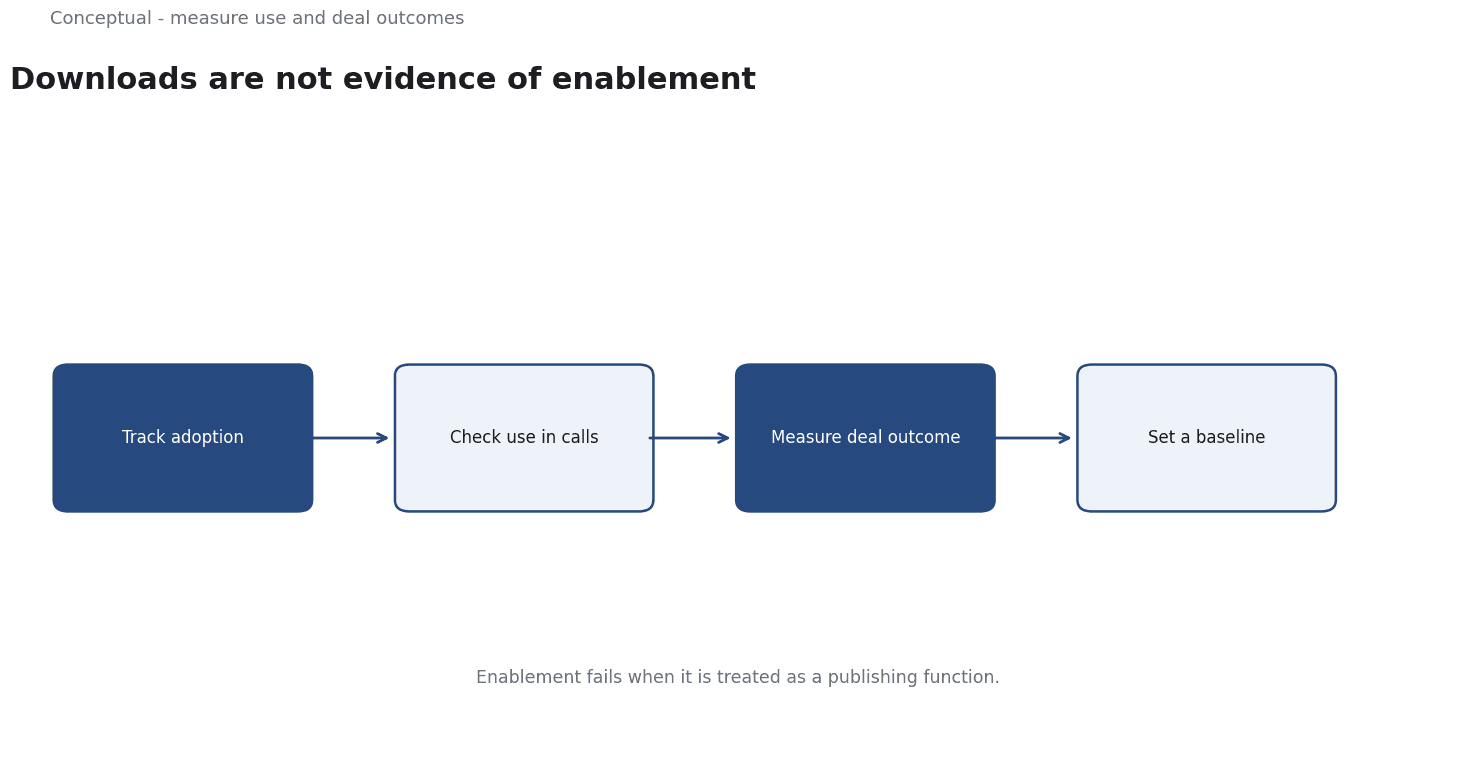
The metrics
Adoption. Is the material actually opened and used in deals, which the documentation article treats as the test of whether guidance is consulted? A battlecard nobody opens has no effect, as the content-operations article warns for documents that sit on a shelf.
Coverage of roles. Does the material address the people in the buying decision, as the account-based-marketing article advises for mapping a committee? Content for only one role leaves the others to be persuaded by whoever happens to make the call.
Conversation quality. Do sellers use the evidence to answer a buyer question, which the value-proposition article treats as the substance of a claim? This is harder to measure than opens and may require call review, as the voice-of-customer article recommends for qualitative evidence.
Downstream outcome. Does the deal progress, which the funnel article treats as a stage transition, against a baseline, as the geo-experiment guidance recommends? A metric that stops at engagement is an intermediate signal, as the email-metrics article warns.
Three consequences follow. The metrics should be tied to a specific decision, which the evaluation-rubric article requires for concrete evidence. They should be read together, as the product-analytics article argues for observed behaviour over stated agreement. And they should have an owner, as the governance checklist requires for any maintained programme.
A worked example
The following is hypothetical and illustrative. A team gives sellers a new one-page comparison for a common competitor.
Three checks decide whether enablement worked. First, adoption: is the page used in calls where the competitor is named, which the documentation article treats as usage rather than distribution? Second, conversation quality: do sellers reference the sourced criteria rather than unverified claims, as Competitive Battlecards without the Hype advises for credibility? Third, outcome: does qualified progression improve against a period before the card, which the geo-experiment guidance supports for a comparison?
Three conclusions follow.
A card that changes the conversation is valuable even before a measurable revenue shift, which the value-proposition article treats as the buyer's evaluation. And the result should be recorded, as the decision-memo article requires for a judgement with a baseline.
From content to capability
Enablement fails when it is treated as a publishing function.
The output of the work is not a deck but a seller who can answer a buyer's question with evidence, which the value-proposition article treats as the buyer's evaluation. A content library that grows while call quality stays flat is a cost, as the content-operations article argues for roles and review loops that change the work.
This is why call review matters. Listening to a small sample of conversations with and without the material gives qualitative evidence of what changed, which the voice-of-customer article recommends for feedback that surveys miss. A seller who uses the sourced criteria from a battlecard is demonstrating a different capability, as Competitive Battlecards without the Hype argues for fair, sourced comparisons, and that capability is the thing enablement should measure.
The metrics should also feed back into what gets built. If a particular asset is never used, the question is whether it addressed a real decision, as the jobs-to-be-done article asks for a job rather than a feature. Retiring unused material is as important as creating new material, which the content-repurposing article recommends for formats that do not perform.
What enablement metrics cannot do
They cannot fix a weak product, which the value-proposition article treats as the buyer's prior question. They cannot establish causation from a before-and-after comparison without a control, as the attribution article warns about credit rules. And they do not replace coaching: a seller who does not understand the material will not use it well, which the engineering-management article analogises to culture built by decisions.
The counterargument that sellers know what they need is partly true and misses the point that enablement provides evidence they cannot easily gather, as the competitive-intelligence article argues for method.
A decision test
- Define the decision the material should change, as the evaluation-rubric article requires.
- Map the buying roles, as the account-based-marketing article advises.
- Measure adoption in real deals, as the documentation article recommends.
- Review conversation quality with call evidence, as the voice-of-customer article advises.
- Compare downstream progression with a baseline, as the geo-experiment guidance recommends.
- Assign an owner for the material and the metrics, as the governance checklist requires.
- Review after a product or competitor change, as the monitoring article advises.
For the material, see Competitive Battlecards; for the GTM context, see Founder-Led Sales.
References & Further Reading
- U.S. Department of Labor, 2026. O*NET OnLine — The standard occupational taxonomy used to compare roles across industries.
- Brian Vaver and Koehler, 2011. Measuring Ad Effectiveness Using Geo Experiments — Geo experiments for incrementality, the cleanest way to attribute marketing spend.