Search Recommender Engines: How Search and Recommendation Converge
Search and recommendation are becoming the same ranking problem. Read what each still does differently and what the convergence means.
Search starts with a query; recommendation starts with a user. Increasingly, both are the same problem: given a context and a set of candidates, produce an ordered list that someone will find useful. The systems have converged at the level of architecture even where they differ at the level of intent.
Direct answer:
Search systems are moving toward learned ranking, personalisation, and semantic matching; recommender systems are moving toward explicit intent and query-like inputs.
The shared machinery is candidate generation followed by ranking, with embeddings representing queries, users, and items in a common space. The difference that remains is the role of explicit intent: a search query is a strong signal that should dominate personalisation, while a recommendation has no query and must infer intent from context.
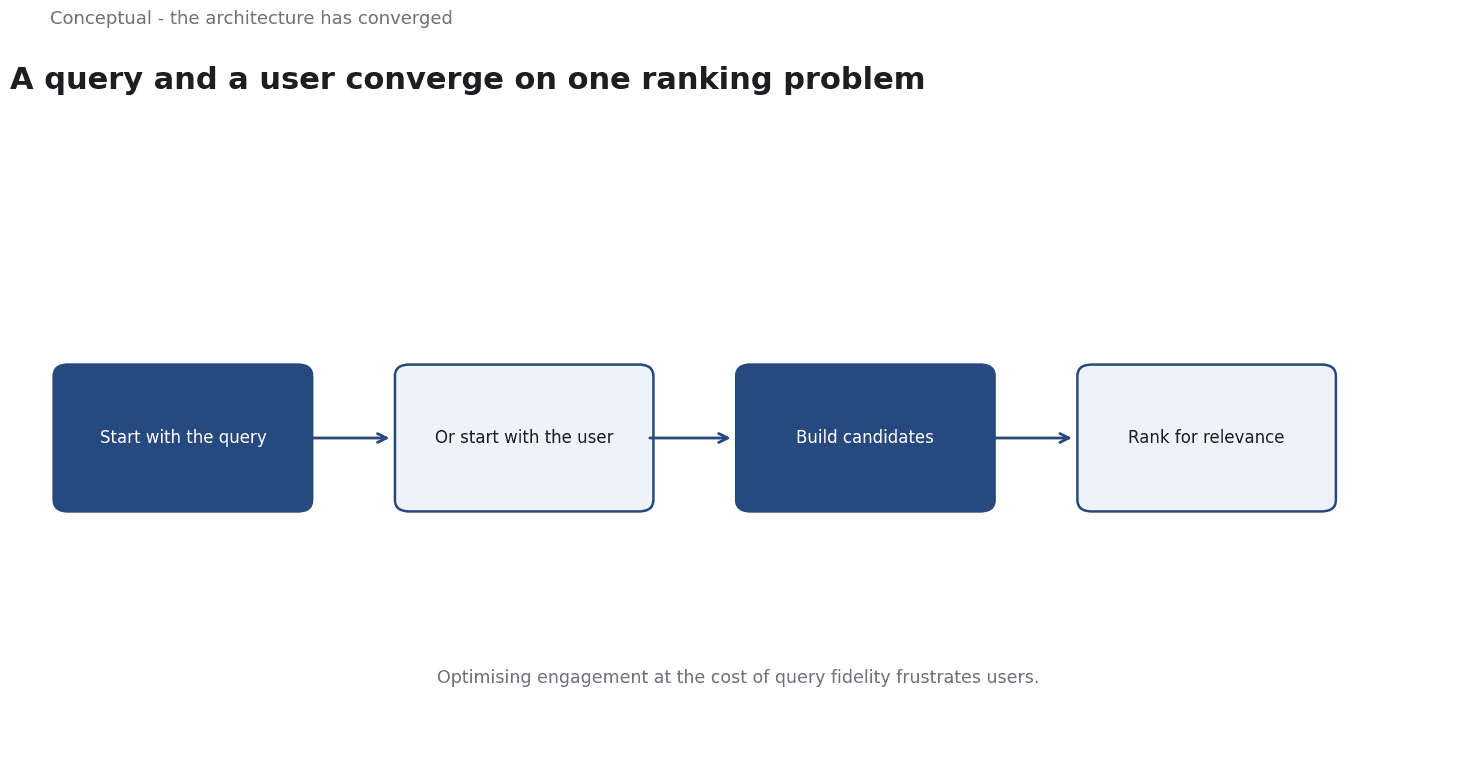
Two entry points, one ranking problem
A classical search engine matched query terms to documents and ordered results by relevance. A classical recommender compared users and items and ordered by predicted affinity. Both produced a ranked list, and the architectures stayed separate because the inputs were different.
That separation has weakened for three reasons:
Semantic matching. Dense embeddings allow a search system to match meaning rather than exact terms. Vaswani et al.'s transformer architecture — with 28.4 BLEU on WMT 2014 English-to-German and 41.8 on English-to-French after 3.5 days on eight GPUs — made the representation approach practical at scale, and the same encoder technology now represents documents and queries in a shared space.
Learned ranking. Ranking models such as DeepFM were developed for click-through prediction, and their object — modelling low- and high-order feature interactions — applies equally to search results and recommendations. A search ranker now uses behaviour signals just as a recommender does.
User context. Search results are increasingly personalised, and recommenders are increasingly conditioned on momentary intent such as a recent search or a current session. The boundary is a matter of degree.
Where they still differ
The most important difference is the authority of explicit intent.
A search query is a deliberate statement of what the user wants. A good search system treats it as the primary signal and uses personalisation to resolve ambiguity, not to override the query. A recommender has no such statement and must infer what would be useful from history, context, and the behaviour of similar users.
This difference has design consequences. In search, the query has to be represented faithfully — an embedding that drifts from the literal terms can produce results that are semantically related and practically useless. In recommendation, the absence of a query means the system has to decide whether to optimise for similarity to past behaviour or for exploration, and there is no external signal to settle it.
The second difference is evaluation. Search can be evaluated with relevance judgements for a query, even if those judgements are inferred from clicks. Recommendation has no fixed query, so its evaluation is inherently about longer-run outcomes — retained usage, discovery, total value — and it is harder to run a clean experiment.
The shared machinery
Both systems have two stages, and the stage boundary is where the engineering decisions live.
Candidate generation narrows a large catalogue to a manageable set — through an inverted index, an embedding index, a collaborative filter, or a popularity list. The tools differ: HNSW achieves "logarithmic complexity scaling" through a hierarchical graph, and FAISS demonstrated a graph over "1 billion vectors in less than 12 hours on 4 Maxwell Titan X GPUs". These make vector retrieval practical, which is why embedding-based candidate generation is now common in both search and recommendation.
Ranking orders the candidates with a richer model and more features. DeepFM's objective is to learn "both low- and high-order feature interactions", and the same pattern applies to a search ranker combining lexical relevance, semantic similarity, freshness, authority, and behavioural signals.
The boundary matters because an error in candidate generation cannot be repaired by the ranker. If the right document or item was never retrieved, no amount of ranking sophistication will surface it. This is the same point that makes recall the first metric to measure in a retrieval system.
What convergence means for a team
The practical consequence is organisational as much as technical. Search and recommendation teams often own different surfaces but are solving the same ranking problem with different signals. They can share the candidate-generation infrastructure, the feature store, the embedding models, and the experimentation framework, and they should compare notes on evaluation because both suffer from position bias and feedback loops.
What they should not share is the objective.
A recommender that optimises relevance to past behaviour at the cost of discovery will narrow the experience. The systems have converged in mechanism, not in purpose.
A checklist
- Separate candidate generation from ranking, and measure recall before precision.
- Let explicit intent dominate in search, and use personalisation only to resolve ambiguity.
- Make exploration explicit in recommendation, because there is no query to provide novelty.
- Log positions and candidate sets in both systems; neither evaluation is trustworthy without them.
- Share the infrastructure where the problems are identical — indexes, embeddings, feature computation, experiments.
- Do not share the objective. The two surfaces answer different questions.
For the ranking models, see Deep Learning for Recommendations; for the retrieval layer, see Vector Databases.
A worked example
The following is hypothetical and illustrative. Consider a hypothetical product with both a search box and a recommendation feed, sharing one candidate-generation index built on approximate vector search of the kind FAISS and HNSW make practical. Three checks follow the checklist. First, separate candidate generation from ranking and measure recall before precision: assume the index holds a large catalogue and returns a top-100 set, so a document absent from those 100 cannot be rescued by a ranker modelling low- and high-order interactions as DeepFM does. Second, let explicit intent dominate in search: suppose a user types a precise product term and personalisation would otherwise promote recently viewed items; the query must win, with context used only to resolve ambiguity. In the feed, exploration is made explicit instead. Third, log positions and candidate sets for both surfaces, because position bias and feedback loops make the two evaluations untrustworthy without them; the infrastructure is shared, but the objective is not. The bounded outcome: recall is fixed at retrieval before any ranking work, each surface keeps its own objective, and a reported engagement gain on search is rejected when it costs query fidelity. No real product is implied.
A counterargument
The convergence thesis is weaker than the shared vocabulary makes it look.
Candidate generation followed by ranking describes nearly any retrieval system, so pointing to it does not establish that search and recommendation are becoming the same problem; the cited papers are largely about click-through prediction, collaborative filtering, and representation learning rather than search ranking itself. The article also insists that explicit intent is the difference that remains, while conceding that search is personalised and recommenders take query-like inputs, which makes the boundary look like a matter of framing. A critic would accept the advice to share indexes and experiments but note that not sharing the objective is asserted, and that the evaluation asymmetry - fixed queries for search, longer-run outcomes for recommenders - argues the problems differ more than the architecture analogy allows.
References & Further Reading
- Ruibin Gai et al., 2017. DeepFM: A Factorization-Machine based Neural Network for CTR Prediction — Feature interactions in click-through-rate models, the shared core of search and recommendation ranking.
- Steffen Rendle et al., 2012. Neural Graph Collaborative Filtering — Graph collaborative filtering that propagates over the user-item graph.
- Ashish Vaswani et al., 2017. Attention Is All You Need — The transformer architecture that the NLP and LLM sections build on.