Sales Operations: Territory Planning, Quota Setting, and Compensation Design
A quota is an output of the forecast; a compensation plan is a statement about behaviour. Read how to design both without gaming them.
Sales operations is the discipline that connects what the business forecasts to what the sales organisation is paid to do, and it is where a lot of avoidable damage comes from. The reason is that the three artefacts — territory, quota, compensation — are usually designed independently and then discovered to contradict each other.
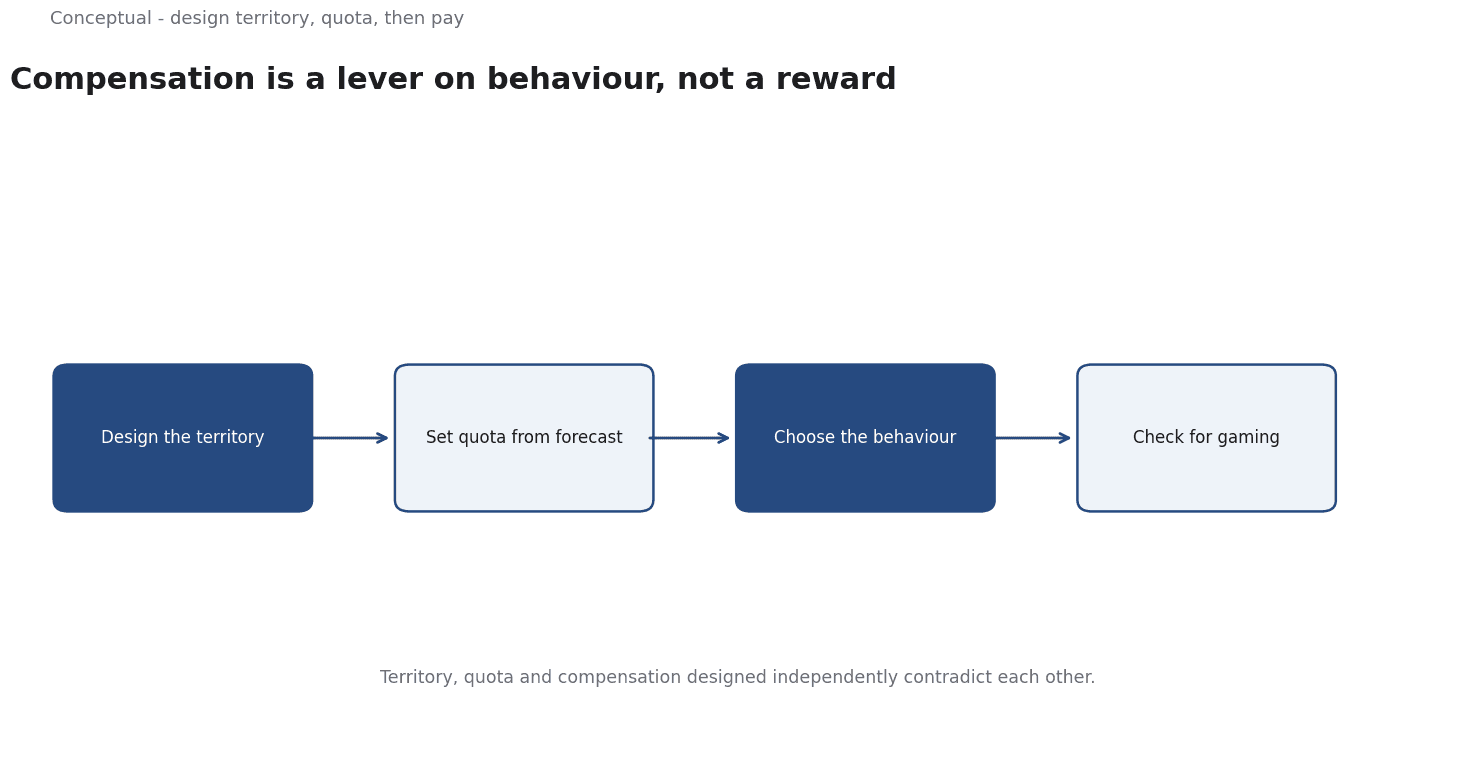
Direct answer: Territory design decides which opportunities a rep can credibly work; quota setting converts a forecast into a number the organisation commits to; compensation design decides which behaviour that number produces. Done in that order, each stage constrains the next honestly. Done in the reverse order, a compensation plan picks the behaviour, a quota is reverse-engineered to fit it, and the forecast becomes whatever the plan needs it to be.
Territory planning is a coverage decision
A territory exists to answer a question: can the rep working this account set actually influence these outcomes?
Everything that makes a territory bad comes from a mismatch between the boundary and the relationship.
The specific failure modes are worth naming because each has a different fix:
Overlap. Two reps both believe they own the account. The account is worked twice or not at all, and the pipeline data becomes ambiguous. The fix is a single rule of ownership with documented exceptions, and the exceptions are where the rule is actually tested.
Gaps. Nobody owns some segment — usually the smallest accounts, the newest products, or the customers with low current revenue but high potential. These get worked reactively by whoever is free, which usually means the largest rep, which is a hidden tax on quota attainment.
Uneven potential. A territory that contains ten enterprise accounts and a territory with a thousand small ones are not comparable units, and quotas set against them are not comparable targets. The fix is segmentation by opportunity, not by geography.
Definition churn. If the rules for "who owns what" change quarterly, the pipeline data becomes unusable, because every historical record was measured under different rules.
The deeper question is whether to segment by account, by industry, by product line, or by geography, and the answer depends on the buying process, not on the org chart. If customers choose one rep and do not cross-shop, a book-of-business model fits. If the purchase involves several functions, an account-based model fits. A hybrid usually beats a pure model because most portfolios have both kinds of customer.
Quota setting is a forecast, not a target
A quota is what the business expects the sales function to deliver. It should therefore be derived from something, and the derivation is where the discipline is.
The arithmetic usually runs: total market opportunity × realistic conversion × expected price, adjusted for capacity and for what has already been closed. The two numbers most often wrong are the conversion rate and the capacity assumption, and both tend to be wrong in the direction that makes the quota unattainable.
The conversion rate should come from the organisation's own history, segmented — a new segment has a different rate from a mature one, and using the blended average for both is how a quota stops meaning anything. The capacity assumption is about how much selling time a rep actually has, which is reduced by onboarding, by internal meetings, and by the administrative load of the very reporting the organisation asks for.
The honest check is the one that gets skipped: does the quota, divided across the team, leave room for the territory segmentation to work? A quota that assumes every rep can work their full idealised list will be met in the good accounts and abandoned in the rest.
Compensation design is a statement about behaviour
The design question comes first: what behaviour do you actually want, and which of these is it?
- Activity — number of calls, meetings, demos. Easy to measure, easy to game, and it rewards the wrong thing as soon as the activity stops correlating with outcomes.
- Qualification — how many opportunities meet a defined bar. Proxies for future revenue, and the definition of the bar becomes the thing being negotiated.
- Outcome — revenue closed. Cleanest alignment, but it rewards closing rather than building, and it produces end-of-quarter behaviour that the forecast then has to absorb.
Most workable plans mix them: a base component tied to qualified pipeline, a variable component tied to revenue, and a small accelerator tied to exceeding a threshold that the team agrees matters. The accelerator deserves care, because an accelerator on a metric that is easy to pull forward produces exactly the pulling-forward you were trying to pay for.
Two design details matter more than the structure. First, what gets excluded — deals that do not meet a criteria, renewals, expansions, multi-year contracts — determines whether the plan rewards the work you want. Second, cliff effects: a plan that pays nothing between 70% and 100% of quota converts a small miss into a large loss and produces sandbagging. Smooth accrual is usually worth more than a bigger cliff.
A sequence that holds together
- Define the selling motion first. How customers buy determines the segmentation, and everything else follows from it.
- Segment the base, and make the boundaries non-overlapping. Write the exceptions down explicitly.
- Derive the quota from the forecast, with a conversion rate taken from your own segmented history and a capacity assumption that accounts for real selling time.
- Choose the behaviour the plan should reward, then build the compensation structure around it.
- Check the plan against the territories. If a rep cannot hit the quota by working their own book well, the plan is wrong, not the rep.
- Set the on-target rate deliberately. It is a management choice about difficulty, and it should be a choice rather than an inherited default.
- Review the plan at the end of the first cycle, with the same rigour you would apply to the forecast. Compensation plans that are never revisited calcify their mistakes.
For the market context these plans operate in, see B2B Marketing and Product-Led Growth; for the role definitions sales roles depend on, see Career Transitions.
A worked example
The following is hypothetical and illustrative. Consider a hypothetical sales organisation with two account segments - enterprise accounts and a long tail of small ones - designing territories, quota, and pay for the next cycle. Three checks apply the prescribed sequence. First, territory boundaries: assume the enterprise accounts are assigned by name and the tail by geography, with non-overlapping boundaries and written exceptions, so the smallest accounts are not left to whoever is free. Second, quota derivation: suppose the forecast starts from market opportunity, a conversion rate from the organisation's own segmented history, and a capacity assumption that nets out onboarding and administrative load; a blended rate applied to both segments would make the target meaningless. The check is whether each rep can reach quota by working their own book well. Third, compensation: a mix of base on qualified pipeline, variable on revenue, and a small accelerator is chosen, and the exclusions and the 70-to-100 percent cliff are reviewed, since a cliff converts a small miss into a large loss and invites sandbagging. The bounded outcome: the plan is piloted for one cycle, then revisited. No real firm is implied.
A counterargument
The prescribed sequence assumes a forecast that is neutral and derivable, but the article's own diagnosis undercuts that assumption: it notes that conversion and capacity estimates tend to be wrong in the direction that makes the quota unattainable.
If the forecast is shaped by commitments the sales function does not control, then deriving a quota from it is less a technical step than a negotiation the framework does not model. There is also a gap between the prescriptive advice and the evidence offered. The cited sources - retail-sales data, investor guidance, and an occupational taxonomy - speak to market context and role definitions, not to territory or incentive design, so the claim that a mixed plan is what works rests on assertion rather than on the references given.
References & Further Reading
- National Retail Federation, 2026. NRF Press Releases | Latest Statements & Announcements | NRF — Primary retail-sales and channel data for sell-in versus sell-out definitions.
- U.S. Securities and Exchange Commission (Investor.gov), 2026. Introduction to Investing — Primary regulator guidance on market mechanics and investor protection.
- U.S. Department of Labor, 2026. O*NET OnLine — The standard occupational taxonomy used to compare roles across industries.