SEO vs Paid Advertising: Understanding the Economics of Customer Acquisition
Organic and paid acquisition are not competing moral choices. Read how attribution, incrementality, and payback should decide the mix.
The debate about organic versus paid acquisition is usually conducted as a question of virtue — SEO is "earned" and sustainable, paid is "bought" and stops when you stop paying. Both statements are partially true and neither is a decision rule. What separates a good acquisition strategy from a bad one is whether you know the incremental cost and the payback of each channel, and whether you have measured rather than assumed it.
Direct answer:
Search and paid are two mechanisms for occupying a moment when a customer is deciding, and the right mix depends on the incremental cost of each and on how quickly the business can recover the acquisition spend.
Attribution models tell you how credit is allocated — Google Ads describes them as a way to "choose how much credit each ad interaction gets for your conversions" — but they do not tell you what would have happened without the spend. For that, you need incrementality, measured with experiments or geo designs. Then compare payback, not channel philosophy.
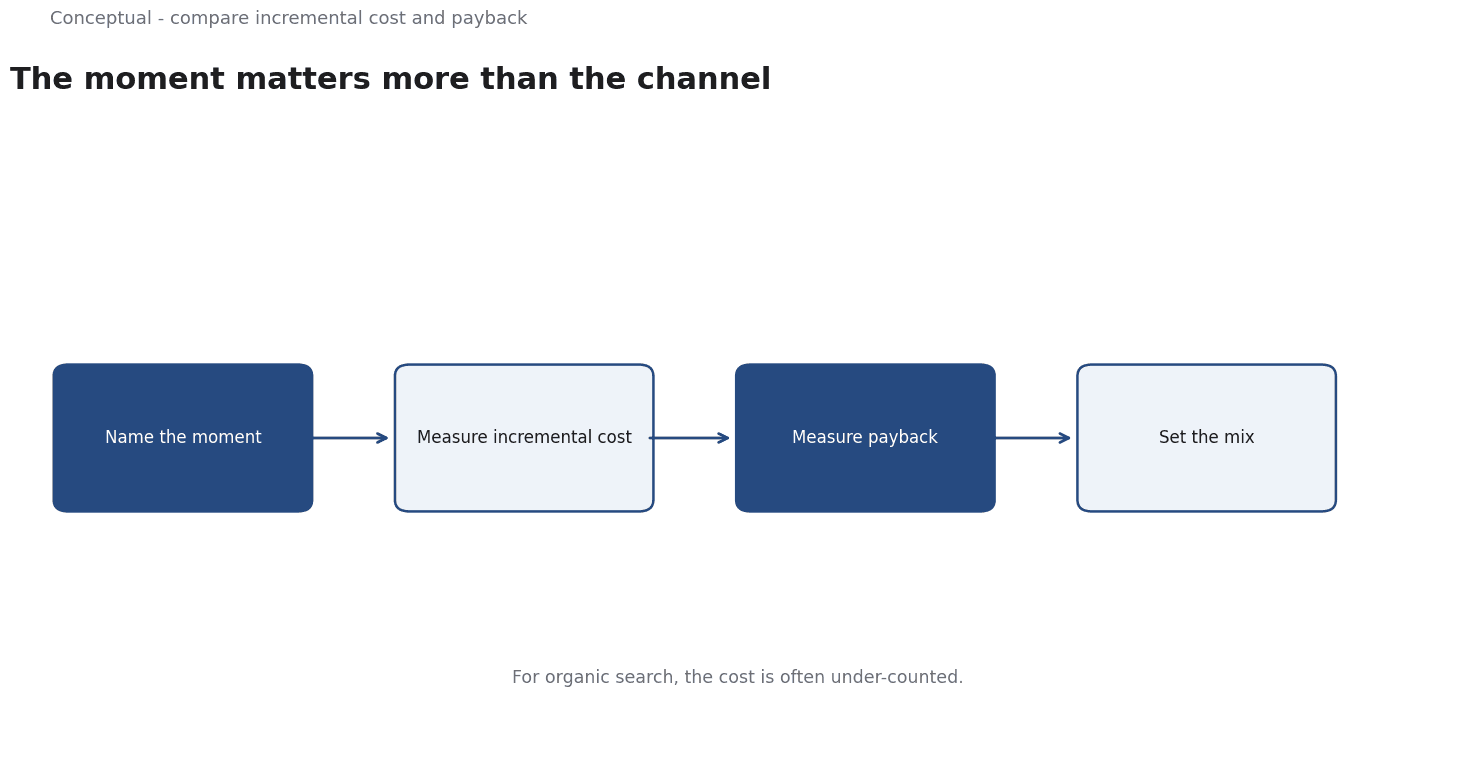
The moment, not the channel
A customer in a search session has an intent. Both an organic result and a paid result are ways of appearing in that moment, and neither is inherently better. The difference is in the economics of getting there: the organic position was paid for with content, technical work, and time; the paid position is paid for per click.
This is why the "which is better" question is ill-posed. The right question is: what did it cost to create and maintain the position, and would the customer have converted without it?
Content has to be produced and updated, the site has to be crawlable and fast, and the investment is cumulative — which is an advantage and a liability. For paid search, the cost is visible per click and it stops immediately. That visibility is genuinely useful for decision-making, and it is why paid can be the more honest channel even when its nominal cost is higher.
Google's own documentation on what a site needs in order to be crawled and indexed — crawlable pages, sitemaps, canonical signals, accessible content — is a useful reminder that the organic position is an engineering outcome as much as an editorial one. The cost of maintaining it is real, just distributed across teams.
Attribution tells you a story, not the answer
Google Ads explains the mechanics: "Attribution models let you choose how much credit each ad interaction gets for your conversions", with data-driven attribution now the default and last-click still supported. A team using last-click will conclude that paid search drives almost everything if paid search tends to close the journey; a team using first-click will reach the opposite conclusion. Both are describing the same data under different rules.
The right use of attribution is descriptive — understanding the shape of journeys — and the wrong use is deciding the budget. For that you need an incrementality estimate, which is a statement about what would have happened without the intervention.
Google's published approach to this problem is geo experiments: "One approach that Google has successfully employed to measure advertising effectiveness is geo experiments", with a design process described as systematic and results that are easy to interpret. The same logic applies to a search-investment decision that operates at a market or brand level. For user-level interventions, a standard randomised test with pre-period variance reduction — CUPED reports about a 50% variance reduction on Bing — is usually sufficient.
Payback is the comparison that matters
Once you have an incremental cost for each channel, the comparison is straightforward and rarely what the philosophy debate suggests.
Compute the cost to acquire a customer in each channel, fully loaded — including the people and tools behind the organic position — and the time it takes to recover that cost from gross margin. Then compare those payback periods against the business's cash tolerance, not against each other.
Organic acquisition often has a longer payback and a lower steady-state marginal cost. Paid acquisition has a shorter payback and a marginal cost that rises with competition. A company with limited cash should prefer the short-payback channel even if the long-run economics of the other are better; a company with patient capital should do the reverse. The decision is a function of the balance sheet, not of the channel's reputation.
And the two are complements. Organic content is often discovered through branded search, which paid can amplify; paid search can test which messages convert before you invest in organic content around them. Treating them as substitutes throws away the interaction.
A way to decide the mix
- Separate the description from the counterfactual. Use attribution to understand journeys, and experiments for budget decisions.
- Measure the fully loaded cost of the organic position, including content, engineering, and maintenance.
- Measure paid cost per acquisition at the margin, not on average — the click you buy next month costs more than last month's average.
- Compute payback for each, in months of gross margin, and compare against your actual cash runway.
- Check for interaction. Does paid amplify the organic position, or does it cannibalise clicks you would have received anyway? A geo experiment can separate these.
- Review the mix quarterly with the same measurement rules. A mix that is right at one scale is rarely right at the next.
For the economics of acquisition cost, see Customer Lifetime Value; for the experimental design, see A/B Testing.
A worked example
The following is hypothetical and illustrative. A mid-sized retailer with nine months of cash runway is deciding how much of its acquisition budget to move from paid search into content and technical SEO. Check one prices the organic position fully loaded, counting content, engineering, and maintenance, and arrives at a monthly cost that must be recovered from gross margin. Check two estimates incrementality: a geo experiment split into comparable regions for brand-level activity, plus a randomised user-level test with pre-period variance reduction, the CUPED approach credited with about a 50 percent variance reduction reported for Bing, replaces attribution's credit allocation. Check three computes payback in months of margin for each channel and tests whether paid clicks amplify branded organic discovery or merely take clicks that would have arrived anyway. The outcome is bounded: with nine months of runway, the short-payback paid channel keeps the larger share this quarter, and the organic budget grows only as the measured payback shortens, reviewed again next quarter under the same rules.
A counterargument
The prescription to measure incrementality, then compare payback assumes the counterfactual is cheaply obtainable, but the cited methods are platform-scale tools. Geo experiments are described as an approach Google has used, and CUPED is credited with about a 50% variance reduction on Bing; for an advertiser without clean geographic cells or a holdout, the experiment is unavailable and the choice falls back to judgment. The treatment of attribution as merely descriptive is also contested by its own example: last-click and first-click reach opposite conclusions from the same data, so the descriptive layer frames what gets counted. And the claim that organic has lower steady-state marginal cost is asserted rather than derived from the Google Ads and research references.
The framework is sensible; its inputs are not evenly available.
References & Further Reading
- Google Ads Help, 2026. About attribution models - Google Ads Help — First-party documentation of attribution models and their limits.
- Brian Vaver and Koehler, 2011. Measuring Ad Effectiveness Using Geo Experiments — Geo experiments for incrementality, the cleanest way to attribute marketing spend.
- Kohavi, Tang, and Xu, 2013. CUPED — ExP Platform — Using pre-experiment data to reduce metric variability; the Bing result cut variance by about 50 percent, giving the same power with half the users or half the duration.