Secondary Markets: Common Questions
A secondary market changes who owns an asset, not what the asset produces. Read the common questions, a worked example, and why liquidity has a price.
Secondary markets are often described as where prices are discovered, which hides their simpler function: they let an existing asset change hands. The Wikipedia entry describes markets where existing assets trade, and the commodity-market entry covers how exchange is organised. The common questions concern liquidity and value.
Direct answer:
Use a secondary market for the ability to change ownership at a price, and judge that price against the asset's cash flows rather than against the market's activity.
The sources describe the mechanism; the rule is a synthesis.
Delta: This article adds a claim-status table and a worked example, separating documented market structure from local judgements about value.
The mechanism
The first question is what the market actually provides. The secondary-market entry describes trading in existing assets, which gives holders a way to exit. That liquidity is valuable, and it has a price that is not the same as the asset's underlying worth.
The second question is how price is formed. The commodity-market entry describes the organisation of exchange, which applies to any market where buyers and sellers meet. A price reflects the marginal trade, which can move far from fundamental value when participants are reacting to each other.
The third question is what the asset produces. A secondary market does not change the cash flows from an asset, only who receives them. A price that rises while those cash flows fall is a change in expectation, not a change in the asset.
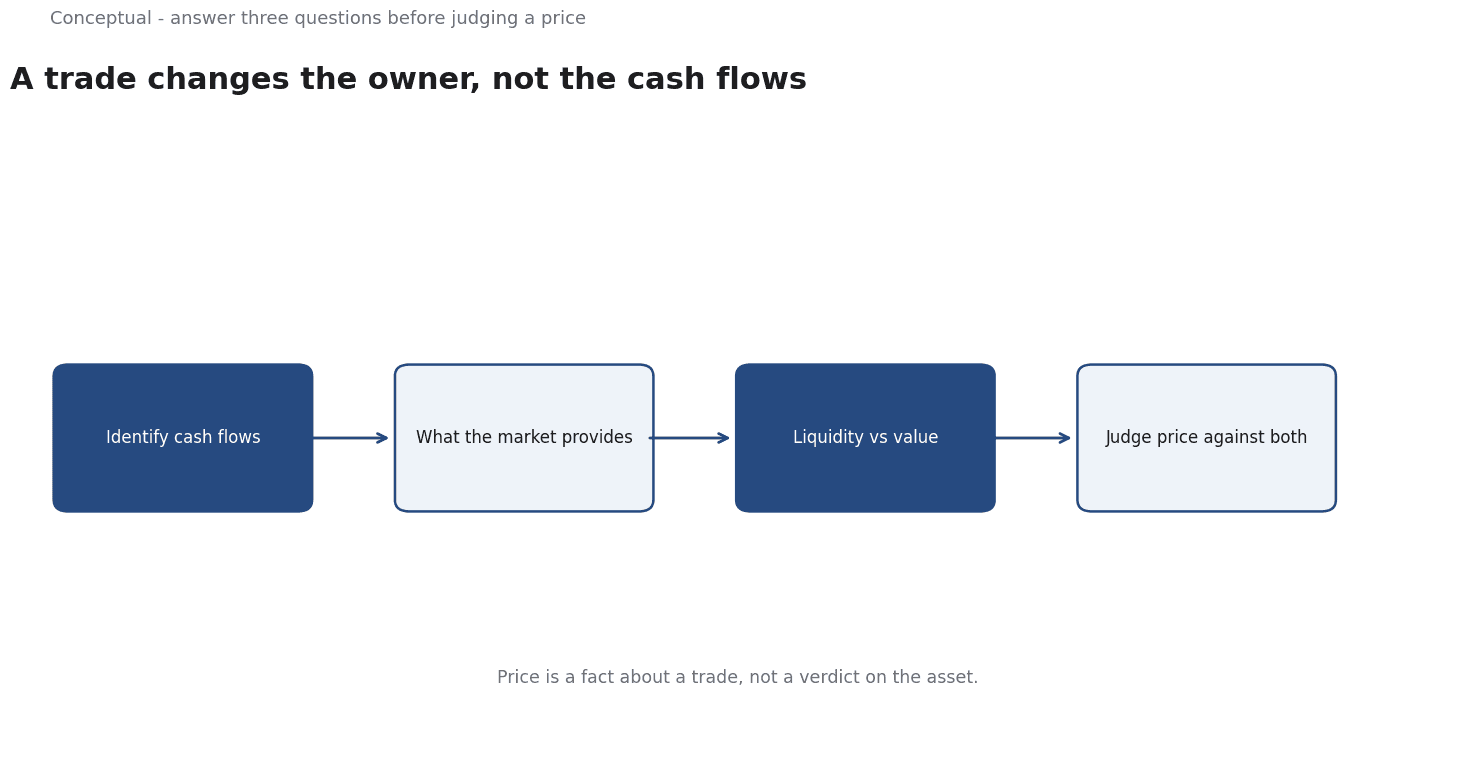
The sequence is: identify the asset's cash flows, understand what the market provides, then judge the price against both. The judgement is local, so it is inferred; the structure is source-reported.
Worked examples
Illustrative. A bond trades actively while its issuer's credit deteriorates.
Three checks decide. First, what are the contractual cash flows, and have they changed? Second, is the trading volume providing liquidity, or amplifying a reaction? Third, does the price reflect new information about the cash flows or a change in the market's mood?
A second example: an illiquid asset with stable cash flows trades rarely. Its lack of a market does not change what it produces, though it changes what a seller can realise quickly.
The outcome is a judgement about price and value, not a verdict on the market. The scenarios are hypothetical; the method is the contribution.
Evidence status
| Claim | Status | Source | Verified | Recheck when |
|---|---|---|---|---|
| Secondary markets trade existing assets | source-reported | Wikipedia, Secondary market | 2026-11-18 | Definition changes |
| Markets organise exchange between buyers and sellers | source-reported | Wikipedia, Commodity market | 2026-11-18 | Definition changes |
| Separate liquidity from underlying value | inferred | Derived from the structure | 2026-11-18 | Asset changes |
Why liquidity has a price
The ability to sell quickly is worth something, and markets price it. That means two assets with similar cash flows can trade at different prices because one is easier to exit.
A further point is that market prices are set by participants who may know less than the holder, or who react to the same information at the same time. That is why an active market can be both a source of useful price information and a source of temporary distortion. Distinguishing the two requires knowing what the asset produces, which is the anchor that the market does not supply.
The common questions also touch on settlement. A market where ownership changes but settlement is delayed creates a gap in which obligations exist without finality. That gap is a risk, and it belongs in any assessment of what trading in the market actually means.
An active market is useful for liquidity and noisy as a signal of long-term value, and the two roles should be kept separate.
The price is a fact about a trade, not a verdict on the asset, and the distinction is the basis of a sound judgement.
A market price that moves without a change in the asset is a change in expectation, and expectations can reverse.
What it cannot do
It cannot change the underlying cash flows. It does not guarantee a fair price. And it cannot remove the need to understand the asset.
The counterargument that an active market makes an asset safe is fair for liquidity and incomplete for value.
A decision test
- Identify the asset's cash flows.
- Understand what the market provides.
- Separate liquidity from value.
- Use dated prices.
- Record the judgement and recheck condition.
For the credit dimension, see Credit Ratings.
References & Further Reading
- Wikipedia contributors, 2026. Secondary market - Wikipedia — Markets where existing assets change hands.
- Wikipedia contributors, 2026. Commodity market - Wikipedia — Structure of markets for raw materials and commodities.