Sell-in Checklist
Sell-in is the transfer from maker to channel, not the final sale. Learn the inventory and returns checks that keep a sell-in target from becoming a channel-stuffing problem.
A sell-in target measures what a manufacturer ships to its channel partners, not what those partners sell to end customers. That distinction is easy to blur, and the blur is where the problem starts: a quarter can look strong on sell-in while inventory quietly accumulates in the channel. The bill arrives later, as returns, markdowns, and strained partner relationships that the original number never showed.
Direct answer:
Sell-in is the movement of goods from producer to channel, and it is a legitimate metric only when read alongside channel inventory and sell-through.
A checklist that pairs each sell-in decision with an inventory position and a returns path turns a shipment number into a managed process. The two sources cover inventory and reverse logistics, so this article stays with those mechanics rather than sales quota design.
Delta: This article adds a decision layer beyond the sources: it maps the inventory and reverse-logistics concepts to a pre-shipment checklist, with claim status explicit.
The mechanism
Wikipedia's inventory article defines inventory as the goods and materials an organization holds for sale or use, and treats it as an asset with a carrying cost. In a sell-in context the goods leave the maker's books and land on the channel partner's, but they have not necessarily reached the person who will use them. The transfer changes where the inventory sits, not whether it exists. A user who reads sell-in as demand has mistaken a change of ownership for a change in consumption.
Reverse logistics describes the flow of goods backward through the chain: returns, recalls, and the recovery of value from products that did not sell as expected. Its existence is the practical consequence of that mistaken reading. When sell-in outruns sell-through, the excess does not disappear; it either sits as channel inventory or comes back through the reverse channel. Each unit returned carries handling, inspection, and restocking costs that a sell-in-only view never priced into the original transaction.
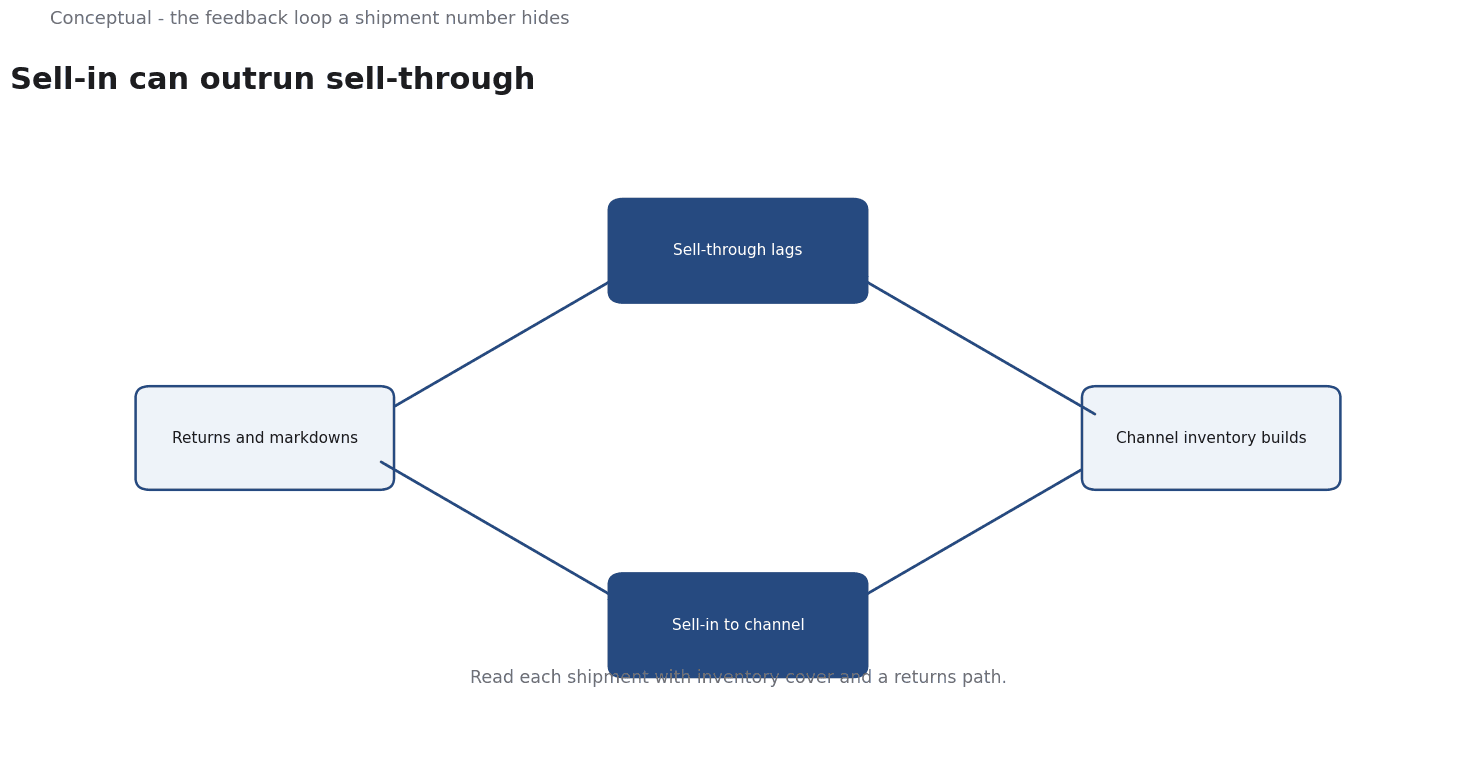
The mechanism therefore has a feedback structure. Push more units into the channel than it can absorb, and inventory builds; the build eventually forces returns or markdowns, which raise the real cost of the original sale. Wikipedia's inventory material on carrying costs and stock levels gives the vocabulary for the build; the reverse-logistics material gives the vocabulary for the unwinding. Together they describe a loop that a shipment number, viewed alone, cannot reveal. The loop is slow, which is why the damage is often attributed to something else by the time it appears.
The practical consequence is that the meaningful unit of analysis is the pair: sell-in plus the inventory position it created. A checklist that captures the partner's current stock, the expected rate of sell-through, and the route a return would take converts the shipment into a decision with visible consequences. Without that pair, the team is optimizing a number that can be improved by moving cost into the future and onto someone else's balance sheet. That is not a harmless accounting shift; it is a transfer of risk that the maker eventually absorbs.
A worked example
The following is hypothetical and illustrative. A regional distributor asks a manufacturer to double a monthly shipment to hit a channel incentive threshold. Before approving, the sales operations lead runs three checks. First, she pulls the distributor's current inventory and finds six weeks of cover against a four-week norm. Second, she compares the distributor's sell-through over the last quarter with the requested shipment rate and sees a gap. Third, she maps the return path: the distributor's contract allows returns within ninety days, and the reverse-logistics cost per unit is significant. The outcome: the team ships a partial increase, ties the rest to documented sell-through, and renews the conversation next month. The checklist turned a shipment request into a staged decision.
Evidence status
| Claim | Status | Source | Verified | Recheck when |
|---|---|---|---|---|
| Inventory is goods held for sale or use and carries a cost. | source-reported | Wikipedia: Inventory | 2026-11-18 | The inventory definition or cost treatment is revised. |
| Reverse logistics covers returns, recalls, and recovery of value. | source-reported | Wikipedia: Reverse logistics | 2026-11-18 | The reverse-logistics entry is substantially rewritten. |
| Sell-in can outrun sell-through and create channel inventory. | inferred | Derived from the sources | 2026-11-18 | Channel data shows the relationship does not hold. |
| Excess channel stock tends to return through the reverse channel. | inferred | Derived from the sources | 2026-11-18 | Return clauses or disposal practices change. |
The source-reported rows restate definitions that can be checked in the two Wikipedia entries. The inferred rows extend those definitions to a sell-in setting; neither article discusses sell-in specifically, so the connection is an application rather than a quotation. Revisit those rows if the underlying inventory or returns definitions are revised, or if observed channel behavior contradicts them.
What it cannot do
The first limit is definitional. The sources describe inventory and reverse logistics in general terms; they do not define sell-in, set quota policy, or offer channel-incentive design. This article borrows their vocabulary to build a checklist, but it cannot specify the right stock cover for a given product or the correct return window for a given contract. Those values depend on the category, the partner, and the cost structure, none of which the sources supply. A team expecting a universal threshold from these pages will be disappointed, and rightly so, because the threshold is a local fact.
A hidden cost of a sell-in checklist is the friction it introduces. Each check takes time and data, and a partner who expects a quick confirmation may read the questions as distrust. The checklist also creates records that can be audited, which is useful in a dispute but uncomfortable when the numbers look unfavorable. Teams that adopt the checklist partly to slow down shipments must be honest that the slowdown is the point; presenting it as pure process improvement hides the trade-off. Candor here matters more than a smooth rollout.
If the stock figure is stale, the sell-through comparison uses the wrong period, or the return path is assumed rather than confirmed, the boxes get ticked while the risk remains. A second failure is the incentive mismatch: a compensation plan that rewards sell-in regardless of returns will pressure the team to interpret every check optimistically. The artifact survives; the discipline does not.
A form that cannot change a decision is decoration, and decoration is worse than nothing because it creates the impression of control.
There is a boundary between what the checklist catches and what it cannot. It can reveal that inventory is building and that returns are costly, but it cannot tell you whether the underlying product is wanted. A well-managed channel can still hold stock that no end customer values, and the reverse logistics will simply recover less of the cost. Demand quality, pricing, and product-market fit sit outside these two sources. The checklist is a guardrail on the transfer of goods, not a test of the product itself.
Because the inputs are operational, the material needs review whenever the channel model changes. A new partner, a different return clause, or a shift from distributor to direct fulfillment changes what the checks should measure. The references should be re-read for definition changes, and the checklist itself should be revised when a check stops predicting a returns problem. A periodic review of false alarms is as useful as a review of misses.
Counterargument: The claim that a checklist prevents channel stuffing is fair for a team that acts on the results and incomplete for a team that treats it as paperwork; the form alone changes nothing.
A decision test
- Define the sell-in decision and the partner involved, and state what the shipment is meant to achieve.
- Pull the partner's current inventory and compute weeks of cover against a stated norm.
- Compare recent sell-through with the proposed shipment rate and note the gap.
- Confirm the return path and its per-unit cost from the contract or the reverse-logistics process.
- Check whether incentives on the table reward shipment volume over sustainable sell-through.
- Decide the shipment size, tying any increase to documented sell-through or a shorter review interval.
- Set the revisit trigger and record who owns the follow-up.
A checklist works when each item can change the answer. If a step never alters the shipment decision, it is documentation rather than control. The test above is designed so that a poor result at any step gives a specific reason to hold, reduce, or stage the shipment, which is the point of a pre-shipment review. The record also gives the partner a clear account of why a decision was made.
For further reading, see Decision Memos That Survive Review.
References & Further Reading
- Wikipedia contributors, 2026. Reverse logistics - Wikipedia — Overview of product returns, reusable packaging and unsold-goods flows; secondary reference used with NRF and Census data.
- Wikipedia contributors, 2026. Inventory - Wikipedia — The role of stock in operations and accounting.