Share Buybacks Best Practices
Buybacks move cash to shareholders, but the headline hides funding, timing, and opportunity cost. A worked example and claim status make the trade-offs explicit.
A repurchase announcement is easy to read as a verdict on management confidence, yet the headline amount says little about what the firm gave up. The Wikipedia entries on share repurchase and dividend policy describe the mechanics and the competing theories, but neither turns the number into a decision. The real problem is that a buyback can raise earnings per share without improving the underlying business.
Direct answer: A buyback is a cash distribution that reduces shares outstanding, so it changes ownership and per-share figures before it changes operations. The sources frame it as an alternative to dividends and as one channel for returning cash or signaling value. Its merit depends on the funding source, the price paid, and the opportunities forgone, none of which the announcement alone settles.
Delta: This article adds a decision framing beyond the sources: it maps repurchase mechanics to a capital-allocation call, with claim status explicit.
The mechanism
Start with the accounting identity. When a firm buys back shares and cancels them, the denominator in earnings per share shrinks while net income can stay flat. The Wikipedia entry on share repurchase sets out these mechanics along with tender offers and open-market programs. The practical consequence is that a rise in earnings per share can be arithmetic rather than operating. A reader who treats the per-share number as proof of improvement has skipped the question of what actually produced it, and has confused a change in the share count with a change in the business.
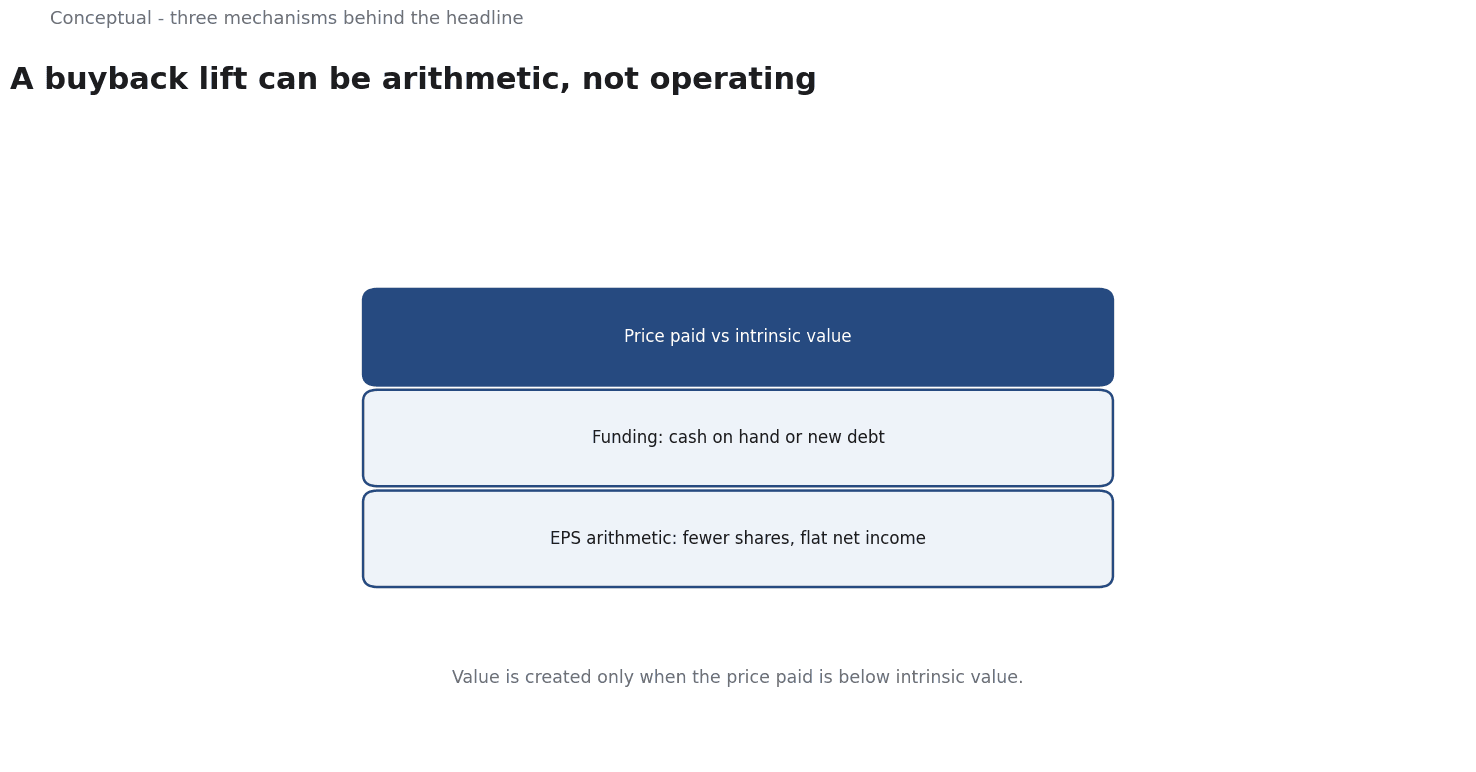
Funding is the second mechanism. A repurchase uses cash on hand or newly issued debt, and the dividend-policy entry treats distributions as a choice made after investment needs are met, the residual idea in corporate finance. Debt-funded buybacks raise leverage while they shrink the equity base. The practical consequence is that the same announced amount can strengthen per-share metrics and weaken the balance sheet at the same time. Any serious evaluation has to name the funding source before judging the result, because cash from operations and cash from a new loan are not economically equivalent.
Signaling and valuation complete the picture. The dividend-policy material covers signaling and agency theories, and repurchases are described as a more flexible alternative to dividends because they carry no lasting payout commitment. A buyback can hint that management sees the shares as cheap, or that free cash flow exceeds useful investment, but the act itself verifies neither claim. Value is created only when the price paid sits below intrinsic value. Repurchasing above it transfers cash to selling shareholders at the expense of those who remain, so the legality of the program says nothing about its wisdom.
A worked example
The following is hypothetical and illustrative. A steady manufacturer with flat net income announces a repurchase equal to a quarter of its cash, funded by a new term loan. Three checks decide the reading. First, what changed the per-share figure: was the earnings rise operational, or did the share count simply fall? Second, what is the funding cost, and how much leverage did the loan add relative to the cash removed? Third, was the average price paid below a defensible intrinsic-value range, and which investment was forgone? The outcome is mixed. Per-share earnings improve, but the gain is mechanical, leverage rises, and the value case rests on a price assumption that must be recorded and revisited.
Evidence status
| Claim | Status | Source | Verified | Recheck when |
|---|---|---|---|---|
| Repurchases reduce shares outstanding and can raise EPS with no change in net income | source-reported | Wikipedia: Share repurchase | 2026-11-18 | Accounting or disclosure rules change |
| Distributions are framed as a choice under cash and investment constraints, with repurchases as an alternative to dividends | source-reported | Wikipedia: Dividend policy | 2026-11-18 | Payout theory or tax treatment changes |
| A buyback's value depends on price paid relative to intrinsic value and on funding source | inferred | Derived from the sources | 2026-11-18 | Share price or capital structure changes |
The first two rows report concepts the sources state directly, so they carry source-reported status and a dated verification. The third row is a judgment assembled from those concepts and stays inferred. Each row names a recheck condition, because a stretched price, a changed tax rule, or a new loan can overturn the reading without any new announcement from the firm.
What it cannot do
A buyback cannot manufacture operating value.
The lift in earnings per share is a denominator effect, and no amount of repurchasing improves revenue, margins, or cash generation on its own.
The mechanism section makes this point explicitly: the share count falls, the arithmetic changes, and nothing about demand or cost structure has shifted. A disciplined reader therefore separates the accounting result from the operating story before attributing cause, and refuses to let a tidy metric stand in for a messy business.
It also hides an opportunity cost. Cash spent on shares is cash not spent on capacity, research, or debt reduction, and the dividend-policy framing of a residual payout puts investment ahead of distribution only as a convention, not as a rule. Debt-funded programs convert that trade-off into a leverage decision with interest expense and refinancing risk attached. The cost rarely appears in the announcement; it shows up in the capital structure and in the projects that never started. Evaluating the buyback without listing the alternative uses of the same cash produces a one-sided case, and one-sided cases are exactly what a press release is designed to supply.
Timing and signaling are failure modes. Buying when shares are expensive destroys value, yet programs are often disclosed without an intrinsic-value anchor, and management may genuinely believe the price is attractive. Markets may read a repurchase as confidence when it is really a lack of investment options, or as a floor under the price when no such floor exists. The signal is ambiguous by construction, so it cannot carry the weight of a verified claim about future prospects. A program can be announced in good faith and still be poorly timed, and the gap between intention and outcome is where most of the risk lives.
Finally, the practice has a boundary that needs active review. The dividend-policy theories include irrelevance results under idealized assumptions, so any claimed benefit is conditional rather than universal, and the tax treatment of buybacks versus dividends varies by jurisdiction and changes over time. Field facts must be dated, price assumptions stated, and residual risk acknowledged. A decision that looks sound at announcement can invert after a price move or a rule change, which is why the read must be revisited rather than filed away. Good practice is less about the size of the program than about the quality of the record that justified it.
Counterargument: the claim that a buyback returns capital efficiently and lifts per-share value is fair when shares are cheap and cash is idle, and incomplete when the program is debt-funded or the price is rich.
A decision test
- Identify the funding source and quantify the change in leverage.
- Separate the mechanical per-share gain from any operating improvement.
- State the intrinsic-value range used to judge the price paid.
- List the investment or debt paydown forgone by spending the cash.
- Treat any signaling story as a hypothesis, not as a finding.
- Use dated figures and note the jurisdiction's tax treatment.
- Record the decision with a reversal condition and residual risk.
A repurchase is a capital-allocation decision wearing the clothes of a headline number. Running these steps turns the announcement into a testable claim about cash, price, and alternatives. The record matters more than the applause, because the same program can be prudent or wasteful depending on facts the announcement never states.
For further reading, see Decision Memos.
References & Further Reading
- Wikipedia contributors, 2026. Share repurchase - Wikipedia — Company buying back its own shares.
- Wikipedia contributors, 2026. Dividend policy - Wikipedia — How firms decide on distributions to shareholders.