SMB Marketing Checklist
An SMB marketing checklist should tie demand-generation activities to available financing. Read the sequencing logic, a worked example, and where it falls short.
Small teams often treat a marketing checklist as a fixed list of tactics: run ads, write content, send email, attend events. The real problem is that the list ignores the constraint that decides which tactics are possible. A demand-generation activity only matters if the business can fund it through the cycle before the leads it produces turn into cash, and most checklists say nothing about that gap.
Direct answer: An SMB marketing checklist should sequence demand-generation activities against the financing available to sustain them, moving from awareness to interest to qualified leads at a pace the cash flow can carry. The sources describe demand generation and the financing options open to small businesses; the sequencing itself is a synthesis.
Delta: This article adds a claim-status table beyond the sources: it maps a demand-generation activity to one financing decision, with claim status explicit.
The mechanism
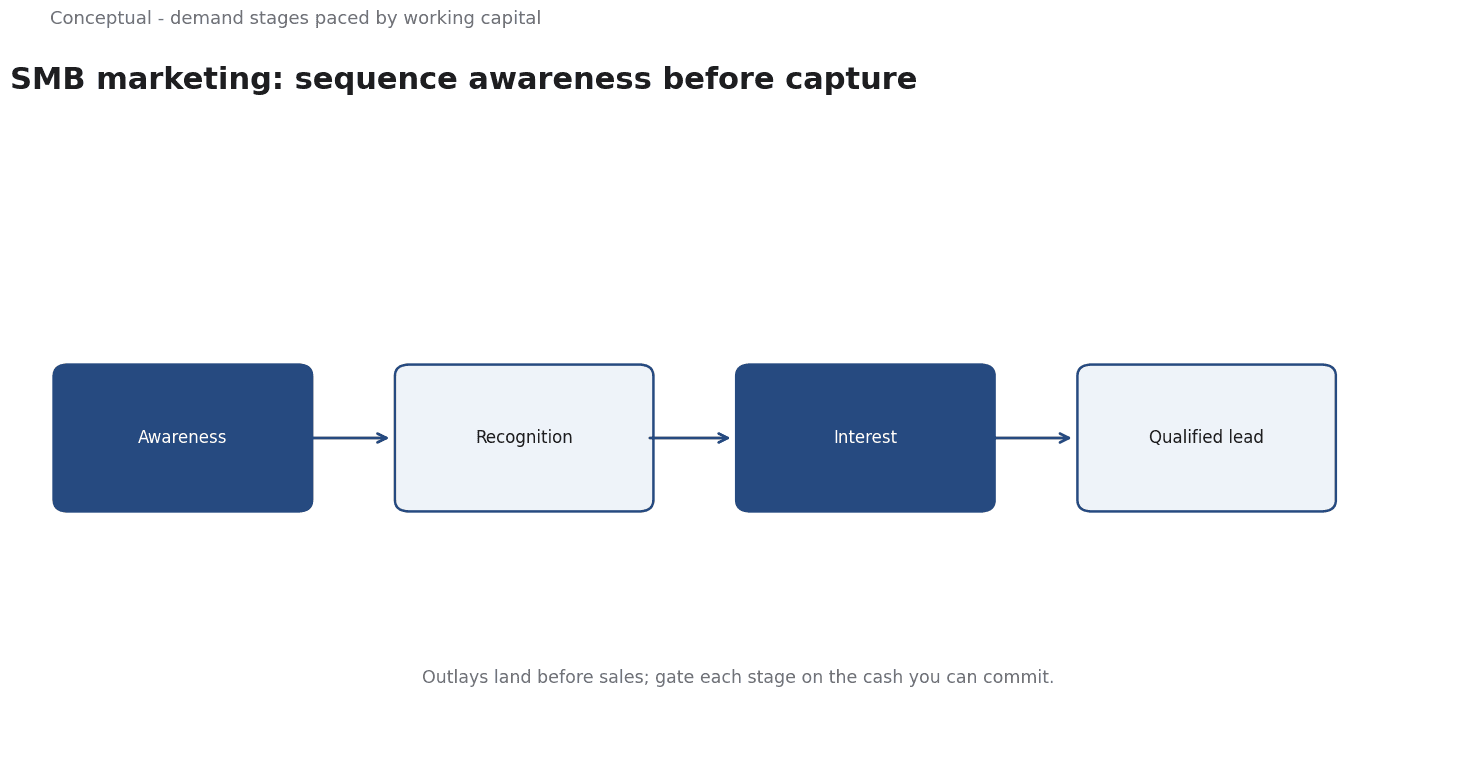
The demand generation entry describes marketing activities that create awareness and interest in an offering so that qualified leads emerge, typically through content, email, events, and paid channels. The mechanism is a progression: a prospect moves from not knowing the business, to recognizing it, to showing interest, to providing a lead that can be contacted. The practical consequence is that the activities are not interchangeable line items. Each one acts at a different stage, and a checklist that starts with lead capture before awareness is built will spend money against an audience that has no reason to respond.
The small business financing entry describes how small firms fund operations, through instruments such as bank loans, credit lines, credit cards, and outside investment, with working capital as a recurring need. The mechanism is that spending must be financed before revenue arrives: marketing outlays come early, while the sales they generate land later. The practical consequence is that the affordable marketing plan is bounded by the cash the business can commit for that interval, not by the total size of the opportunity. A longer lead-to-cash cycle demands more financing for the same activity.
Read together, the two sources make sequencing a cash question as much as a marketing question.
Demand generation describes what should happen at each stage of the funnel; financing describes what the business can afford to spend while it happens. The practical consequence is that the checklist should be ordered by dependency and by funding: establish the awareness and interest layers that later tactics rely on, then add lead-focused tactics as the working capital supports them. Adding a channel that the cash flow cannot sustain through its payback period creates a gap between spend and return that no amount of tactical discipline closes.
The final element is timing within a cycle. Financing is rarely continuous, and a small business may have a clear view of what it can spend this month but not the next. The mechanism is a rolling commitment: activities are chosen for the window they can be funded in, with the next stage gated on the leads and cash that emerge. The practical consequence is that the checklist becomes a sequence of decisions rather than a static document, and each activity earns its place by the stage it serves and the financing it can hold. That gate is an inference, not something either source prescribes.
A worked example
The following is hypothetical and illustrative. A small business with limited working capital wants a marketing checklist and is tempted to fund a paid campaign first, since it promises fast leads. Three checks decide. First, the stage check: is there enough existing awareness and interest for a lead-capture tactic to convert, or must content and email come first to build recognition? Second, the financing check: can the current credit line cover the campaign spend through the expected lag before those leads become sales, without straining payroll or stock? Third, the quality check: among leads from any channel, what share are genuinely qualified and reachable? The outcome is a sequenced plan: start with low-cost content and email to build the earlier stages, add paid only once the financing window covers its payback. The figures are hypothetical; the sequence of checks is the contribution.
Evidence status
| Claim | Status | Source | Verified | Recheck when |
|---|---|---|---|---|
| Demand generation builds awareness and interest to produce qualified leads | source-reported | Demand generation - Wikipedia | 2026-11-18 | when the entry's description of the funnel changes |
| Small businesses fund operations through loans, credit lines and outside investment | source-reported | Small business financing - Wikipedia | 2026-11-18 | when the entry's list of financing sources changes |
| A marketing checklist should be sequenced by financing capacity | inferred | Derived from the sources | 2026-11-18 | when financing or funnel research links the two directly |
The first two rows report what the sources state and can be checked against them directly. The third is an inference: it follows from placing spend early and returns late, but neither source offers a sequencing rule for marketing. Recheck conditions point back to the sources or to new research, keeping the status of each row explicit rather than implied.
What it cannot do
A checklist cannot decide which market the business should serve. It can order activities, but the choice of audience, positioning, and offer sits outside it. A perfectly sequenced list applied to a weak proposition will still fail to generate qualified leads, because demand generation amplifies an offer rather than creating its value. Treating the checklist as a strategy substitutes a tidy process for the harder question of why a buyer would choose this business at all, and no amount of stage discipline repairs that gap.
A hidden cost is the time the checklist consumes relative to its payoff. Maintaining content, email, and paid channels takes effort, and a small team has little of it. When the list grows to cover every stage, the business can end up doing a little of everything and none of it well, spreading attention across tactics that each need sustained work to produce leads. There is also a financing cost in starting too many channels at once: each one draws cash before it returns any, and several half-funded activities can strain working capital more than one well-funded activity would.
A team can tick off every item on the checklist and still have no qualified leads, because the list tracks what was done rather than what moved a prospect toward a decision. The opposite failure is adding a channel because a competitor uses it, without checking whether the financing window covers its payback or whether the earlier funnel stages exist for it to work with. In both cases the checklist becomes a record of motion, and the business mistakes the completion of tasks for the creation of demand.
The boundary is that these sources describe a marketing function and a set of funding instruments, not a planning method. The demand generation entry explains how awareness and interest become leads; it does not rank tactics or promise results. The financing entry describes how small firms raise and use money; it does not prescribe how marketing should be scheduled against cash. Using them responsibly means treating the checklist as a way to order activities by funnel stage and funding capacity, without presenting the combination as a validated growth system.
Because both cash and channels change, the checklist needs scheduled review. A tactic that was affordable last quarter can become a strain when financing tightens, and a funnel stage that was once the constraint can fill up while another empties. The practical requirement is to revisit, on a fixed cadence, which stage is currently limiting qualified leads and what the working capital can support in the next window. Without that review, the checklist hardens into a routine that keeps spending on yesterday's bottleneck.
The counterargument that a fixed checklist enforces useful discipline is fair for teams new to marketing and incomplete for teams whose financing and funnel stages keep moving.
A decision test
- Identify which funnel stage currently limits qualified leads.
- List only the activities that act on that stage.
- Estimate the cash each activity needs through its expected payback lag.
- Confirm the financing source covers that spend without crowding other obligations.
- Sequence the activities so earlier stages support later ones.
- Define the lead-quality signal that would justify the next stage of spending.
- Revisit the stage and the funding window on a fixed cadence.
These steps turn a static list into a sequence tied to the two things that actually constrain a small business. The mapping from funnel stages and financing capacity to one spending decision is what makes the checklist useful rather than decorative. A passed test leaves a short ordered plan, a funding check, and a clear signal for when to add the next activity.
For further reading, see Marketing Dashboards without the Hype.
References & Further Reading
- Wikipedia contributors, 2026. Demand generation - Wikipedia — An overview of demand generation as a marketing discipline distinct from lead generation; secondary reference used with the lead-generation entry.
- Wikipedia contributors, 2026. Small business financing - Wikipedia — Sources of funding for small businesses including internal funds.