Sovereign Debt Mistakes to Avoid
Sovereign debt mistakes often come from ignoring restructuring mechanics and inflation's effect on real value. Learn the definitions, a worked check, and the limits.
Sovereign debt is borrowing by a national government, and mistakes often come from treating nominal figures as if they were fixed in real terms. The sources describe debt restructuring and inflation. The real problem is that an observer can focus on a headline debt number while missing how restructuring and price changes alter what is actually repaid.
Direct answer: Avoid the mistake by separating nominal obligations from real value and by understanding how restructuring changes the terms. The sources describe restructuring and inflation; the checklist is a synthesis. A figure that looks stable in nominal terms can weigh less in real terms when prices rise, and restructuring can change who is paid and when.
Delta: This article adds a claim-status table and a real-value decision test beyond the sources: it maps each debt figure to a repayment decision, with claim status explicit.
The mechanism
Debt restructuring occurs when a debtor, including a sovereign borrower, renegotiates the terms of its debt because it is struggling to meet obligations. The changes can include extending maturities, reducing principal or interest, or exchanging one instrument for another. The practical consequence is that the face value of a debt is not necessarily what is ultimately paid. Any reading of a sovereign's obligations must account for the possibility that the schedule and the amount are subject to revision.
Inflation is a general rise in the price level, which reduces the purchasing power of a unit of currency. The practical consequence for debt is that a fixed nominal obligation becomes lighter in real terms as prices rise, provided nominal payments do not adjust. This is why a debt figure quoted in currency units can be misleading: the same number represents a smaller real burden when the price level is higher. The effect is not free, since inflation brings other costs, but it changes how a nominal obligation should be interpreted.
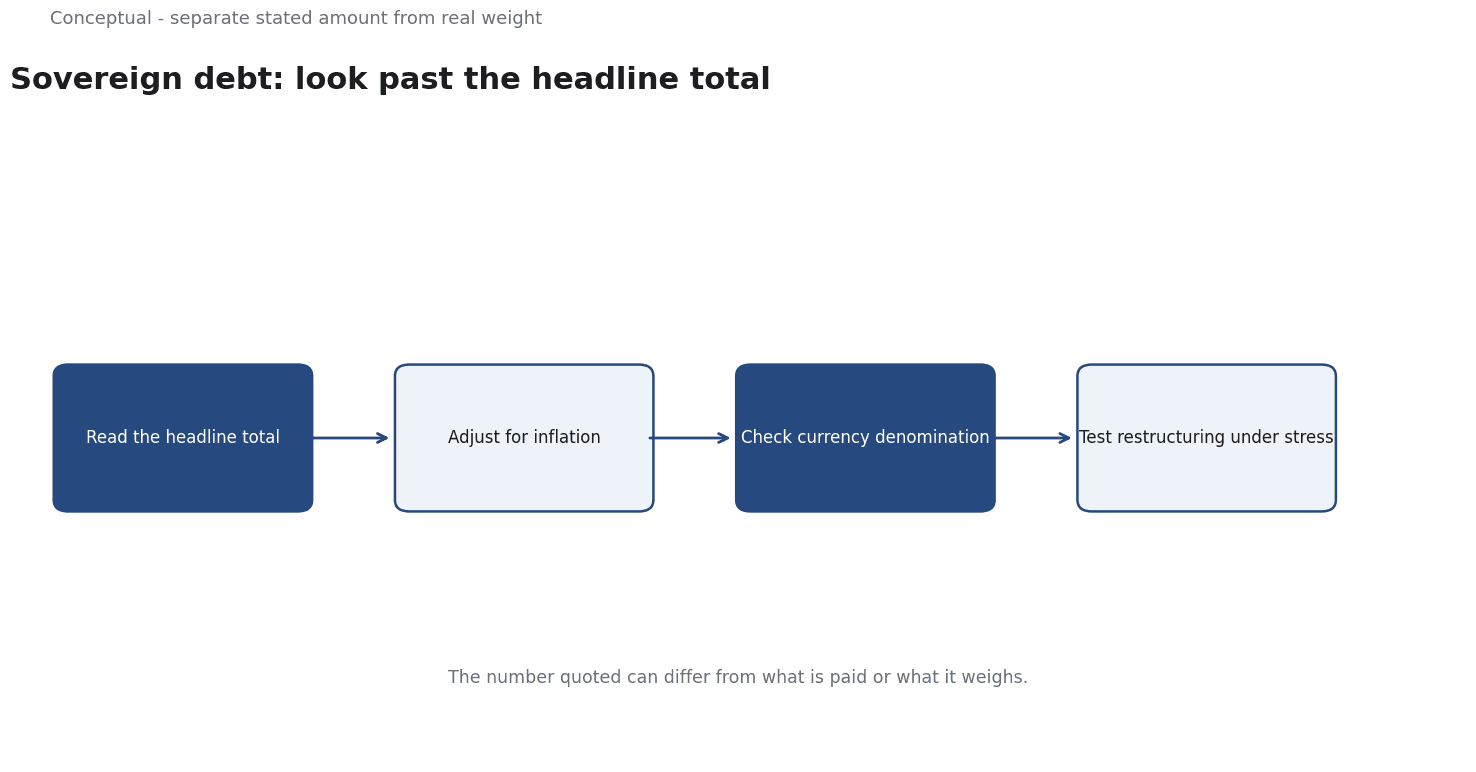
The two ideas interact in the assessment of sovereign debt. A headline total may combine obligations with different maturities, currencies, and sensitivity to price changes, while restructuring can alter the payment schedule behind that total.
Sound evaluation separates the stated amount from its real weight and asks how the terms might change under stress.
The sources define restructuring and inflation; neither prescribes a test or a threshold. That gap is filled by local analysis, which must be marked as inferred.
Currency denomination is one such local fact. A debt owed in a foreign currency cannot be dismissed as light because domestic prices rose; the government must earn that foreign currency to service it. The sources do not address denomination or default risk. Those factors should be recorded as items to verify rather than folded into the definitional claims. Keeping them separate lets a reviewer see which parts of the assessment rest on the sources and which depend on the borrower's specific position.
A worked example
The following is hypothetical and illustrative. An analyst reviews a sovereign's obligations in a year of rising prices. Three checks decide the review. First, are the figures quoted in nominal terms, and how does the price level change their real weight? Second, has restructuring altered maturities or amounts, so the headline total no longer reflects the payment schedule? Third, is the currency of denomination identified, since real burden depends on what the government must earn to service it? The review finds the headline figure overstates the real burden but masks a near-term refinancing cliff. The outcome is a measurement decision, not a forecast. The scenario is hypothetical; the verification method is the contribution.
Evidence status
| Claim | Status | Source | Verified | Recheck when |
|---|---|---|---|---|
| Restructuring renegotiates debt terms under financial stress | source-reported | Wikipedia, Debt restructuring | 2026-11-18 | Definition revised |
| Inflation reduces the purchasing power of money | source-reported | Wikipedia, Inflation | 2026-11-18 | Definition revised |
| Separating nominal and real value avoids a common debt mistake | inferred | Derived from the sources | 2026-11-18 | Price level or terms change |
The first two rows are factual claims drawn from the sources. The third is an inference about what a sound assessment requires, because neither source offers a checklist. Recheck the definitions when the source entries change, and the inferred claim when the price level or the debt terms change.
What it cannot do
This framing does not predict default or assign a risk rating. The sources define restructuring and inflation; they do not supply debt levels, maturity profiles, interest rates, or a model of fiscal capacity. A reader who expects a verdict on a specific sovereign will not find one here. The framework supports a clearer reading of the numbers, not a forecast about whether a government will meet its obligations. Forecasting requires data and assumptions the sources do not carry.
The hidden cost is the effort of restating figures correctly. Nominal amounts must be adjusted for the price level, terms must be checked against restructuring history, and currency exposure must be identified. Each of these steps requires data that may be incomplete or reported on different bases. The work is recurring because prices and terms move, and a figure that was clear last quarter can be stale now. A team that reports the headline number without this work saves effort at the price of accuracy.
The main failure mode is nominal thinking. A debt total is quoted in currency units, and those units lose purchasing power as prices rise.
The same error appears when restructuring is ignored: a headline total may conceal a maturity concentrated in the near term. Both failures come from accepting the reported figure at face value.
There is a boundary around what the sources support. They do not model the political economy of a restructuring, the role of international lenders, or the legal structure of sovereign debt. They do not address how inflation expectations are formed or how indexation clauses change the real burden. They do not make a judgment about whether a given level of debt is sustainable. Those questions require evidence and frameworks beyond two definitions.
Because prices and terms change, the assessment needs a periodic review. Each assumption about the price level, the maturity profile, and the currency of denomination should carry a recheck condition. Without that record, a future reviewer cannot tell which parts of the assessment were grounded in the sources and which were local judgments. The habit of restating figures explicitly is the main defense against repeating the mistake.
The counterargument that focusing on the headline figure is fair for a quick overview is incomplete when restructuring is underway.
A decision test
- State whether the figures are nominal or real.
- Adjust the relevant amounts for the price level.
- Check whether restructuring has changed the terms.
- Identify the currency of denomination.
- Compare maturities with available resources.
- Record which figure drives the decision and why.
- Set a recheck date for prices and terms.
The assessment is useful only when nominal amounts are restated in real terms and the terms are checked against restructuring history. The test turns a headline figure into a sequence of measurement decisions with a visible recheck point, so a reviewer can see what the number actually represents. For further reading, see Cash Flow Forecasting: A 13-Week Operating Model.
References & Further Reading
- Wikipedia contributors, 2026. Debt restructuring - Wikipedia — The process of renegotiating debt terms between borrower and lenders.
- Wikipedia contributors, 2026. Inflation - Wikipedia — The definition of inflation, its measurement and its effect on nominal versus real quantities; secondary reference.