Brand Consistency Across Channels: What Must Match
Consistency is not repetition. Read which elements must travel intact, which should adapt, and a worked audit that finds the real inconsistencies.
A brand team's instinct when a campaign looks different across channels is to enforce uniformity: same words, same colours, same layout everywhere. The result is often a rigid template that works poorly where the audience's context changes. Consistency matters — but only for the elements that carry meaning. The rest should adapt.
Direct answer: Brand consistency means that the promise, the core message, and the recognisable identity elements travel intact, while format, length, and emphasis adapt to the channel. Wikipedia's overview of brand management treats it as the discipline of maintaining a brand across touchpoints, and marketing communications covers the coordination of messages across channels. The boundary: consistency is not identity — a legal notice, a support reply, and a social post need not read the same to express the same brand.
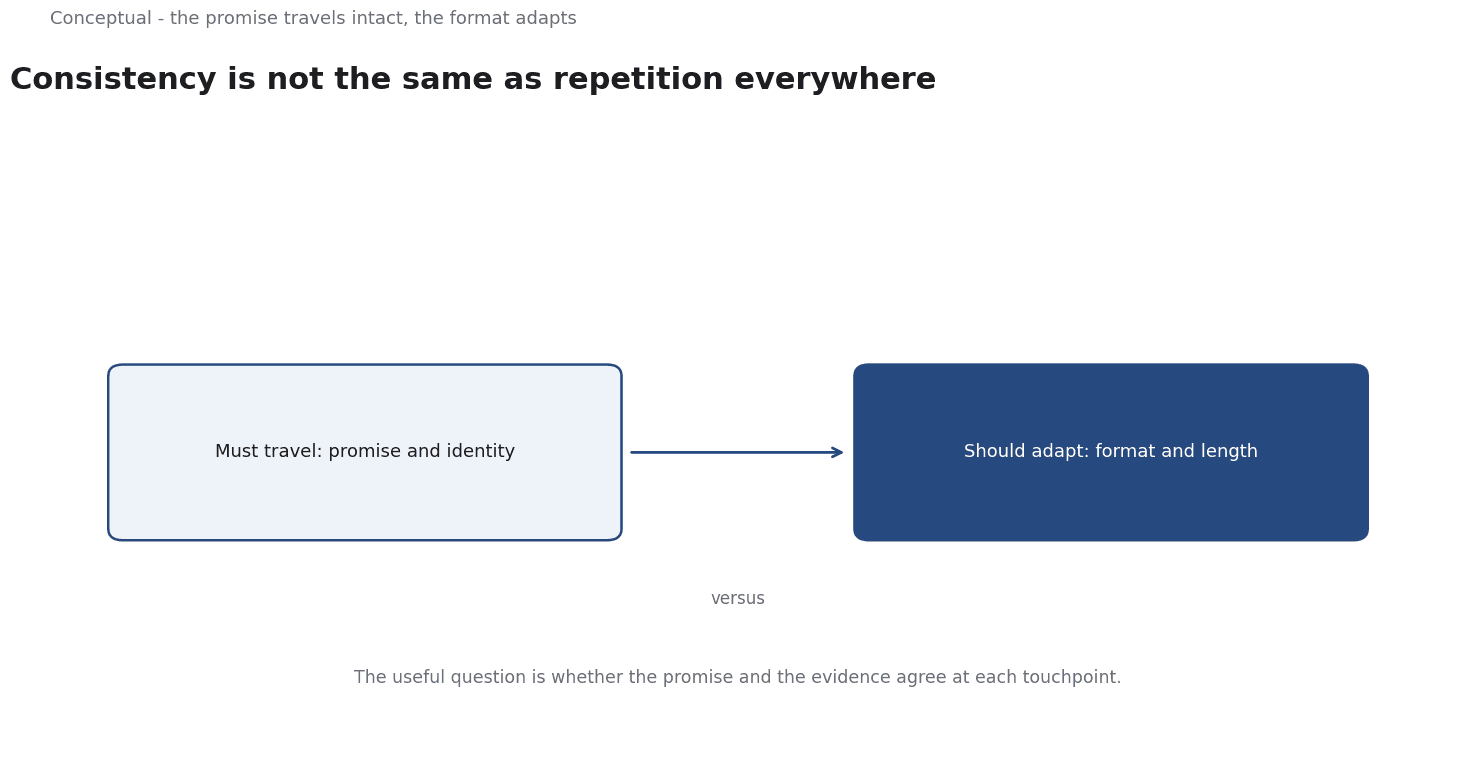
What must travel intact
Three elements carry the brand's meaning:
The promise. The outcome a customer can expect. If the website promises "set up in five minutes" and onboarding takes a week, the inconsistency is not cosmetic — it is a broken claim.
The core message and voice. What the company stands for and how it sounds. A formal, careful tone in a security document and a playful one in a support chat can both be consistent if the underlying attitude — precise, respectful, useful — is the same.
The recognisable identifiers. Name, logo treatment, colours, and the way the product is named. These let a person recognise the same source across contexts. Varying them at random costs recognition.
What should adapt
Format and length. A search ad, a landing page, and a technical document answer different questions at different attention levels. Copying the same paragraph into all three produces a message that fits none.
Proof. A developer audience may want a benchmark; a finance buyer may want a reference case. The proof should change with the decision the reader is making.
Emphasis. The same promise can be framed around speed in one channel and reliability in another if both are true and the audience's priority differs.
Wikipedia's marketing-communications overview frames the coordination problem as one of managing messages across channels — which implies choices about what to standardise and what to tailor, not blanket uniformity.
A worked example of a brand audit
The following is hypothetical and illustrative.
A company sells a B2B analytics product. An audit samples six touchpoints: homepage, paid search ad, sales deck, onboarding email, support macros, and the public changelog. Each is scored on three dimensions — promise, voice, and identifiers — as pass or fail.
| Touchpoint | Promise | Voice | Identifiers | Finding |
|---|---|---|---|---|
| Homepage | pass | pass | pass | — |
| Search ad | pass | pass | pass | — |
| Sales deck | pass | fail | pass | Overstates capability |
| Onboarding email | fail | pass | pass | Promises "five-minute setup" the product does not deliver |
| Support macros | pass | fail | fail | Different product name and legal name used |
| Changelog | pass | pass | pass | — |
Three conclusions follow:
- The onboarding claim is the real problem. It is a promise inconsistency, not a style issue. Fixing the copy without fixing the setup time would be dishonest; fixing the setup time changes the product roadmap. This is the item that deserves executive attention.
- Support macros are a low-cost fix. The different product name and legal name are identifiers that drifted because nobody owned the template. Standardising them is a copy edit.
- The sales deck's voice problem is contextual. A deck that overstates capability is not a tone issue, it is a credibility risk — but the fix is a claims review, not a brand workshop.
An audit that only checked colours and logos would have found none of these.
The useful question is whether the promise and the evidence agree at each touchpoint.
How to maintain consistency without freezing everything
Maintain a small set of artefacts. A one-page promise statement, a voice guide with examples, and an identifier specification are enough for most teams. A hundred-page manual is not consulted during a support reply.
Put the check where the work happens. A template in the support tool and a claims list in the sales system are more effective than a brand guideline nobody opens.
Review at change points. Product changes, acquisitions, and new channels are when drift happens. Tie a brand review to those events rather than to an annual refresh.
Allow local proof. Different channels may use different evidence. Consistency of claim does not require identical examples.
The counterargument — that strict consistency builds recognition and should therefore be enforced everywhere — is partly right for identifiers and wrong for everything else.
A brand that sounds identical in a bug report and a launch video is not consistent; it is failing to communicate in either context.
Who owns the check
Brand drift is rarely caused by people ignoring a guideline. It happens because nobody owns the intersection of product, support, and communications. Three ownership patterns work:
A named owner with authority. Someone can change a template in the support tool and a claim in the sales deck without asking three teams. Without that authority, the audit becomes a list of suggestions.
A claims register. Keep a short list of approved product claims with the evidence behind each. When support or sales writes a new macro, the claim either exists in the register or needs review. This turns consistency into a checkable fact rather than a matter of taste.
An event trigger. Add "brand check" to the checklist for product launches, pricing changes, and channel launches. These are the moments when the promise and the evidence diverge, and catching them there is cheaper than a full audit.
The discipline works when it is a small, continuous check attached to work people already do.
What the discipline cannot guarantee
Consistency is not truth. A perfectly consistent false claim is still false. The audit above found an onboarding promise that matched the brand but not the product — a consistency check alone would miss it.
Brand is not the whole experience. Product behaviour, pricing, and support response time shape perception more than copy does. A brand programme that ignores them is working on the surface.
Different channels have different owners. Enforcing consistency requires someone with authority across teams. Without an owner, drift returns as soon as the project ends.
A decision test
- List the touchpoints a customer actually encounters, including support and documentation.
- Score promise, voice and identifiers separately — do not collapse them into one brand score.
- Treat promise mismatches as product issues until proven otherwise.
- Fix identifier drift with templates, not training alone.
- Allow channel-specific proof and format where the decision context differs.
- Keep the guideline short and place it where work happens.
- Review at product and channel changes, not only on a calendar.
For the positioning layer, see Brand Positioning; for the content layer, see Content Marketing.
References & Further Reading
- Wikipedia contributors, 2026. Brand management - Wikipedia — The discipline of maintaining a brand across touchpoints; secondary reference used for channel consistency.
- Wikipedia contributors, 2026. Marketing communications - Wikipedia — The coordination of messages across channels and the distinction between consistent and identical communication.