Sovereign Debt without the Hype
Sovereign debt is a stock, not a mood. Learn the source definitions, a worked sustainability review, and the limits of ratios in public finance.
Public debt is usually discussed in extremes: either as an imminent crisis or as money a government can simply print. Both framings skip the basic accounting. Debt is a stock that accumulates from past borrowing, while deficits and interest payments are flows, and the ratio quoted in headlines compresses several of these into one number. The real problem is that a single ratio is asked to carry a judgment it cannot support alone.
Direct answer: Read government debt as the stock owed by a central government and assess it alongside the government's revenue base and obligations. The Wikipedia entries define government debt and government; neither supplies a universal safe threshold. A review should pair the debt-to-GDP ratio with the interest burden and the currency the debt is issued in.
Delta: This article adds a claim-status table beyond the sources: it maps each public-finance metric to a concrete review decision, with claim status explicit.
The mechanism
The Wikipedia entry on government debt describes money owed by a national government, typically raised by issuing securities to investors. It distinguishes debt owed domestically from debt owed to foreign lenders, and it introduces the debt-to-GDP ratio as a way to size the stock against the economy. Interest payments are the flow cost of carrying that stock. The practical consequence is that the headline ratio measures scale, not the capacity to service the debt.
The Wikipedia entry on government describes the institutions that govern a state and the functions they perform, including the provision of public services funded largely through taxation. This connects debt to a purpose: borrowing finances the gap between what a government spends and what it collects, whether for infrastructure, stabilization, or other functions. The practical consequence is that debt service competes directly with those functions. A larger interest bill leaves less room for everything else.
Reading the two sources together gives a working sequence. Debt accumulates when spending exceeds revenue over time; the ratio compares the accumulated stock with the size of the economy; and the interest burden compares the flow cost with the revenue available to pay it. Growth and interest rates therefore matter as much as the raw stock. None of this yields a single number that decides sustainability, so the conclusion remains a judgment assembled from several checks.
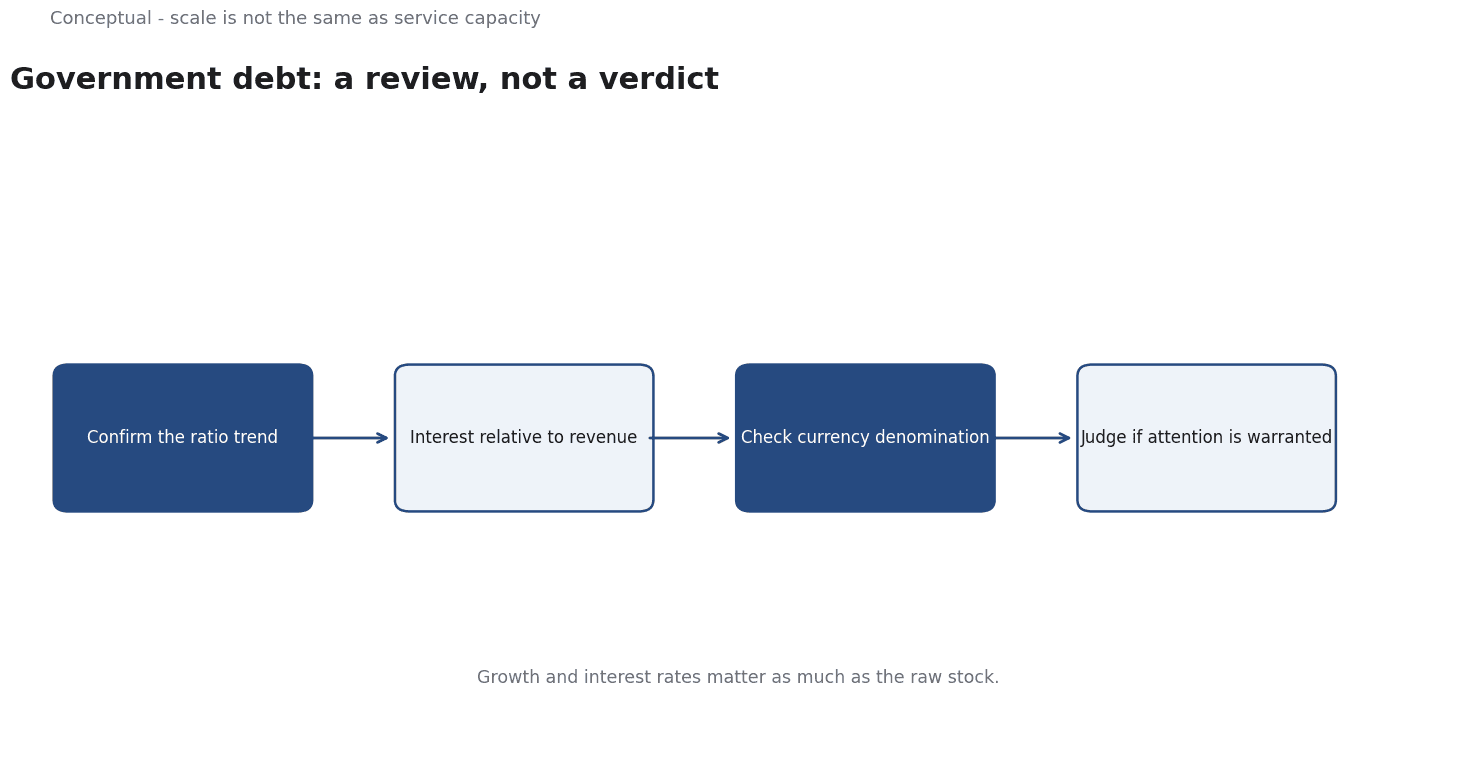
The output is a short review, not a verdict. The sequence is: confirm the trend in the ratio, measure interest relative to revenue, check the currency denomination, then decide whether the position warrants attention. Each step narrows the interpretation before the next.
A worked example
The following is hypothetical and illustrative. A finance ministry is briefed that its debt ratio has "crossed a threshold." Three checks reframe the claim. First, is the ratio rising over several years or merely fluctuating with the cycle? Second, how much of revenue is absorbed by interest, and is that share trending up? Third, is the debt issued in the country's own currency or in foreign currency? The review finds a stable ratio but a rising interest share, with most borrowing in foreign currency. The conclusion is a refinancing risk, not a solvency crisis, and the ministry reallocates the review to maturity dates and reserve cover. The numbers are hypothetical; the verification method is the contribution.
Evidence status
| Claim | Status | Source | Verified | Recheck when |
|---|---|---|---|---|
| Government debt is money owed by a national government | source-reported | Wikipedia, Government debt | 2026-11-18 | Definition revised |
| Governments provide public services funded by revenue | source-reported | Wikipedia, Government | 2026-11-18 | Definition revised |
| Interest burden indicates sustainability pressure | inferred | Derived from the sources | 2026-11-18 | Rates or revenue change |
The first two rows are definitions stated by the sources. The third is an inference about how to interpret the flow cost, since the sources describe interest payments without declaring a threshold. Recheck definitions when the entries change, and the inferred row when interest rates or revenue shift materially.
What it cannot do
A debt ratio cannot, on its own, decide sustainability.
Two countries with the same debt-to-GDP figure can face very different situations depending on growth, interest rates, and the term structure of their borrowing. The sources define the stock and the ratio but do not endorse a universal danger line. A claim that a specific percentage is safe or catastrophic is a political or analytical position, not something these definitions establish.
Currency denomination changes the risk substantially. A government that borrows in its own currency has more room to service that debt than one that borrows in a currency it must earn through exports or reserves. The Wikipedia entry distinguishes domestic from external debt, and that distinction should carry weight in any review.
A debt service bill in a currency the state cannot issue at will is a cash-flow obligation that must be met from revenue or reserves, and the review should say so plainly.
The headline stock also misses contingent liabilities. Guarantees, public pensions, and obligations of state-owned entities may sit outside the measured debt until they crystallize. A position that looks comfortable on the published figure can carry large hidden commitments. The sources describe measured debt; they do not inventory these off-balance-sheet exposures, so the reviewer must ask what is not counted.
Institutional and political capacity matter as well. The ability to raise revenue, pass a budget, and roll over maturing debt is not captured by an accounting ratio. A country with shallow markets may face refinancing pressure well before a high ratio would suggest, while another with deep markets and credible institutions carries more debt comfortably. The government entry describes functions, not this capacity, so it cannot settle the question. Two countries with similar published figures can therefore face opposite refinancing outcomes, and the difference lives in institutions rather than in the ratio itself.
Finally, the metrics are silent on what the borrowing financed and who bears the cost. Debt used for productive infrastructure differs from debt used for current consumption, and the burden falls differently across generations. These are distributional and intergenerational questions that a ratio cannot answer. Each review needs a recheck date tied to budgets and rate changes, with the assumptions recorded so a later reader can follow the reasoning.
The counterargument that a single debt ratio is fair for quick comparison is incomplete when currency and revenue capacity differ.
A decision test
- Record the debt-to-GDP ratio and its multi-year trend.
- Measure interest payments as a share of revenue.
- Check the split between domestic and foreign-currency debt.
- Identify contingent liabilities outside the headline figure.
- Assess the government's capacity to raise revenue and roll over debt.
- Compare the position with a relevant peer group, not a universal threshold.
- Record the conclusion with a recheck date tied to budgets or rate changes.
The test replaces a single alarming number with a structured review. Its value is that each figure is paired with a condition for rechecking, so a reader can see which conclusion followed from which check. For further reading, see Cash Flow Forecasting: A 13-Week Operating Model.
References & Further Reading
- Wikipedia contributors, 2026. Government debt - Wikipedia — Debt owed by a national government.
- Wikipedia contributors, 2026. Government - Wikipedia — The structure and functions of public administration.