Stakeholder Management: Common Questions
Stakeholder management is about identifying who can affect or be affected by a decision. Read the mechanism, a worked example and where a stakeholder map stops being useful.
Stakeholder management is often reduced to a diagram of names and influence, which looks rigorous while hiding the actual decision. The real problem is that a stakeholder covers anyone who can affect or be affected by an organisation, so the set is large and the priorities are unclear. The corporate-stakeholder and decision-making material provides the concepts; the missing piece is how those concepts change a choice.
Direct answer: A stakeholder is any party that can affect or be affected by an organisation, which is broader than a shareholder. Stakeholder management is the practice of identifying those parties and ordering their claims before a decision, using the decision-making literature to decide how much weight each gets. The boundary: mapping stakeholders does not tell you whose interest should win.
Delta: This article adds a decision framing beyond the sources: it maps stakeholder identification and bounded rationality to the specific question of which voices enter a decision and how, with claim status explicit.
The mechanism
The corporate-stakeholder entry defines a stakeholder as a party with an interest in an organisation who can affect or be affected by it. That definition is deliberately wider than shareholder: employees, customers, suppliers, investors, communities and governments can all qualify. The practical consequence is that the first task is enumeration from the definition, not from a familiar list. Any party meeting the affect-or-be-affected test belongs in scope, even if it has no formal standing in the decision.
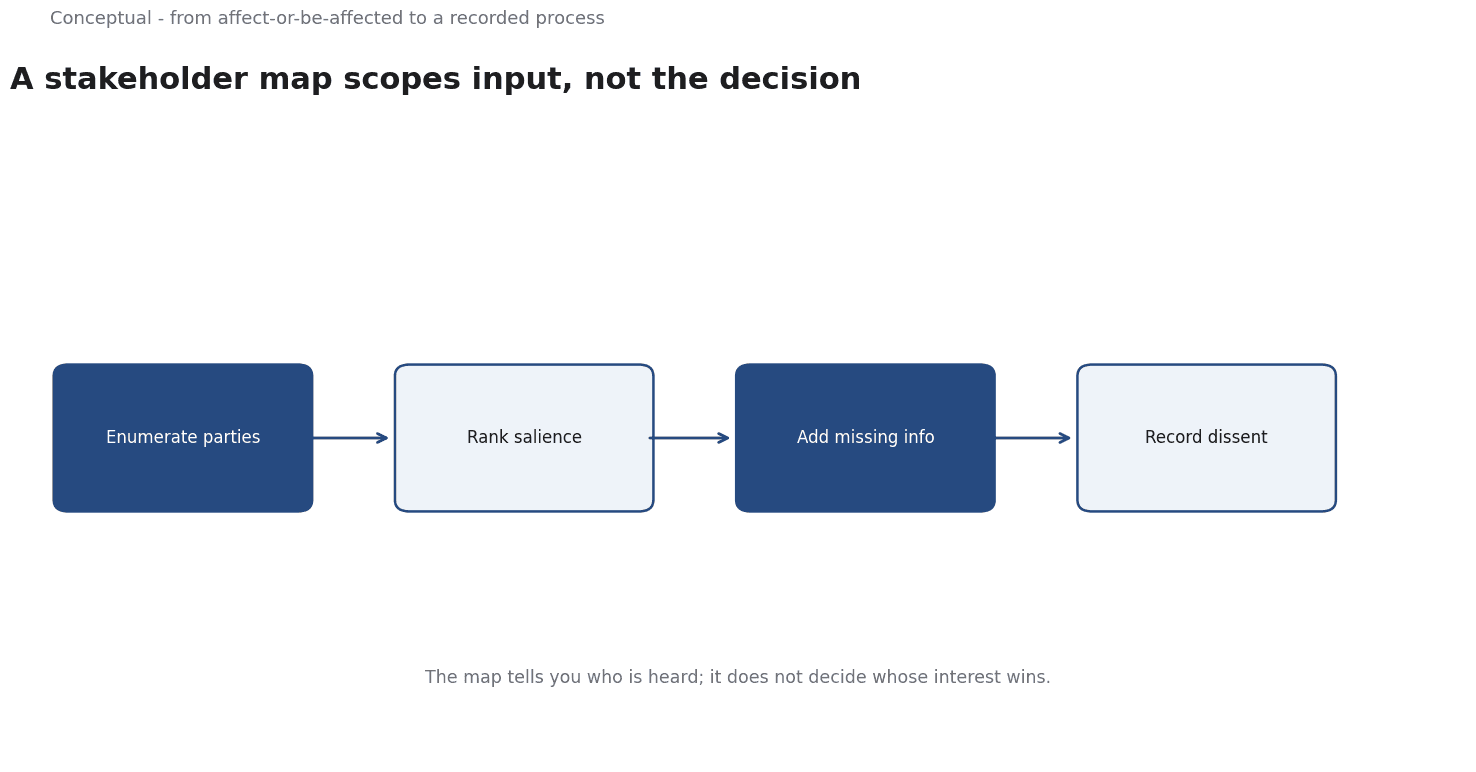
Because the set is broad, classification is the second mechanism. The literature distinguishes primary and secondary stakeholders and proposes salience based on attributes such as power, legitimacy and urgency. These are ways of ordering attention, not moral rankings. The practical consequence is that a mapping exercise should record which attribute gives a stakeholder salience for this decision, because the answer changes with the issue. A group that is urgent in one decision may be peripheral in another, so a single permanent ranking is misleading.
The decision-making entry describes the cognitive process of selecting among alternatives and introduces bounded rationality: decision makers work with limited information and time rather than optimising perfectly. The practical consequence is that stakeholder input expands the information available to a bounded decision maker, but it is not a substitute for the decision.
More voices can improve the premises while slowing the process, so the design question is which voices add information the decision currently lacks.
Adding voices that merely repeat known facts raises cost without raising quality.
The fourth mechanism is group process. Stakeholder input often arrives through meetings, where pressure to agree can suppress dissent. The practical consequence is that format matters as much as the list: written input, independent statements and a recorded dissenting view preserve information that a single discussion can lose. The mechanism therefore ends not with a map but with a rule about how input is gathered and how conflict is recorded. That rule is the part most often omitted.
A worked example
The following is hypothetical and illustrative. A company is choosing whether to move a support function to a new location and builds a stakeholder view before deciding. Three checks decide. First, scope: applying the affect-or-be-affected definition, does the list include affected employees and local communities, not just investors and customers? Second, salience: for each party, which attribute, power, legitimacy or urgency, gives it standing on this specific decision, and is that recorded? Third, bounded rationality: which voices add information the decision lacks, and how will a dissenting view be preserved in writing? The outcome is not a verdict but a process rule: affected employees provide written input before the meeting, and the dissent is attached to the decision record. The scenario is hypothetical; the mapping from concepts to process is the contribution.
Evidence status
| Claim | Status | Source | Verified | Recheck when |
|---|---|---|---|---|
| A stakeholder can affect or be affected by an organisation | source-reported | Stakeholder (corporate) - Wikipedia | 2026-11-18 | Definition or scope changes in the source |
| Decision makers operate under bounded rationality | source-reported | Decision making - Wikipedia | 2026-11-18 | Model or terminology is revised |
| Recorded dissent preserves information that open discussion can lose | inferred | Derived from the sources | 2026-11-18 | New evidence on group decision processes appears |
The two definitional claims are reported directly from the reference entries and are stable as descriptions. The claim about dissent is an inference from combining the stakeholder and decision concepts, so it should be revisited if the group-process evidence changes. Keeping the statuses separate prevents an interpretive step from being read as a documented fact.
What it cannot do
A stakeholder map cannot decide whose interest wins. It tells you who is affected and how salient each party is, not what weight their claim should carry. Any claim that the map produces the right answer confuses representation with resolution. The decision still requires a judgement about objectives, constraints and trade-offs that the map deliberately leaves open.
The hidden cost is process. Broad inclusion takes time, adds meetings and creates an expectation that every input will be honoured. Inclusion can also be used instrumentally: selecting friendly voices and calling the result stakeholder engagement gives a decision legitimacy it has not earned. That cost is harder to see than the time cost, because the map appears more thorough the more names it contains. A useful discipline is to record why each voice was included and how its input changed the decision, or why it did not.
A common failure mode is treating salience as fixed. Power, legitimacy and urgency change over time and across issues, so a map built for one decision can mislead when reused for another. Another failure is equating loudness with salience, which lets the most persistent party dominate the record. Both failures share a cause: the attributes are treated as properties of the people rather than as relationships that depend on the decision at hand. Re-deriving salience per decision is the only reliable correction.
There are settings where broad stakeholder input should not drive the decision. Crises demand speed, confidentiality limits who can be told, and some parties hold formal rights that a map does not create. Regulators and shareholders may have standing defined by law or contract, which a salience score neither grants nor removes. The tool is for scoping input, not for allocating legal authority. Its boundary is the informational question of who should be heard, not the normative question of who has the right to decide.
Finally, a stakeholder map needs scheduled review because both the organisation and its environment change. New groups become affected, old ones recede and the salience attributes shift with each issue. The practical requirement is to re-derive the map for each consequential decision, to record which version supported which choice and to note where input was excluded and why. Without that discipline the map becomes a fixture that people cite rather than a tool they use.
The counterargument that broad inclusion slows decisions is fair for urgent, low-reversibility choices and incomplete for consequential ones, where information missed early costs more than the time spent gathering it.
A decision test
- Define the decision and who is affected by it.
- Enumerate parties using the affect-or-be-affected test.
- Record the salience attribute relevant to this decision for each party.
- Identify which voices add information the decision lacks.
- Choose a format that preserves independent and dissenting input.
- Record how each input changed the decision, or why it did not.
- Set a review point for the map and note the version used.
These steps turn broad concepts into a repeatable input process without pretending the map decides anything. The test is passed when a reader can see who was in scope, why each voice was included and where dissent was recorded, and failed when the diagram is presented as the decision itself. For further reading, see Voice of Customer: Turning Feedback into Decisions.
References & Further Reading
- Wikipedia contributors, 2026. Stakeholder (corporate) - Wikipedia — Parties affected by an organisation.
- Wikipedia contributors, 2026. Decision-making - Wikipedia — Overview of decision processes, trade-offs and the distinction between the decision and its outcome; secondary reference.