Store Formats Examples
A store format is a choice about assortment, service, and cost. Read examples, a worked comparison, and why copying a format rarely transfers.
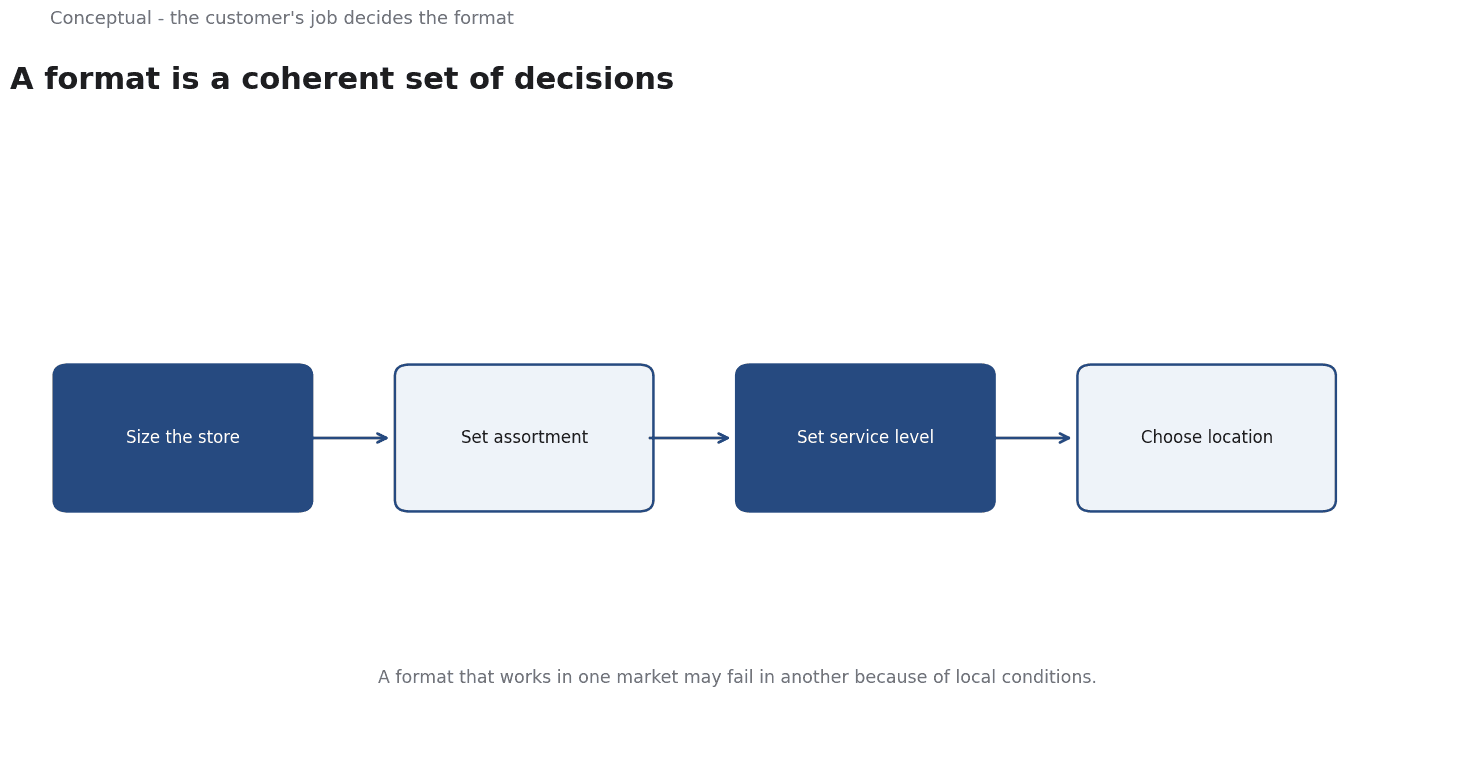
A store format is a coherent set of decisions about size, assortment, service level, and location. Discussing retail as if all stores were variations of one model hides the fact that a convenience store and a warehouse club solve different problems for different customers. The format should follow the customer's job, which the jobs-to-be-done article frames as a situation, as Why Product Assortment Matters More Than Having More Products argues for deliberate choices about what to carry.
Direct answer: Choose a store format by the customer need it serves and the economics it can sustain, with the assortment, pricing, and service aligned. The retail-media overview provides channel context, and NRF statements offer primary industry perspectives. The boundary: a format that works in one market may fail in another because of local conditions, which the international-expansion article treats as localization, as the industry-insights lens requires scope and limits.
Examples of formats
Convenience. Small footprint, limited assortment, high convenience, and higher prices, as the retail-channel economics article explains for how rent and service shape cost. The customer job is speed, which the jobs-to-be-done article frames as a situation.
Supermarket. Broad assortment, self-service, and moderate margins, which the assortment article treats as a trade between variety and inventory cost. The format depends on density and footfall, as the location question in the retail-channel article explains.
Warehouse club. Large footprint, limited SKUs, bulk packs, and membership, which the e-commerce-versus-brick article explains for how a format trades service for price. The customer job is stocking up, which the inventory article treats as a cash and space decision.
Specialty. Deep assortment in one category with high service, which the product-assortment article argues can matter more than breadth, as the private-label article treats brand and margin choices.
Three consequences follow. Each format has a different cost structure, which the unit-economics article requires for margin analysis. Each serves a different job, as the jobs-to-be-done article advises. And each fails when the signals are mismatched — a convenience store in a low-footfall location or a warehouse club where customers lack storage, as E-commerce vs Brick and Mortar: The Economics of Retail Channels explains for operating context.
A worked comparison
The following is hypothetical and illustrative. A retailer considers opening a second format in a neighbouring market.
Three checks decide. First, what job does the local customer have, which the market-research article advises investigating with neutral wording, as the survey-design article requires. Second, what does the format cost to operate at that location, as the unit-economics article requires for rent, labour, and margin? Third, does the existing supply chain support the assortment, which the inventory article treats as a cash and stock decision, as the retail-technology article advises for operational fit?
Three conclusions follow. A copy of a successful store elsewhere is a hypothesis, as the competitive-intelligence article warns about success stories. And the decision should be recorded with the assumptions, as the decision-memo article requires.
The format should be chosen by local evidence, which the international-expansion article treats as localization, as the industry lens requires defined scope.
Why formats evolve
A store format is not fixed once and kept forever. Customer habits shift, competitors open new formats, and the cost of space changes, which the retail-channel article treats as the economics that shape a format, as the real-estate article explains for how property cycles affect occupancy cost. A format that was right a decade ago can be expensive and misaligned now, which the monitoring article treats as a change trigger for any design tied to conditions.
The evolution is usually incremental. A supermarket adds prepared food, a convenience store adds seating, a specialty retailer adds a smaller satellite format, each a response to a job the current store does not serve, as the jobs-to-be-done article advises for framing demand.
For a practitioner, the useful habit is to revisit the format's assumptions on a schedule and after a material change, which the risk-assessment article recommends for known uncertainties. The question is not whether the store is busy but whether it still serves the job it was designed for at a sustainable cost, as the worked comparison frames the decision, as the decision-memo article requires for a recorded judgement.
What format examples cannot do
They cannot guarantee a result in a new market, which the publication standard states for commercial claims, as the competitive-intelligence article warns about survivorship. They do not remove the need for good execution, which the retail-technology article treats as the operating mechanism. And they cannot fix a weak assortment, which the product-assortment article treats as the prior decision.
The counterargument that a proven format is safe is partly true and misses the local conditions, which the international-expansion article argues for localisation, as the worked comparison shows.
A decision test
- Define the customer job the format should serve, as the jobs-to-be-done article advises.
- Check local evidence with neutral research, as the survey-design article requires.
- Model the cost structure, as the unit-economics article requires.
- Check supply chain fit, as the inventory article advises.
- Treat a copied format as a hypothesis, as the competitive-intelligence article warns.
- Record the decision with the local assumptions, as the decision-memo article requires.
- Review after opening, as the monitoring article advises.
For the operating context, see E-commerce vs Brick and Mortar; for the assortment, see Product Assortment.
References & Further Reading
- Wikipedia contributors, 2026. Retail media - Wikipedia — Overview of retail media channels, first-party data and the reported ~21% share of global digital ad spend in 2024; secondary reference used with IAB and NRF material.
- National Retail Federation, 2026. NRF Press Releases | Latest Statements & Announcements | NRF — Primary retail-sales and channel data for sell-in versus sell-out definitions.