Storytelling Best Practices
Good storytelling is structured and repeatable, not improvised. Read how narrative maps to brand decisions, a worked example, and where the practice breaks down.
Storytelling is routinely described as a creative gift, which makes best practices sound like a contradiction. In organizational use it is closer to a discipline: events are selected, ordered, and repeated to transmit a particular meaning. The storytelling entry describes that structure, and the brand management entry describes the perception a firm works to maintain; the real problem is deciding which stories are worth telling again.
Direct answer: Storytelling best practices are the checks that keep a story both coherent and consistent with the brand it serves: a clear sequence, a change that matters, and alignment with the intended perception. The sources describe narrative form and brand maintenance; the filter that joins them is a synthesis. A memorable story that contradicts the brand is a liability, not an asset.
Delta: This article adds a claim-status table and a story-to-brand test beyond the sources: it maps each story to the perception it reinforces, with claim status explicit.
The mechanism
Storytelling is the conveying of events in words, images, or sounds, often with improvisation or embellishment, and it serves to transmit knowledge, values, and culture. The entry describes narrative as a structured account: events are selected and ordered into a beginning, middle, and end, with a subject, a sequence, and a change of state. That structure is what separates a story from a list of observations. The practical consequence is that a story does not require invention to be effective; it requires selection and order. A team that arranges real events into a coherent sequence is doing the work of storytelling, even when nothing in the account is fictional.
Brand management is the discipline of maintaining and improving a brand so that its name is associated with positive results. It concerns brand identity, the signals a firm sends, brand image, how those signals are received, and the equity that accumulates over time. Consistency across touchpoints is central: a brand is the accumulated perception in an audience, not a single message. The practical consequence is that a story is never standalone. It either reinforces the perception the brand has built or competes with it, and repeated, consistent stories are what make a brand recognizable rather than a series of unrelated statements.
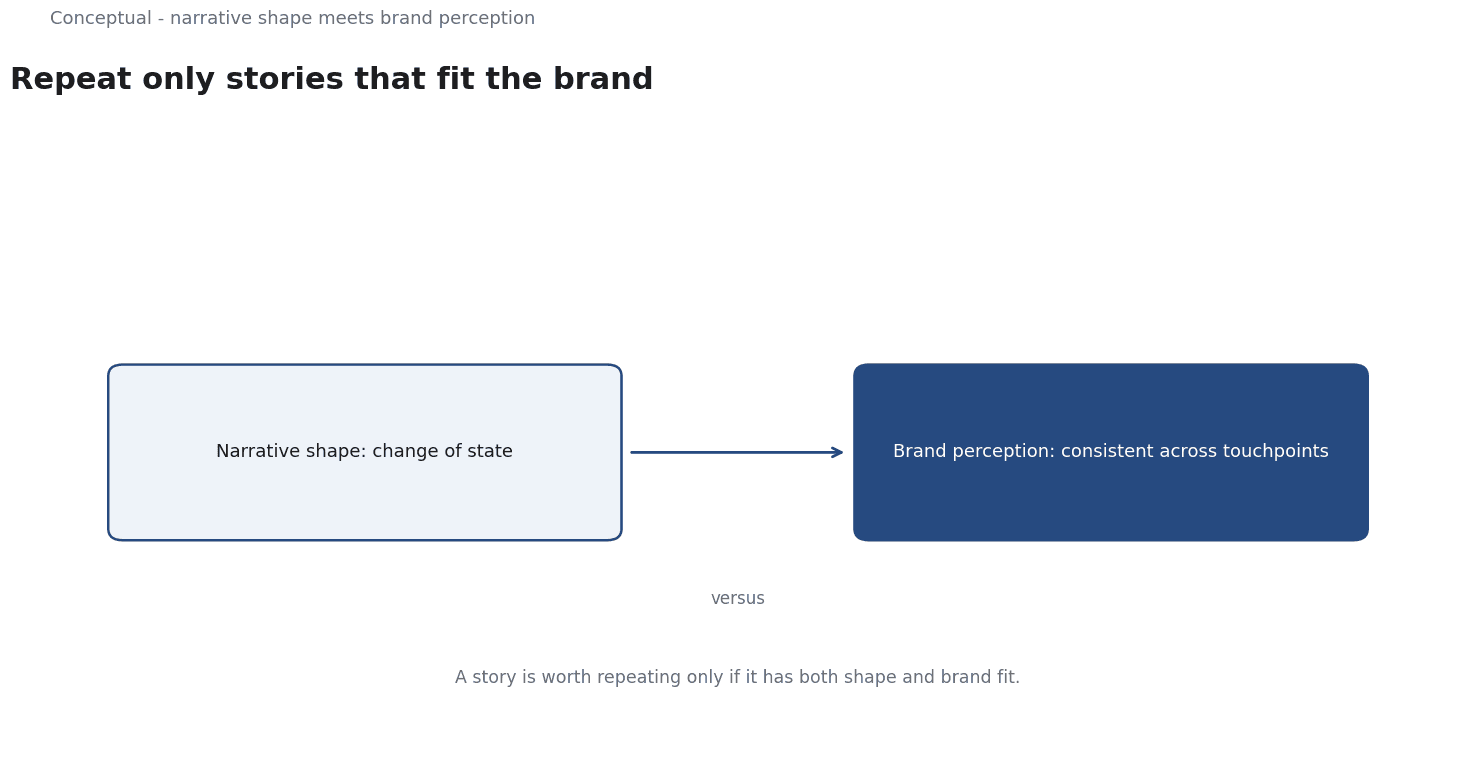
The two sources meet where structure meets repetition. Storytelling supplies the form: a selected sequence with a change that matters. Brand management supplies the constraint: the story must be consistent with the perception the brand intends to own.
Combining them yields a test: a story is worth repeating only if it both has a clear narrative shape and reinforces the intended brand perception.
That test is inferred, because neither source prescribes a filter for choosing stories. It should be recorded as a local decision and revisited when the brand's positioning changes. A vivid story that contradicts the brand is a liability precisely because repetition amplifies it.
The output is a small story map: for each candidate story, the narrative shape, the brand perception it supports, and the audience that needs to hear it. That map, rather than a collection of anecdotes, is the decision instrument. It shows which stories are worth telling again and which are one-off observations. Because each entry names the perception it reinforces, a reviewer can later tell whether a story was chosen deliberately or simply because it was memorable. The value lies in making the brand link explicit: a good story in this sense is one that can be repeated without weakening what the brand stands for.
A worked example
The following is hypothetical and illustrative. A team is choosing which customer story to lead with in a launch narrative. Three checks decide the choice. First, does the account have a narrative shape, with a starting situation, a change, and an outcome? Second, does the change illustrate the perception the brand wants to own, rather than an unrelated strength? Third, can the story be told consistently by different people without drifting into a different claim? The team finds one account that is dramatic but promotes a feature the brand does not want to lead with, and another that is quieter but reinforces the intended perception. It chooses the second and scripts it for reuse. The outcome is a story that can be repeated safely. The scenario is hypothetical; the verification method is the contribution.
Evidence status
| Claim | Status | Source | Verified | Recheck when |
|---|---|---|---|---|
| Storytelling conveys selected events in a structured sequence | source-reported | Wikipedia, Storytelling | 2026-11-18 | Entry revised |
| Brand management maintains consistent perception over time | source-reported | Wikipedia, Brand management | 2026-11-18 | Entry revised |
| Repeat only stories that reinforce the intended perception | inferred | Derived from the sources | 2026-11-18 | Positioning changes |
The first two rows restate what the source entries describe directly. The third is an inference about which stories to repeat, because neither entry supplies a selection rule. Recheck the first two rows when those entries change, and the third whenever the brand's positioning or intended audience changes.
What it cannot do
A story map does not make a story true or compelling. It checks that a narrative has shape and that it aligns with a brand, but an aligned story can still be factually weak or fail to move an audience. The sources describe storytelling as a form and brand management as perception maintenance; neither offers a way to verify the facts inside a story. Treating a brand-consistent story as a true one is a category error: alignment answers whether the story fits the intended perception, not whether its events occurred as described. A team that needs factual assurance must verify the underlying events, not the narrative structure.
The hidden cost is that consistency constrains creativity. Once a story is tied to a brand perception, each retelling must stay within that frame, and the pressure to stay on message can flatten the details that made the story vivid in the first place. The sources do not discuss this tension, but the practical consequence is real: teams spend effort scripting and policing retellings rather than discovering new ones. That effort is the price of repetition. Without it, a story drifts as it is passed between people, and the brand perception it was meant to support becomes diluted or contradictory.
A memorable anecdote that highlights the wrong attribute can entrench a perception the brand is trying to change, and repetition makes the mistake harder to undo. A second failure mode is overfitting: a team repeats one story so often that it stops carrying information and becomes a slogan. The sources do not describe these failures, so they must be watched locally. A defensible practice records why a story was chosen and what perception it supports, so a reviewer can see whether it still fits after the brand evolves.
There is a boundary around the method. It covers stories an organization chooses to repeat, not the full range of storytelling as a human practice. Improvisation, oral tradition, and fictional narrative are outside its scope, because the test depends on a brand that an organization is trying to maintain. It does not supply the brand positioning it enforces; it draws on a positioning that already exists. A story map cannot tell a team what its brand should stand for; it can only show whether a given story supports what the brand already claims. That is narrower than the broad claim that storytelling builds brands.
Because positioning and audiences change, the map needs a refresh. Each story should carry a recheck condition, and the link to brand perception should be treated as a local decision rather than a value the sources provide. A shift in strategy can turn a formerly aligned story into a misleading one, and a new audience may read the same story differently. Without a record, a future reviewer cannot tell which stories were chosen deliberately and which were inherited. The story collection will still exist; the reasoning behind each choice is what makes the review possible.
The counterargument that a vivid story is fair for grabbing attention is incomplete when repetition locks in a perception the brand does not want.
A decision test
- State the brand perception the story should support.
- Check that the account has a clear narrative shape.
- Identify the change that makes the story matter.
- Test whether the change illustrates the intended perception.
- Confirm the story survives retelling by different people.
- Record it with the perception it supports and a recheck condition.
- Revisit the map when positioning or audience changes.
A story map is useful only when both the narrative and the brand link are recorded. The test turns a subjective preference into a sequence of checks with a visible rationale, so a reviewer can see which perception a story serves and when it must be revisited. For further reading, see Voice of Customer.
References & Further Reading
- Wikipedia contributors, 2026. Storytelling - Wikipedia — The structure and elements of narratives.
- Wikipedia contributors, 2026. Brand management - Wikipedia — The discipline of maintaining a brand across touchpoints; secondary reference used for channel consistency.