Store Pricing Checklist
A price is a decision about position and margin. Read the checklist, a worked example, and why a higher price can increase volume.
Store pricing is often treated as a calculation from cost, which ignores what a price communicates. The Wikipedia entry describes pricing as a practice, and the retail-media entry covers channels where price is visible. The checklist starts from the position the store wants.
Direct answer: Set prices from the position, the margin, and the customer's frame of reference, then test the result. The sources describe pricing and channels; the checklist is a synthesis.
Delta: This article adds a claim-status table and a worked example, separating documented pricing concepts from local choices about position.
The mechanism
Three points matter:
- Price is a signal. The pricing entry describes how prices are set and interpreted. A low price can suggest lower quality, which is a positioning effect.
- Cost is a floor, not a price. A price must cover cost, but cost does not determine what a buyer will pay. The retail-media entry describes channels where the same price competes with others.
- Reference points matter. A price is judged against alternatives the customer knows. Changing the frame changes the judgement.
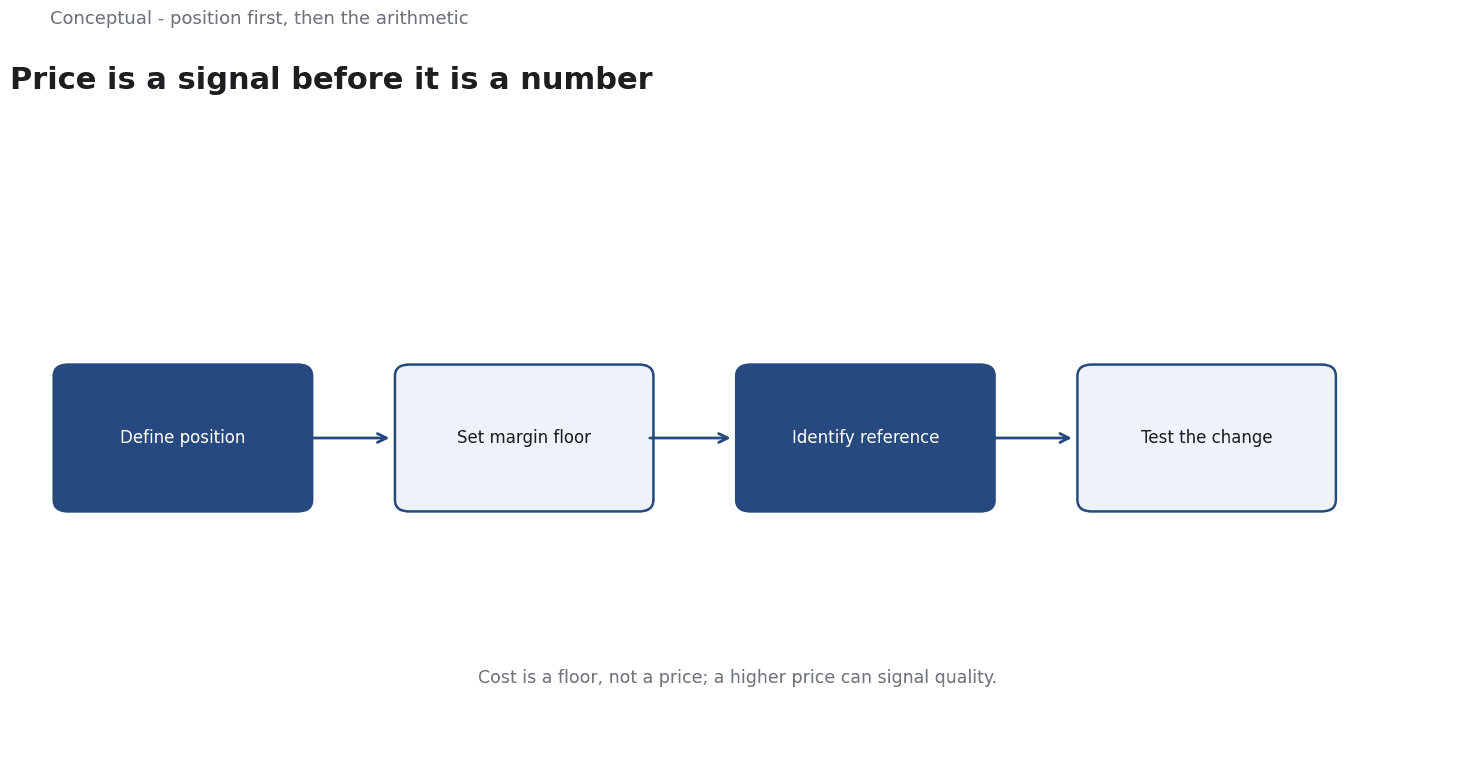
The sequence is: define the position, set a margin floor, choose a reference, then test. The position is local judgement, so it is inferred; the concepts are source-reported.
A worked example
Illustrative. A shop raises prices on a private label and sees volume increase.
Three checks decide. First, did the higher price signal better quality rather than reduce affordability? Second, what is the margin after the change, and does it cover the same costs? Third, what alternatives were customers comparing against?
The outcome is a pricing decision with a recorded rationale. The scenario is hypothetical; the method is the contribution.
Why the reference price matters
A buyer judges a price against alternatives they know, which may be a competing store, a previous price, or an anchor set by the product itself. Changing the price without knowing the reference means changing the signal without knowing how it will be read. Identifying the reference is therefore the first analytical step.
What a test should include
A price test should run long enough to cover normal buying cycles and should record margin alongside volume. A short test can capture a novelty effect, and a volume gain at a lower margin can be a loss. Reading both figures prevents a change that looks successful on one measure from being accepted without checking the other.
Evidence status
| Claim | Status | Source | Verified | Recheck when |
|---|---|---|---|---|
| Prices are set and interpreted by buyers | source-reported | Wikipedia, Pricing | 2026-11-18 | Practice changes |
| Retail media exposes prices across channels | source-reported | Wikipedia, Retail media | 2026-11-18 | Channel changes |
| Set position before the number | inferred | Derived from pricing practice | 2026-11-18 | Position changes |
Why a higher price can raise volume
When quality is hard to judge, buyers use price as a cue.
A higher price can therefore increase demand up to a point, which contradicts a simple demand curve derived from cost.
Recognising this effect is the reason to test rather than assume.
Pricing also cannot fix a weak assortment.
The price decision belongs after the assortment decision, which is a sequence worth respecting when a category underperforms.
The checklist has a limit on what it can observe. A price change can move sales between channels without changing total demand, and a report that looks at one channel will miss the shift. Reading the whole category is the correction, which is a measurement decision rather than a pricing one.
The test should record the date and the competitive context, since a price that worked during one period may not work after a competitor changes theirs. A result without context is hard to reuse, which is the difference between an observation and a decision aid.
A price is also a promise about the product, and changing it frequently can make that promise unclear. Stability is part of positioning, which is why a checklist should include a rule for how often prices are revisited.
The checklist works best when it is applied to a category rather than a single item, because prices are judged in relation to neighbouring products. A price that seems high alone can look reasonable in context.
A price recorded without its date is hard to interpret later, because the reference set will have moved.
What it cannot do
It cannot create demand for an unwanted product. It does not remove the need to know costs. And it cannot guarantee that a signal works in another channel.
The counterargument that the lowest price always wins is fair for commodity goods and incomplete where quality is uncertain.
A decision test
- Define the position.
- Set a margin floor.
- Identify the reference price.
- Test a change.
- Read volume and margin together.
- Record the decision and recheck date.
For the margin context, see Unit Economics.
References & Further Reading
- Wikipedia contributors, 2026. Pricing - Wikipedia — How prices are set and what they signal.
- Wikipedia contributors, 2026. Retail media - Wikipedia — Overview of retail media channels, first-party data and the reported ~21% share of global digital ad spend in 2024; secondary reference used with IAB and NRF material.