Survey Design Explained
A survey measures what its wording and sample allow. Read the design decisions, a worked example, and why a large sample cannot fix a biased question.
A survey looks simple — ask people questions and count the answers — which is why it is often designed casually. The result is a number that feels precise and may be meaningless, because the wording, the sample, and the ordering decide what was actually measured. The research standards published by AAPOR exist to make those decisions visible.
Direct answer: Design a survey by defining the population, writing neutral and unambiguous questions, choosing a sampling method, and testing the instrument before fielding. AAPOR's standards are the primary reference, and the Stack Overflow survey illustrates a large, repeated instrument with published methodology. The boundary: a survey measures stated responses under the conditions asked, not behaviour in the world, which the NPS article warns about for intentions, as the voice-of-customer article treats behaviour as a separate signal.
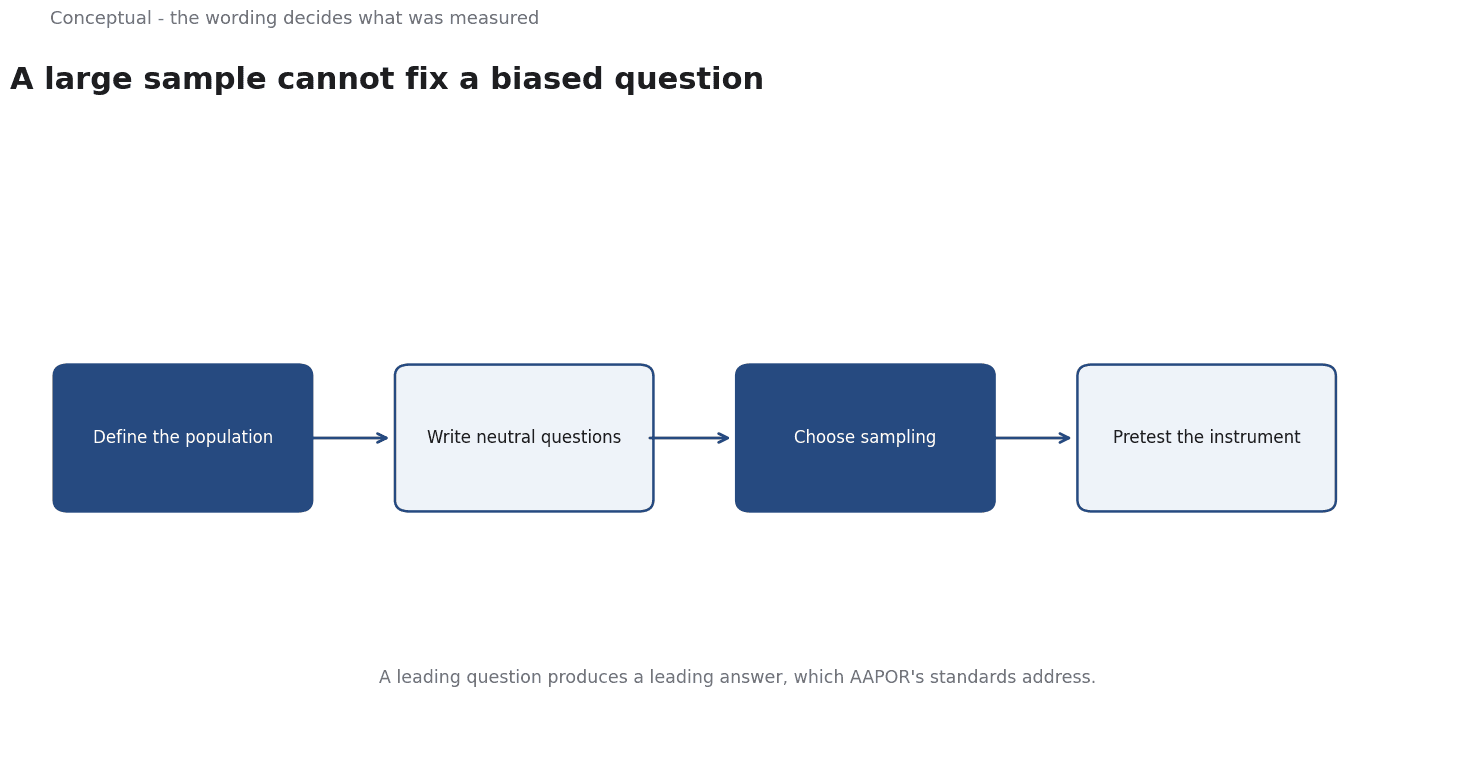
The design decisions
Population and sampling. Who is eligible to answer, and how are they selected, which AAPOR requires you to state?
Wording.
A leading question produces a leading answer, which AAPOR's standards address directly.
"How much do you love this feature?" is not a measurement of satisfaction, as the brand-awareness article explains for aided versus unaided recall, as the survey-design guidance in market research argues for neutral phrasing.
Question order. Earlier questions frame later ones, which the survey-methodology literature treats as an effect to control, as the correlation article warns about variables that move together. Randomising or fixing the order deliberately is part of the design, as the A/B testing article argues for controlling variables.
Pretesting. Run the instrument on a small group and ask what each question means, which the usability-testing method recommends for finding misinterpretation, as the customer-journey article advises for evidence from real people. A question that two respondents interpret differently is a defect, not a nuance, as the evaluation-rubric article argues for explicit criteria.
Three consequences follow. The sample and wording must be reported with the result, which AAPOR's standards require for transparency, as the data-governance article requires provenance for relied-upon figures. Stated intentions should be labelled as such, which the NPS article advises. And the survey should be compared with behaviour where possible, as the product-analytics article recommends for observed signals.
A worked example
The following is hypothetical and illustrative. A company wants to know whether customers value a new feature, and sends a survey to everyone who opened an email about it.
Three checks decide whether the result is usable. First, population: the sample is people who opened an email, which excludes customers who never saw it and selects for interest, as AAPOR requires you to state, as the NPS article warns about self-selection. Second, wording: "How valuable is this feature?" invites a positive answer, as the neutral-wording standard requires a question like "How often have you used it, if at all?" Third, behaviour: usage logs can check whether stated value matches actual use, as the product-analytics article advises.
Three conclusions follow. The original survey would overstate value, which the sampling and wording checks reveal. A better instrument samples a defined population, uses neutral wording, and reports the response rate, as AAPOR requires. And the result should be compared with behaviour, as the voice-of-customer article treats both as evidence, as the decision-memo article requires for a recorded judgement.
What surveys cannot do
They cannot measure behaviour directly, which the NPS article treats as a distinction between intention and action. They do not fix a biased sample with a large count, which AAPOR's standards make clear, as the loyalty article warns about averaging across groups. And they cannot replace a comparison design when the question is causal, which the causal-inference article requires for a different method.
The counterargument that surveys are cheap and fast is fair, which is why they are widely used, and incomplete, as Market Research: Survey Design, Conjoint Analysis, and MaxDiff treats sampling and wording as the core of the method, as the AAPOR standards insist.
A decision test
- Define the population and sampling method, as AAPOR requires.
- Write neutral, unambiguous questions, as the standards advise.
- Fix and document question order, as the methodology literature recommends.
- Pretest with a small group, as the customer-journey method advises.
- Report response rate and wording with the result, as AAPOR requires.
- Compare with behaviour where possible, as the analytics article advises.
- Record the decision and limits, as the decision-memo article requires.
For the standard, see AAPOR; for the survey genre, see Market Research.
References & Further Reading
- American Association for Public Opinion Research, 2026. AAPOR — The professional association for public opinion and survey research; its standards and resources underpin the survey-design discussion.
- Stack Overflow, 2026. Developer Survey — The recurring cross-stack developer survey used for adoption and tooling claims.